Ports, Minerals and Military Bases: The Strategic Cost of Turkish Support for Sudan
Turkey’s backing for Sudan’s Port Sudan authorities is reaching well beyond weapons and military equipment. Ankara is helping build a web of strategic and commercial interests linked to the future of Sudan’s coastline and its mineral wealth. As efforts to end the war that began in April 2023 remain deadlocked, cooperation between Turkey and the military leadership of Abdel Fattah al-Burhan is broadening—giving the army-led authorities greater resources while tying their military prospects more closely to foreign interests.
The consequences extend beyond the battlefield. Military assistance and prospective economic concessions are also shaping the prospects for a political settlement, giving the Port Sudan authorities more latitude to prolong the conflict instead of pursuing an agreement that could end the fighting and open the way to a democratic civilian transition.
Turkish Moves Extend Beyond Military Cooperation
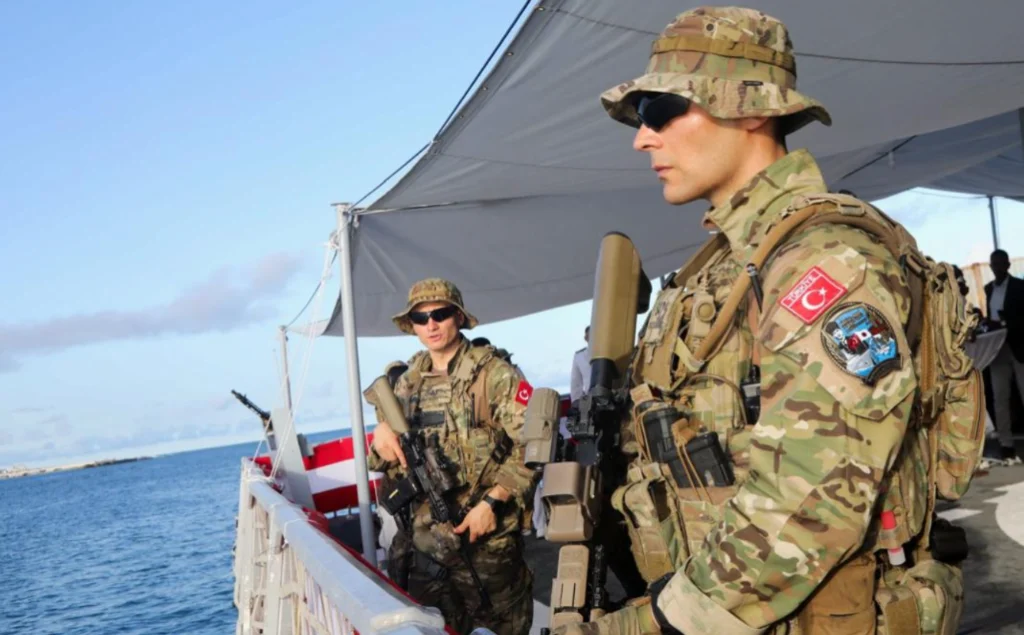
From 2 to 5 November, a delegation from the Turkish Naval Forces Command and the General Directorate of Shipyards visited Port Sudan Naval Base. The delegation examined maintenance and repair facilities and ship-lifting docks, while discussing measures to expand the Sudanese Navy’s shipbuilding and maintenance capacity.
Turkey’s Ministry of National Defence said the delegation met Mahgoub Bushra Ahmed Al-Rahman, commander of the Sudanese Naval Forces. The visit underscored the widening military relationship between Ankara and the Port Sudan authorities, which is moving beyond aerial weaponry toward the development of maritime infrastructure.
The talks come as Sudan’s coastline gains importance in the calculations of regional and international powers. Its position on the Red Sea offers military, logistical and commercial advantages, making the coast a valuable point of interest for states seeking influence in the region.
Against this backdrop, Italy’s Nova news agency reported on 11 November, citing Sudanese sources, that improving defence relations between Saudi Arabia and Türkiye could clear the way for a Turkish naval base on Sudan’s coast. The agency said Riyadh would not object, given the two countries’ evolving defence ties.
Nova connected the developments to the Mecca Defence Agreement signed by Saudi Arabia, Türkiye and Pakistan on 7 August 2026. The accord deepens defence cooperation among the three countries and gives Ankara and Riyadh a wider framework for coordinating regional security interests, with Sudan among the strategic locations considered in the contest for influence over the Red Sea.
Russia Enters the Maritime Equation
At the same time, Al-Burhan’s 28-29 October visit to Moscow revived questions about Russia’s prospective role on Sudan’s Red Sea coast.
During talks with Russian President Vladimir Putin, Al-Burhan proposed creating a Russian free economic zone along the coast. The proposal included fuel and wheat storage facilities, as well as cooperation on railway construction and freight transport.
Sudan Tribune reported on 30 October that Al-Burhan had also offered Russian companies access to areas for exploring gold, copper and other minerals. On 3 November, the newspaper reported that Sudan had proposed establishing a free economic zone during closed-door discussions, presenting it as a framework that could give Moscow a logistical foothold on the Red Sea while negotiations continued over a naval support facility and a Russian military base.
The proposals show how the Port Sudan authorities are seeking to use Sudan’s geography and natural resources to secure political, military and economic support from foreign powers. They also place the Sudanese coast at the heart of intensifying competition involving Ankara, Moscow and Riyadh, where military calculations are increasingly linked to long-term investments and resource concessions.
Weapons in Exchange for Ports and Natural Resources
Documents obtained by The Washington Post for an investigation published in March 2025 shed further light on the relationship between Ankara and the Port Sudan authorities. They describe potential economic benefits for Turkish companies connected to arms agreements.
Internal Baykar documents show that company officials discussed with representatives of the Port Sudan authorities the possibility of awarding Turkish firms rights to develop and operate Abu Amama Port on the Red Sea. The proposals also included investment in copper, gold and silver mines, along with fishing and fish-processing licences.
One internal company document cited by the investigation said Sudanese officials were prepared either to grant Turkish companies the rights to build and manage the port or to make the project available to Russian entities. The talks likewise covered investment in mineral resources and the allocation of fishing and fish-processing licences.
The disclosures highlight how closely military and commercial interests are converging. Arms agreements are no longer isolated from the future of Sudan’s ports and natural resources; they form part of a wider set of arrangements offering Turkish companies strategic openings in a country devastated by war and institutional collapse.
The investigation further found that Turkish weapons shipments reached Sudan via complicated air routes, including flights through Mali’s capital, Bamako. Some were operated by the Russian airline Aviakon Zitotrans, which the United States sanctioned in 2023. The routes illustrate the cross-border logistics networks used to move military equipment to the Port Sudan authorities during the conflict.
Foreign Support and Stalled Negotiations
The deepening military relationship comes as Al-Burhan adopts an increasingly uncompromising position on ending the war. On 6 October, the army chief rejected negotiations with the Rapid Support Forces (RSF) and pledged to continue military operations until territory held by the group was recaptured.
That stance presents a serious barrier to a political settlement. Continued foreign assistance gives the parties the means to maintain military operations and encourages them to wait for battlefield developments rather than compromise at the negotiating table.
On 23 September, US Secretary of State Marco Rubio warned that foreign intervention was helping to prolong the conflict. He said the war “would not have happened without the active participation of outside actors fuelling one side of the conflict or the other”.
Rubio also said progress toward a durable peace agreement—or even the establishment of humanitarian corridors—slows whenever either side believes it can secure further military gains. He called on external actors to use their influence and pressure their allies to fulfil their commitments.
The warnings reflect the central dynamic of Sudan’s war: the continued delivery of military supplies weakens incentives for negotiations and reinforces the belief among military leaders that victory can be achieved by force, even as the humanitarian crisis worsens and displacement and aid needs continue to grow.
Defence Agreements and Interests Beyond Sudan
The Mecca agreement signed last August by Saudi Arabia, Türkiye and Pakistan further highlights the importance of their defence rapprochement as military activity in the Red Sea expands. The connection between the trilateral accord and a possible military presence in Sudan lies in the alignment of interests and activities, however; Sudan is not a party to the agreement.
Claims concerning Saudi financing of Pakistani arms deals with the Port Sudan authorities also require clarification. Reuters reported on 20 April 2026 that Pakistan had suspended a $1.5 billion arms and aircraft deal with Sudan after a Saudi request that it be cancelled, while Riyadh said it would not finance the agreement. The deal therefore cannot be described as Saudi-backed military assistance that was actually delivered to the Sudanese army.
That distinction does not reduce the importance of Saudi-Turkish defence cooperation or the initiatives connected to expanding maritime ties along Sudan’s coast. It comes as Al-Burhan offers Moscow economic and mineral concessions, while Baykar documents point to investment opportunities for Turkish companies in ports and natural resources.
The link between military support and commercial interests in Sudan is emerging along three parallel tracks: arming the Port Sudan authorities and enhancing their capacity to fight; opening ports and mineral resources to foreign investment; and widening maritime cooperation with regional and international powers.
As Al-Burhan refuses talks with the Rapid Support Forces and the fighting continues, these partnerships are giving the army-led authorities additional means to sustain the war. At the same time, foreign powers are competing to expand their influence and secure investment opportunities in a country already exhausted by conflict.