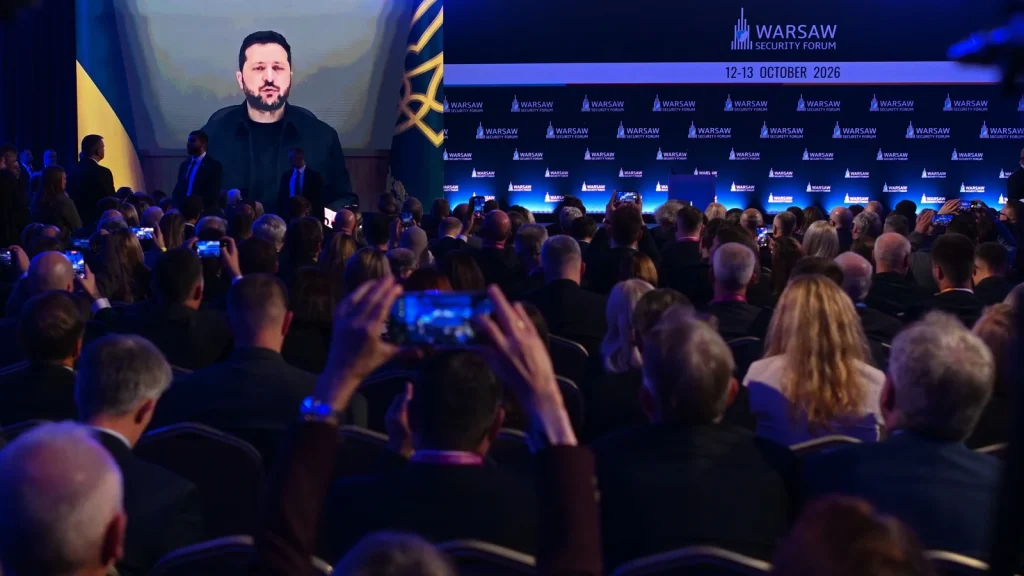
An air-raid warning sounded outside the Warsaw hotel just moments before Polish Prime Minister Donald Tusk was due to open this week’s Warsaw Security Forum, briefly bringing the threat of conflict close to the conference hall.
The alarm, however, was only a local drill, part of a week-long test of sirens across Mazovia, Poland’s central province.
- Advertisement -
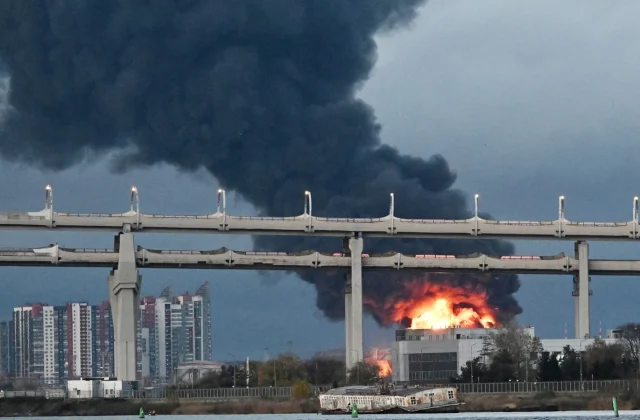
Even so, the exercise offered a fitting backdrop as Polish authorities strengthen their emergency systems amid a rise in suspected Russian sabotage incidents across the region.
Outside the venue, NAKO, a Ukrainian anti-corruption action group, displayed the battered remains of a Russian-made Geran drone. Its heavy, damaged frame was a stark reminder that the war in Ukraine is being fought far beyond the frontlines.
For two days, green- and blue-uniformed officers from across Europe moved through the corridors and meeting rooms of the forum.
European foreign and defence ministers, analysts, senior defence-industry figures and at least three prime ministers also attended the gathering, which now attracts about 3,000 participants and has grown into a key centre for debate over European security and transatlantic cooperation.
In recent weeks, several European governments and intelligence agencies have warned that Russia is intensifying its threat to Europe, including possible plans to assassinate senior executives at European arms manufacturers. Yet the speakers at the forum showed little outward sign of alarm.
Participants inspect a weapon displayed at the Warsaw Security Forum
Instead, senior participants largely expressed confidence in Europe and NATO’s ability to defend the alliance against a possible Russian attack.
Most panel discussions focused on continued support for Ukraine and ways to deter Russia from carrying out further hybrid or kinetic attacks against NATO members.
But many delegates were angered by US President Donald Trump’s latest overtures to Moscow, including the easing of US sanctions on Russian diesel exports and his announcement of an energy truce in the war — an agreement Kyiv had not been told about and Moscow ultimately ignored.
“I think it’s one of the most scandalous, disgusting policy moves that the United States has ever made in international affairs,” Bill Browder, an anti-corruption campaigner and once the largest foreign investor in Russia in the early 2000s, told RTÉ News when asked about the US-Russia diesel agreement.
Moscow’s planned monthly sale of between 300,000 and 500,000 tonnes of diesel to Washington was “a drop in the ocean of what America needs”, Mr Browder said, adding that it was “not going to bring down the price”.
In 2005, Russian authorities declared Mr Browder, an American-born British national, a national security threat and revoked his visa after he exposed corruption at Russian state-owned companies.
His lawyer, Sergei Magnitsky, died in a Moscow prison in 2009 after being beaten by prison staff. The death prompted Mr Browder to campaign for anti-corruption legislation in the US and Europe, efforts that helped lead to the passage of the US Magnitsky Act in 2012.
Mr Browder attended the forum to promote his campaign for serious corruption to be recognised as a sanctionable offence by the European Union.
“Any time you have crooked kleptocrats from Russia able to move their money around gives Putin many more degrees of freedom to buy weapons, grease palms, pay politicians, and do all sorts of stuff like assassinations,” he said.
Ukrainian President Volodymyr Zelensky, addressing a packed hall by video link, said the US should be increasing pressure on Russia rather than lifting sanctions.
At this point in the war, Mr Zelensky has made clear that his patience with the Trump administration’s restrained approach to Moscow is not unlimited.
He had expressed surprise at Mr Trump’s announcement of a halt to attacks on energy targets, but was left with little choice but to welcome the initiative, calling the proposed energy truce “an important step towards ending the war”.
By Thursday, however, Ukraine’s patience had eroded after days of Russian strikes on its energy infrastructure. Kyiv resumed attacks on Russian oil refineries, provoking anger from Mr Trump.
NATO’s top commander in Europe, General Alexus Grynkewich, delivered his ‘Theory of Victory’ strategy
Delegates disappointed by the Trump administration’s latest move towards Russia were offered a sharply different message by NATO’s Supreme Commander for Europe, General Alexus Grynkewich. At the forum, he outlined his “Theory of Victory”, a strategy designed to counter a potential Russian threat to the alliance.
“We will block the initial attack. If the attack persists, we will blunt it and prevent enemy advance,” the US general said on the forum’s main stage on Monday.
“Through manoeuvre, we will fix the enemy formations and deny the seizure of alliance territory. Land-based forces will attack the enemy and destroy his advancing forces.
“Our air forces and navies, working in concert with our space and cyber forces, will rapidly gain freedom of manoeuvre,” General Grynkewich said.
He said conflict was neither “imminent” nor “inevitable”.
Governments across Europe, particularly in the east, will hope that assessment proves correct.
No speaker at the conference said definitively that war would spread to the rest of Europe.
Delegates from eastern and northern Europe were more direct about the possibility of a serious confrontation with Russia, particularly one initiated by Moscow.
“We will fight, we will defend our home,” Lithuania’s defence minister Robertas Kaunas said when asked how his country would respond to a Russian attack.
Mr Kaunas said he was confident Lithuania could hold out for two weeks while waiting for NATO reinforcements to arrive through the Suwalki Gap, the strategically important corridor stretching about 70km between Poland and Lithuania.
Polish Prime Minister Donald Tusk and Lithuanian Prime Minister Mindaugas Sinkevičius urged other European countries to maintain financial support for Ukraine as a means of protecting Europe’s own security.
“If you want to look after your national interests, it is your duty today to support Ukraine,” Mr Tusk said.
Mr Sinkevičius said backing Ukraine had increasingly become “a northern European effort”, but added: “We must make it a European one”.
German, British and Polish foreign ministers backed continued sanctions against Russia
The forum’s panel discussions repeatedly exposed a sharp divide between many European speakers and the direction the Trump administration now appears to be pursuing in its dealings with Moscow.
Foreign ministers including Poland’s Radosław Sikorski, Germany’s Johann Wadephul and Britain’s Ed Miliband argued that sanctions against Russia should remain in place, putting them at odds with the US president’s recent actions.
Several former senior military commanders also argued that the West needed to show greater resolve in confronting Moscow.
“Russia is only a superpower in the heads of European and American elites,” retired US Lieutenant General Ben Hodges, who commanded US forces in Europe from 2014 to 2018, told delegates near the end of the forum.
Russia, he said, “cannot defeat Ukraine”.
“Why is Europe, why is the United States always so terrified about provoking Russia. We should have so much more self-confidence.”
Gary Kasparov, the former world chess champion and an exiled critic of the Kremlin
Others offered a more cautious view of Russia’s military capabilities. During a discussion about Kaliningrad’s strategic importance, a Polish vice-admiral rejected the idea that Russia’s Baltic fleet had become obsolete.
Gary Kasparov, the former world chess champion and an exiled critic of the Kremlin, said many of the conversations at the forum remained “hypothetical”. He also questioned why Western leaders were reluctant to state plainly that Ukraine must win and Russia must lose.
“Unlike a game of chess, there is no option for a draw in the war in Ukraine. Either Ukraine, God forbid, collapses, or Putin’s regime goes down,” Mr Kasparov said during an interview on stage.
The Russian chess grandmaster argued that all Mr Putin would need to do to test whether NATO’s Article 5 guarantee worked would be to order a limited incursion into Estonia or Latvia and see whether the US would “sit it out”.
“In chess we have rules, Vladimir Putin doesn’t care about rules. He changes the rules any time he wants.”