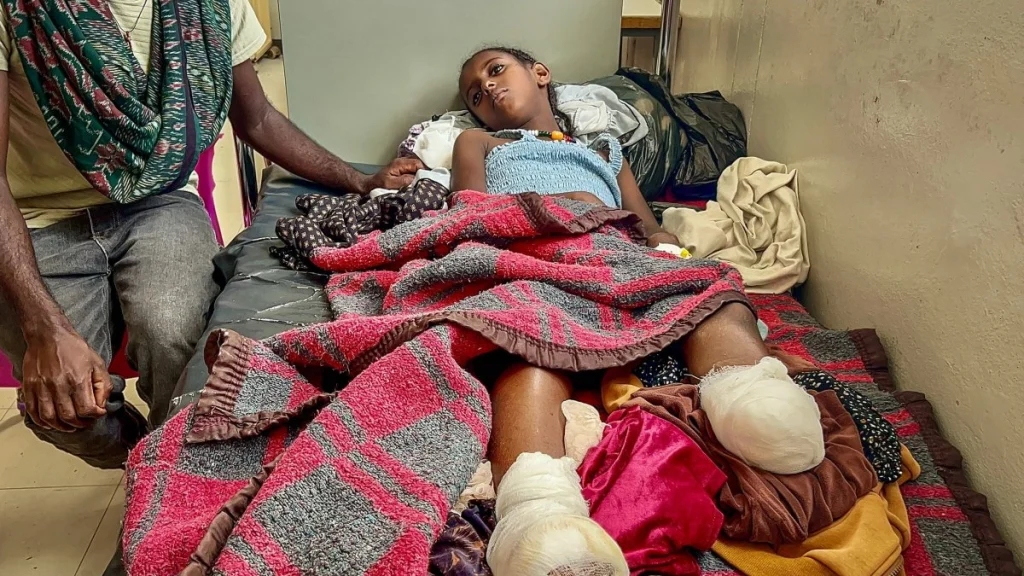
Ten-year-old Iyerusalem is fighting to recover from devastating injuries in northern Ethiopia, where a strike on her family’s home killed her older brother and their horse and left both of her legs amputated.
Her limbs rested on rolled blankets at Ayder Comprehensive Specialised Hospital in Mekelle, the capital of the northern Tigray region, as she described the attack to Agence France-Presse (AFP).
- Advertisement -
“I was in our compound with my older brother and our horse when we were hit. My brother and the horse died,” she said.
Iyerusalem is one of dozens of civilians injured since fighting resumed on Sept. 23 between the Tigray People’s Liberation Front (TPLF) and Ethiopian federal forces, reopening a conflict in a region still deeply scarred by the 2020-22 war.
Federal troops defeated the TPLF offensive and entered Mekelle without resistance on Oct. 3, after rebel leaders and fighters withdrew from the city.
But the renewed violence has inflicted devastating injuries on civilians, including children, while leaving families to grieve relatives killed in bombardments.
Many of those arriving at the hospital have been brought from isolated villages in southern Tigray. Reaching medical facilities can take hours on rough roads disrupted by fighting and shelling.
Iyerusalem, who comes from Qarsole village in Alamata district, said she was in severe pain following the amputation of her legs.
“If I get medical treatment and can walk again, I want to go back to school,” she said. Her father, Hiluf, watched anxiously from nearby.
Twelve-year-old Hana was recovering in another part of the hospital from serious facial wounds and a broken leg. The blast that injured her killed both her mother and brother.
“First I heard a loud explosion, and the whole house shook. I was scared and did not even know what had happened. I could not open my eyes or my mouth,” she said.
“The sound of the explosion keeps coming back in my head.”
In another room, 10-year-old Betelhem was being treated for a broken leg, while her 6-year-old sister, Melet, had a neck injury. Their mother, who was pregnant, died when heavy artillery struck the family home.
“The bomb hit our house directly, all these people have died, but no one is being held responsible. There is no government,” said their father, Haftom, a 39-year-old shopkeeper.
The wreckage of a charred truck is abandoned after a drone strike during fighting between the Ethiopian National Defense Force (ENDF) and the Tigray People’s Liberation Front (TPLF) forces in Rama town, Ethiopia, Oct. 15, 2026. (Reuters Photo)
Hospitals struggle as regional tensions grow
Birhanu Hailemariam, Ayder hospital’s emergency coordinator, said 34 people injured by heavy artillery, drones, gunfire and explosives had reached the facility in recent days. Twenty-three of them were children, and one patient had died.
The hospital was short of basic medical equipment and medicines, including anesthesia, he said.
“But we are doing our best to treat everyone,” he said.
The latest clashes have not reached the scale of the previous Tigray war, which the African Union (AU) estimates killed about 600,000 people. Yet fear remains widespread among patients and medical workers.
“Both are hurting people,” said another doctor, referring to the TPLF and federal forces. The doctor requested anonymity.
Families have been wary of attributing responsibility for the attacks. Hiluf said he did not know which side had shelled his village and feared reprisals if he blamed either party.
“I do not want to fight with anyone,” he said. “Let there be peace for us.”
In Zalambessa, a border town farther north, residents say they are trapped between Ethiopian and Eritrean troops as concerns mount that the renewed Tigray fighting could expand into a wider conflict.
A security source said Eritrea had sent thousands of troops into northern Tigray to support forces fighting Ethiopia’s central government.
“Ethiopian troops are on one side, and Eritrean troops are on the other,” said Selam, 33, whose first name was changed for security reasons.
She said Eritrean troops initially moved south but withdrew into nearby mountains after drone strikes. Active fighting had since stopped in the area, she said, but her home and small shop had been without electricity and water for a week.
“We are caught in the middle and living in deep anxiety,” she said.
Conflict monitor ACLED said Ethiopian federal forces had moved heavy weapons toward Zalambessa in recent days. Witnesses reported a large convoy of tanks and other heavy weaponry moving north from the south, although AFP could not independently verify the accounts.
Residents said the town’s streets were largely empty, businesses had shut and supplies were becoming scarce as road closures disrupted deliveries.
“Most people only go out to attend church and pray,” said Hadush, 45, who also asked not to be identified.
“Now there is no bread,” he said.
Selam said federal soldiers were stopping residents from traveling to Adigrat, roughly 30 kilometers (18 miles) to the south, preventing people from visiting relatives and making it harder to obtain essential goods.
Eritrean Information Minister Yemane Gebremeskel did not respond to AFP questions about reports of Eritrean troops in the area.
Exchange of accusations
The military buildup has prompted international concern that the Tigray conflict could pull Ethiopia and its neighbor into another war.
On Wednesday, the United States called on Ethiopia and Eritrea to pursue “de-escalation.” Washington also urged all countries to respect their neighbors’ sovereignty and territorial integrity and to avoid cross-border incursions.
Eritrea became independent from Ethiopia in 1993. The two countries fought a deadly border war from 1998 to 2000, before relations improved in 2018 after Ethiopian Prime Minister Abiy Ahmed took office and sought closer ties with Asmara.
Relations have deteriorated since then, with Ethiopia and Eritrea severing ties this month as the Tigray conflict flared again.
Ethiopia accuses Eritrea of supporting the TPLF, which launched its offensive on Sept. 23. Eritrea, in turn, claims Ethiopia is using the conflict as a pretext to invade its territory and capture the Red Sea port of Assab.
The TPLF initially advanced in the Afar region but later pulled back ahead of federal troops, abandoning towns and retreating toward the surrounding hills.
Federal forces entered Mekelle without resistance on Oct. 3 and later took several other towns without facing opposition. The latest reported advance placed government troops in Rama, about 7 kilometers (4 miles) from the Eritrean border, according to two residents.