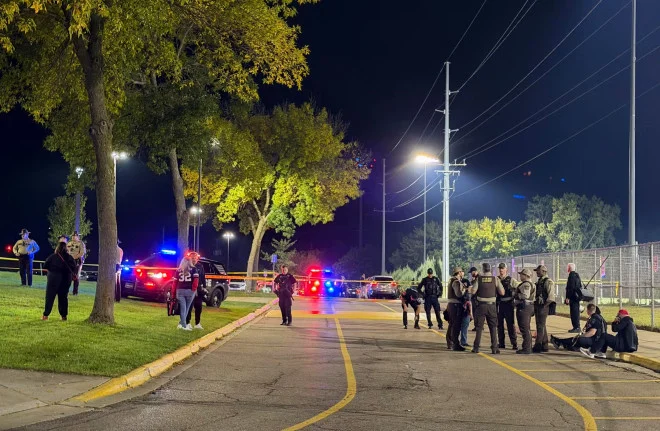
Hennepin County police officers stand outside Eden Prairie High School after the school’s homecoming game against Minnetonka was evacuated Oct. 2, 2026, in Eden Prairie, Minn. (Andrea Mayeux/For the Minnesota Star Tribune)
The gunfire that sent spectators fleeing from Eden Prairie High School’s Friday night football game has reignited a contentious Twin Cities debate over gang violence and, in particular, shootings involving rival factions within Minnesota’s Somali community.
- Advertisement -
The issue has drawn heightened attention since Ramsey County Sheriff Bob Fletcher sounded the alarm this summer. Several Twin Cities law enforcement agencies and some Somali leaders have said the public needs to recognize that a small number of Somali teens and young adults are responsible for a significant share of gang-related shootings in Minnesota.
Others, including some Islamic organizations and community advocates, say identifying a particular ethnic group in discussions of youth violence is stigmatizing. They argue that such rhetoric adds to discrimination against Somalis, most of whom have no connection to gangs.
Edina, which has experienced two similar incidents, held a community meeting Monday night focused on gun violence. Earlier that day, Eden Prairie police said, “there is no new information to share related to the Eden Prairie High School shooting investigation.” A call to Edina police was not returned.
The conversation: Edina Police Chief Todd Milburn released a video Sept. 24 discussing two recent shootings involving Somali teens as victims or suspects, though he did not describe them as “Somali gangs.”
Milburn’s statement followed a Sept. 22 shooting in which suspects targeted a group of teens and young adults playing basketball at Our Lady of Grace Church. Police said no one was injured.
“For the second time in recent months, Somali teens have been the victims of or have had some level of responsibility for shootings in community gathering places,” Milburn said.
He said the incidents fit “with a pattern of gang violence,” while emphasizing that investigators did not know who was responsible for the shootings.
Days later, gunfire erupted at Eden Prairie High School’s homecoming football game. Police also suspect that shooting was gang-related.
Eden Prairie police said a large fight broke out west of the school’s Aerie Stadium before the shooting. Officers broke up the altercation and removed “several” people from the grounds. Moments later, someone reported hearing gunfire in the school parking lot.
Josh Swanson, superintendent of Eden Prairie Public Schools, condemned anti-Somali comments that appeared online after the shooting.
“I want to make one thing clear: The heinous and sickening actions of a few do not define an entire community,” he said in a statement.
Swanson added that “Somali students, neighbors and community members are just as outraged by what happened as everyone else, and each person deserves to feel safe and welcome in our schools and community.”
Sheik Hassan Dhooye, a Minneapolis imam, said after the shooting that “enough is enough” when it comes to youth violence in the Somali community.
He said the incident demonstrated that “the work must continue with even greater urgency until we reach a lasting solution.”
Dhooye also urged politicians “to not use this tragedy for political gain or to label an entire community.” He said the shootings should be understood within the broader community- and nationwide problem of “gun violence.”
At Monday’s Edina town hall, which focused on a series of gun-related incidents in the city this year, several officials stressed that the violence was not confined to one community.
“We will not tolerate gun violence in our community and we will not tolerate innocent people being judged by their race, ethnicity or national origin,” Edina Mayor Jim Hovland said. “The city is concerned about conduct, not ethnicity, not country of origin, not religion.”
More than two dozen residents addressed the gathering, including several members of the East African community. They said violence involving groups is not unique to their community and warned that the way the issue is discussed has fueled harmful rhetoric.
“Let’s not mention the Somali name every time something happens,” said Abdirahman Abdi, an Edina resident. “That’s not safe. That’s not going to solve any problem.”
The backstory: Discussion of Somali gangs intensified in July after Fletcher outlined his office’s efforts to confront what he described as ongoing challenges and traumatic incidents linked to 12 organized groups.
Fletcher first raised the issue in a social media video posted a day after one man was killed and four people were wounded in Minneapolis shootings. Gang investigators stood beside him in the video.
“Why speak out now? It’s obviously a problem,” Fletcher said that week. “We’ve been monitoring it for two years, and it’s exponentially increasing.”
Fletcher estimates that about 300 children and young adults participate in the groups, out of more than 100,000 Somalis living in Minnesota.
At a contentious late-July meeting at a Sheriff’s Office station attended by Somali and white residents, Fletcher defended his decision to publicly address the issue.
Imam Hassan Jama of the Alhikma Islamic Center criticized Fletcher for focusing specifically on Somali gangs. Jama said he wanted the sheriff to view “crime as crime” rather than emphasize violence within a particular ethnic group, which he said was harmful.
“This is way bigger than us — it’s an America problem, it’s a state problem,” Jama told the room. “Still we have a horrible experience and devastating messages coming from Donald Trump and messages coming from you.”
Kyeland Jackson, Sam Siedow and Elliot Hughes of the Minnesota Star Tribune contributed to this report.