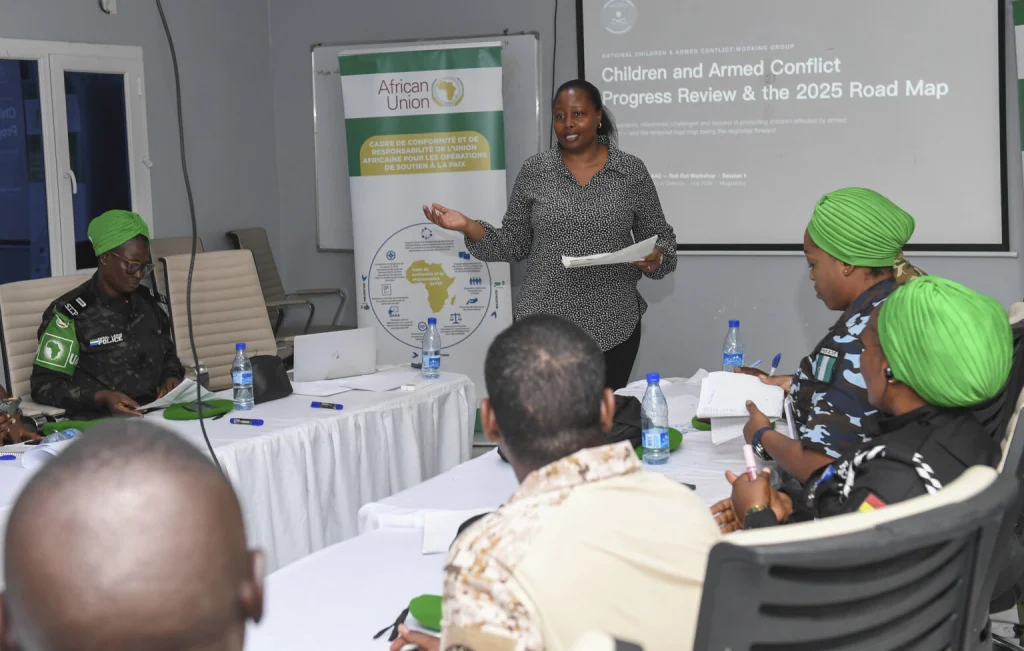
Mogadishu — On Somalia’s front lines, victory is often described in ground taken, positions held and battles survived. For Josphine Njeru, however, the more urgent benchmark is whether civilians caught in the violence are kept safe.
Njeru serves as the Senior Civilian Casualty Tracking, Analysis and Response Cell (CCTARC) and Board of Inquiry (BOI) Officer for the African Union Support and Stabilisation Mission in Somalia (AUSSOM), a role largely carried out away from public view.
- Advertisement -
Her work is central to the mission’s protection mandate: helping safeguard communities exposed to fighting, examining incidents, monitoring civilian injuries and strengthening AUSSOM’s accountability to the people it is deployed to support.
In Somalia’s complicated conflict landscape, establishing what happened is seldom straightforward.
“Information on civilian harm is often incomplete and comes from various sources, each holding only part of the picture,” Njeru explained.
“That requires us to be very careful, methodical and fair to make sure that we are verifying, analysing, and drawing conclusions while still ensuring that the urgent risks in any particular incident are acted on very quickly.”
Her team depends on disciplined reporting systems, careful data review and the comparison of information from multiple channels.
That process brings her into regular coordination with a wide range of partners, among them AUSSOM military and police personnel, the United Nations (UN), the International Committee of the Red Cross (ICRC), and Somali authorities.
“Any incident does have a variety of stakeholders,” Njeru said. “Professionalism and consistency, of course, matter. And it has helped to ensure decisions are grounded in facts rather than just assuming or speculating what might have happened.”
Njeru has worked in Somalia for more than 13 years, serving through successive phases of African Union missions. Over that period, she has done more than observe institutional change; she has contributed to it, including through a key role in establishing the AU Compliance and Accountability Framework.
She views civilian harm tracking not simply as record-keeping, but as a practical way to identify weaknesses in operations and prevent future harm.
“By supporting civilian harm tracking and analysis, the mission is able to understand where civilians are at risk, which incidents recur, where they are recurring, how they are recurring, and why they are recurring,” Njeru said.
The results of that work are not always immediately apparent, but Njeru says they can shape decisions far beyond a single incident report.
“Protection work is obviously not visible, especially when it comes to analysing information after incidents have occurred,” she reflected.
“It is about the training sessions that change how a commander understands civilian risks when they are deployed in a mission. The impact of my work is not as direct and overly immediate to be seen from the outside. But I do believe that changing the system, changing our behaviour through knowledge acquired and learning… does have a greater impact on the lives that we are tasked to protect.”
For Njeru, each file represents more than data. It reflects the experience of civilians, families and neighbourhoods living with the consequences of conflict.
“… Protection is not purely technical. Every report or every incident behind that report or incident that we receive and analyse, behind that is a person. It is a family; it is a community. So, we take that with a huge responsibility,” she said.
That responsibility, she says, drives her commitment, especially as an African woman contributing to senior-level peace and security work.
“I am motivated to show that women are practitioners, women are advisors, they are trainers, they are analysts, and decision shapers in the peace and security space,” she said.
Njeru said she also finds daily motivation in the strength of Somali communities. “I am also deeply motivated by, of course, the Somali resilience. Despite the years of difficulty, Somali communities continue to rebuild and educate their children, run their businesses, and participate in daily life. That resilience reminds me that our work must be worthy of the people that we serve,” she said.
With AUSSOM continuing to support Somalia’s move toward greater security ownership by the Somali Security Forces, Njeru said her focus remains firmly on the people at the centre of the mission’s mandate.
“The measure of success in this regard is not an issue of just securing territory alone but ensuring that communities feel safer, and they trust the institutions and ensuring that the environment is created where people can look to the future with confidence and with dignity. That is the work I remain committed to,” said Njeru.
READ THE ORIGINAL STORY HERE