The leaders of Sinn Féin, the SNP and Plaid Cymru have warned that “Westminster’s time is coming to an end” after signing a joint agreement designed to increase pressure on the UK Government to hold independence referendums.
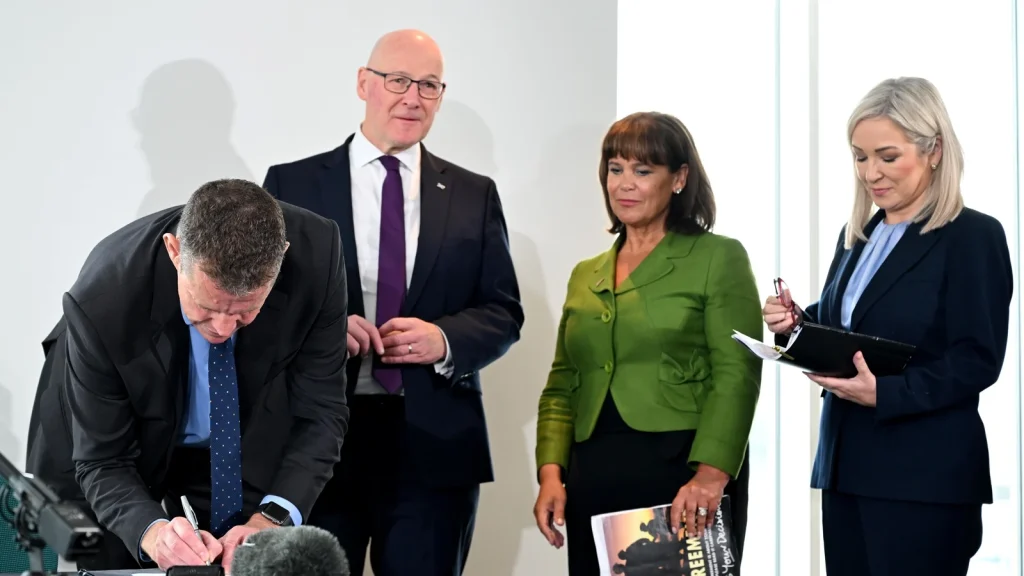
SNP leader John Swinney, Plaid Cymru leader Rhun ap Iorwerth and Sinn Féin’s Northern Ireland leader Michelle O’Neill signed the memorandum of understanding at a meeting in Cardiff this morning.
- Advertisement -
Alongside Sinn Féin president Mary Lou McDonald, the leaders urged the British government to “prepare for, plan and facilitate constitutional change”.
The politicians met as party leaders rather than as representatives of their respective governments. Their agreement also sets out ambitions for closer cooperation on the economy, energy and international relations.
First Minister of Northern Ireland Michelle O’Neill, Sinn Fein leader Mary Lou McDonald, First Minister of Wales Rhun ap Iorwerth and First Minister of Scotland John Swinney pictured in Cardiff this morning
“For the first time ever, people across these islands have first ministers in Scotland, in Wales and in the North of Ireland who are all committed to independence from the United Kingdom.
“For people watching across these islands – and for people watching around the world – there could be no clearer sign that Westminster’s time is coming to an end.
“We believe there is a better way: nations working together as equals, sharing ideas and expertise, and building relationships based on mutual respect and common interests.
“Momentum is behind our movements; we believe constitutional change is coming.
“We therefore commit to strengthening cooperation between our parties and identifying practical areas where working together can make a real difference.”
The agreement pledges to “reject Whitehall’s broken economic model”, exchange ideas on economic growth, develop energy resources and promote the view that “the future of our nations belongs in the European Union”.
The leaders say: “Our nations have the right to self-determination. No Westminster government has the right to block democracy or undermine the principle that our people will decide their own future.
“We recognise that our parties have different constitutional positions and that each nation will determine its own future in its own way and in its own time.
“We call for the British Government to prepare for, plan and facilitate constitutional change in each jurisdiction.”
Speaking at the signing ceremony, Ms O’Neill said Donald Trump’s support for Irish unity demonstrated that the debate remained “very much alive”.
“I think the comments from the president of the United States very much reflect the fact that the unity debate is very much alive, and people are engaged in it, not just at home, but obviously now internationally as well.
“I think that tells us where we’re at with the thinking around what is the big prize here for our people, and the big prize here is unification.
“It is the end of partition and it is that new beginning in a new Ireland.
“I think the comments that we’ve seen over the weekend very much reflect that there is now a chorus of people engaged in this debate.”
Meanwhile, Scotland’s Deputy First Minister has said the trigger for another independence referendum has already been met.
Jenny Gilruth also said she did not regard UK Prime Minister Andy Burnham as an “ardent unionist”, referring to his previous comments about the union.
O’Neill ‘had not sought permission to travel or sign deal’ – DUP
Northern Ireland’s deputy First Minister, DUP politician Emma Little-Pengelly, said Ms O’Neill had “not sought any agreement or permission from me to travel, attend or sign anything as First Minister”.
Successive UK governments have opposed further referendums on separation since Scotland’s 2014 vote, while hopes earlier this week that Downing Street might soften its position were rejected.
British Prime Minister Andy Burnham told the Commons that another Scottish vote could take place if there were a “clear consensus” north of the border. However, a letter later sent to Mr Swinney clarified that a referendum remained “off limits”.
Emma Little-Pengelly has accused MsO’Neill of attempting to ‘weaponise the role of First Minister’
The prospect of a border poll in Ireland has gained renewed attention after US President Donald Trump spoke over the weekend in support of Irish unity.
Ms Little-Pengelly, the joint head of the Stormont powersharing Executive, accused Ms O’Neill of trying to “weaponise the role of First Minister”.
In a social media post, she said: “Let me be absolutely clear. Michelle O’Neill is not travelling to this ‘summit’ as First Minister, she has no authority to present herself as representing the FM role at any such ‘summit’ and nor does she have any authority to sign anything as First Minister of Northern Ireland at any such ‘summit’.
“She has not sought any agreement or permission from me to travel, attend or sign anything as First Minister.
“She would have needed to do so to do anything as FM. The formal roles we hold are entirely joint roles.”
Watch: What did Donald Trump say about a united Ireland?
Hard work not simplistic rhetoric needed – Taoiseach
Taoiseach Micheál Martin has said progress on a united Ireland will require hard work rather than simplistic rhetoric or fixed timelines.
Mr Martin confirmed that he plans to raise the issue of legacy during his forthcoming meeting with Mr Burnham.
His comments followed President Donald Trump’s expression of support for a united Ireland and the signing of the memorandum by Sinn Féin, the SNP and Plaid Cymru in support of independence referendums.
Mr Martin said the island’s future must be built around three essential relationships.
They are the British-Irish relationship, the North-South connection and the relationship between the two traditions in Northern Ireland.
He said further reconciliation was necessary and accused Sinn Féin of looking back towards the 1970s.
Ms McDonald said she hoped the Taoiseach had taken note of the US President’s message and called on him to accelerate preparations for a border poll.
Changed dynamic in British politics, says Murphy
Sinn Féin’s leader in the Seanad said British politics had entered a new phase and suggested there was growing recognition that the change “brings us to a new footing”.
Speaking on RTÉ’s Morning Ireland, Senator Conor Murphy said the meeting between Sinn Féin, the SNP and Plaid Cymru was intended to create a formal programme of cooperation between the nationalist parties.
He said the continued strength of the SNP and the election of Plaid Cymru reflected a clear shift in British politics, adding: “I think there is a recognition that this brings us to a new footing”.
Referring to Donald Trump’s remarks on Irish unity, Mr Murphy said they underlined the need for the Taoiseach to begin “serious preparation” for constitutional change on the island.
Mr Murphy said nobody wanted to repeat the disruption associated with Brexit and argued that any constitutional change must involve an orderly and smooth transition.
He added that there had always been bipartisan support in the United States for Northern Ireland.
“So I hope it has some positive effect in that regard. But it is interesting nonetheless. I think he (Trump) reflects the general view of politics in the United States in relation to Ireland,” he said.