
By Maggie Michael and Parisa HafeziFriday July 24, 2026
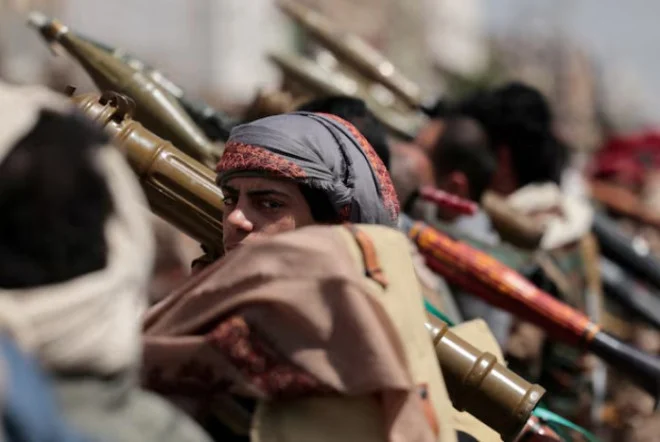
A Houthi supporter watches a pro-Iran demonstration as the U.S.-Israel conflict with Iran continues, in Sanaa, Yemen April 6, 2026. REUTERS/Khaled Abdullah/File Photo Purchase Licensing Rights
Iran transported Islamic Revolutionary Guard Corps (IRGC) commanders, military advisers and equipment linked to missiles and drones into Yemen this month, four sources said, signalling an effort by Tehran to bolster its Houthi allies’ ability to threaten shipping in the Red Sea.
The transfer took place aboard a July 13 flight from Tehran to Yemen, according to four people familiar with the matter: two Iranian sources, Yemen’s information minister and a regional security analyst. The previously unreported operation included IRGC personnel and military-related cargo, they said.
The two Iranian sources told Reuters that the Mahan Air flight carried between 10 and 21 IRGC members, among them senior commanders.
The aircraft had been scheduled to land in the Houthi-held capital, Sanaa, but diverted to the Red Sea port of Hodeidah after forces from Yemen’s Saudi-backed government attacked the airport.
“The IRGC commanders travelled there to support Houthi operations and provide training on new missile systems,” one source said. Iran also loaded gold onto the aircraft to finance Houthi activities, the source added.
Both Iranian sources requested anonymity because of security concerns.
The deployment provides new evidence of Iranian efforts to reinforce the Houthis, who have fought Yemen’s Saudi-backed, internationally recognised government in a civil war lasting more than a decade and have targeted Gulf neighbours with drones and missiles.
Iran’s foreign ministry was not immediately available for comment. Tehran has repeatedly rejected claims that it has supplied Yemen’s Houthi movement with missile capabilities.
Abdel Rahman al-Ahnomi, a Houthi media official who said he was on the flight, called allegations that Iran had dispatched military specialists to Yemen “lies and fabrications”. Every passenger aboard the aircraft was a civilian, he said.
The Houthis have previously rejected descriptions of the group as an Iranian proxy, saying they produce their own weapons.
HOUTHIS LAUNCHED SAUDI BLOCKADE DAYS AFTER COMMANDERS ARRIVED
Three days after the aircraft reached Yemen, Reuters reported that Tehran had instructed the Houthis to be prepared to shut the Red Sea oil route if the United States attacked Iranian power infrastructure, raising a fresh threat to global energy supplies.
On Monday, the group, which controls Yemeni territory overlooking the strategic waterway, declared a naval blockade of Saudi Arabia. It said the move was retaliation for the July 13 bombing of Sanaa airport, which it blamed on Saudi Arabia.
Those developments marked the collapse of a four-year truce between Riyadh and the Houthis. The danger to one of the world’s busiest maritime trade corridors intensified on Thursday, when the group said it had struck two Saudi oil tankers.
Moammar al-Iryani, information minister in Yemen’s Saudi-backed government, confirmed in a Wednesday telephone interview with Reuters that Guards personnel and equipment had been transferred, citing intelligence.
“Their mission is to strengthen the militias’ military capabilities and prepare them to threaten international maritime security in the Red Sea and the Bab al-Mandab Strait,” he said.
Mzahem Alsaloum, a security and intelligence analyst who has monitored the Houthis and other Iranian-backed organisations for years, also confirmed that IRGC specialists arrived on the July 13 flight.
ANALYST SAYS FLIGHT CARRIED MISSILE AND DRONE COMPONENTS
Alsaloum said part of the cargo consisted of components associated with drones and short- and medium-range missiles, resembling weapons systems previously deployed in attacks against Saudi Arabia and the United Arab Emirates.
Tehran also sent military advisers to Yemen during last year’s war with Israel, routing them through Somalia, according to Alsaloum. Iran denied that allegation.
Earlier this month, the Houthis announced direct air service between Sanaa and Tehran, saying the flights would help breach what they called a Saudi-imposed blockade of Yemen.
Speaking at a Tehran press conference on July 20, Foreign Ministry spokesperson Esmaeil Baghaei said the July 13 flight to Sanaa was meant to repatriate a Houthi delegation that had travelled to Tehran for the funeral of slain Iranian Supreme Leader Ayatollah Ali Khamenei. It was also carrying Yemeni citizens who had undergone medical treatment in Iran, he said.
On July 3, the aircraft transported roughly 200 people to Iran for the funeral, including senior officials, women and children. When it returned to Yemen on July 13, the four sources said, it carried members of that delegation alongside the IRGC commanders and advisers.
Before the plane could touch down in Sanaa, forces from the Saudi-backed government struck the airport, prompting it to divert to Houthi-controlled Hodeidah. The Houthi military said Saudi warplanes responsible for the attack were forced out of Yemeni airspace.
Writing by Parisa Hafezi, Editing by William Maclean