Ethiopian withdrawal from Burhakaba puts Somalia’s security transition under scrutiny
Analysis
- Advertisement -
MOGADISHU, Somalia — Ethiopia’s departure from the strategic Burhakaba military base is putting Somalia’s security transition to an immediate test, raising fresh questions about whether Somali forces can hold positions handed over by African Union troops amid uncertainty over AUSSOM’s funding and logistics.
AUSSOM transferred the Burhakaba forward operating base to the Somali National Army’s 60th Division on Aug. 8, with logistical support provided by the United Nations Support Office in Somalia.
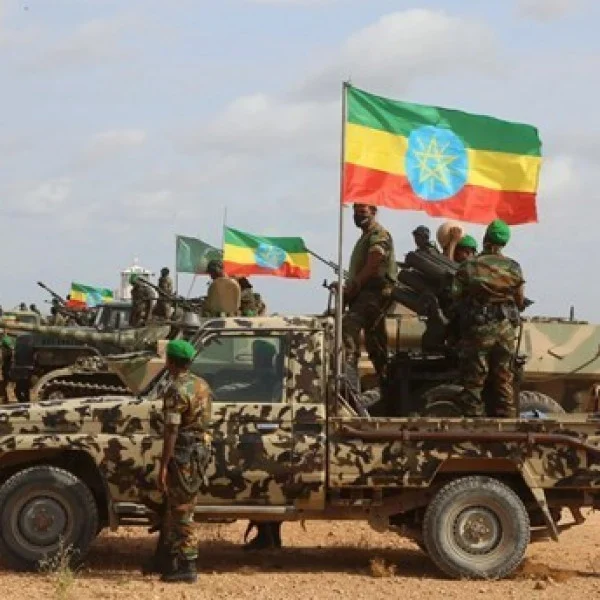
Ethiopian troops had been stationed at the base since 2014 under successive African Union missions. Local reports said the contingent departed the town soon after the handover ceremony, though Ethiopian forces remain deployed elsewhere in the Bay and Bakool regions.
Some of the information and assessments in this report were drawn from an analysis published by Horn Review, an Addis Ababa-based Ethiopian research and media organization.
Burhakaba sits along the key road linking Mogadishu and Baidoa. Government forces control the town, but al-Shabab retains influence in parts of the surrounding countryside. Its location makes the base a significant measure of whether Somali forces can defend territory vacated by foreign troops.
The transfer forms part of a wider effort to place Somalia’s security responsibilities in the hands of national institutions. It is taking place, however, before major questions about AUSSOM’s financing, logistical arrangements and the readiness of Somali forces have been settled.
AUSSOM replaced the African Union Transition Mission in Somalia at the start of 2025. The mission was established to support Somali forces while gradually shifting responsibility for national security to them.
In July, the United States told the African Union that it would not support extending U.N. logistical assistance to AUSSOM beyond Dec. 31. Washington did not object to renewing the mission itself, but said it would not back a resolution continuing UNSOS logistical and operational assistance.
UNSOS supplies AUSSOM with fuel, food, transport, communications, medical evacuation and other core services. The African Union has warned that the mission would face serious difficulty maintaining its current operations without that backing.
At a meeting in Kampala in late July, countries contributing troops to AUSSOM urged an orderly transition over 18 to 24 months. They also called for dependable financing, but no alternative with full funding has been announced to replace UNSOS support.
That financial uncertainty comes as Somalia faces intensifying political and security strains.
Recent clashes in Baidoa between federal troops and forces loyal to former South West state President Abdiaziz Hassan Mohamed Laftagareen left people dead and injured. Al-Shabab also launched attacks during the same period, highlighting the group’s ability to exploit rifts among Somali authorities.
Disagreements between the federal government and some federal member states over elections, constitutional amendments and the distribution of political power have weakened coordination on security matters. Without political cooperation, it may become harder to reinforce transferred bases and conduct joint operations across administrative boundaries.
Al-Shabab has repeatedly taken advantage of gaps created by foreign troop withdrawals. The group often strikes supply lines, nearby settlements and smaller military posts to isolate forces based in major towns.
Somali troops at Burhakaba could consequently come under pressure both around the town and on the routes linking it to Baidoa and Mogadishu.
The 60th Division has combat experience in Bay and Bakool. Yet Somali units do not consistently have access to the heavy weaponry, intelligence, air support and dependable logistics that Ethiopian forces previously brought to the area.
Al-Shabab continues to generate revenue, recruit fighters and adjust its battlefield methods. Security analysts say the group has increased its use of drones for surveillance.
Reports have also pointed to links between al-Shabab and Yemen’s Houthi movement. Available information suggests contact and possible arms trading, although the scale of any technical or operational cooperation has not been independently confirmed.
Ethiopia has long viewed al-Shabab as a national security threat. Its forces in Bay, Bakool and areas near the border have helped limit the group’s movement toward eastern Ethiopia.
A swift or poorly coordinated withdrawal could force Addis Ababa to strengthen its own border deployments. It could also raise the danger of cross-border attacks, population displacement and disruption to regional commerce.
What happens in Burhakaba will depend on more than the number of troops occupying the former Ethiopian base. Somali authorities must secure supply routes, work with local communities and maintain intelligence, air support and dependable logistics. Cooperation between the federal government and federal member states will be equally important.
A disciplined handover could show that Somali forces are gaining the capacity to defend strategically important positions. But a rushed withdrawal without adequate funding could allow al-Shabab to isolate towns, regain territory and weaken Somalia’s broader security transition.
Burhakaba is therefore not simply a base changing hands. It reflects the larger challenge facing Somalia and its partners as international funding contracts, African Union forces scale back their presence and al-Shabab looks for vulnerabilities in the country’s evolving security order.