
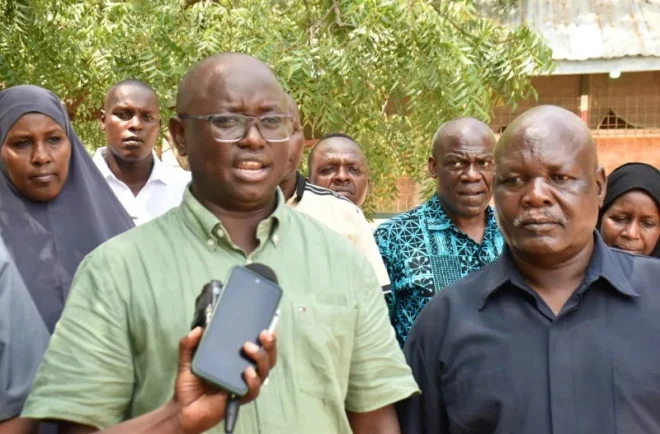
Muktar Dahir, chairman of the Garissa Human Rights Network, sharing his views at the forum.
The Unclaimed Financial Assets Authority (UFAA) has been urged to extend its services to the country’s regions so that Kenyan citizens can more easily access and recover their assets without bearing the heavy cost of travelling to Nairobi.
Garissa residents said the community has little information about the authority’s existence and that the available opportunities are highly limited, particularly for people living in remote and far-flung areas who are entitled to unclaimed funds and assets.
The views were presented during a public consultation meeting held at the Garissa Government Guest House, where UFAA, in partnership with the National Treasury and a technical team, engaged residents on the Draft National Policy on Unclaimed Financial Assets.
The meeting gave residents an opportunity to discuss the provisions of the proposed policy in depth, seek questions and clarification from officials, and submit recommendations on how the management, protection and restitution of unclaimed financial assets could be improved.
Participants called for services to be decentralized to the regional level to improve access to information and enable more Kenyan citizens to recover funds and other assets held in their names.
Muktar Dahir, chairman of the Garissa Human Rights Network, said many Kenyan citizens were still unaware of UFAA’s existence and the services it provides to the public. He said the authority’s office being confined to Nairobi had prevented it from becoming fully known in the rest of the country.
“The proposed policy presents a valuable opportunity to find ways of expanding services, raising public awareness, and increasing the authority’s visibility and recognition across the country,” he said.
Aden Bille, chairman of the Garissa County Association of Persons with Disabilities, expressed concern about the process of identifying people entitled to inherit assets, particularly in cases where account holders die without naming or updating information about their next of kin who are entitled to inherit.
He urged the authority to ensure that the draft policy clearly defines matters relating to inheritance and the identification of beneficiaries, to prevent assets belonging to deceased people from being lost simply because their relatives have no information about them.
“Many Kenyan citizens open bank accounts or acquire financial assets without properly naming or updating the details of their next of kin who are entitled to inherit. In some cases, that information is completely lost or is not used correctly, making it difficult to identify beneficiaries when the assets become unclaimed. This issue needs to be clearly addressed in the future draft policy,” Bille said.
Damaris Shiko, a resident, said services should be brought closer to disadvantaged people at the local level, stressing that the cost of travelling to Nairobi to claim funds could discourage ordinary citizens from pursuing their rights.
She noted that some beneficiaries could end up spending a large portion of the money they sought to recover on transport, accommodation and other travel-related expenses.
Shiko said opening easily accessible regional offices or establishing other service-delivery channels would reduce the burden on claimants and ensure that the process of recovering assets did not cost more than the value of the assets being sought.
UFAA Executive Director and Chief Executive Officer Laban Molonko said the authority had fully recorded the concerns raised, particularly the need to expand services and strengthen the use of next-of-kin information.
Molonko said the authority had so far succeeded in returning only about eight per cent of the assets transferred to it to their rightful owners, prompting the government to decide to develop a comprehensive national policy to address existing gaps.
“This prompted the government to develop a national policy that will establish a highly effective framework for the collection and restitution of unclaimed financial assets,” he said.
He said next-of-kin information was central to the claims process, noting that incomplete or outdated records continued to hinder the authority’s efforts to trace and reunite assets with their owners.
Molonko added that the authority was examining ways to use data held by financial institutions more effectively to identify account holders and beneficiaries, while improving the efficiency of the claims process.
The broad changes taking place in the financial world have expanded the definition and types of assets that could become unclaimed in the future, making it important for the new policy to address emerging categories of financial instruments.
“Mobile money has become an important part of the financial system, while digital currencies and other modern financial services are growing rapidly,” Malonko said.
“As we develop the national policy, these new financial services form part of our discussions, particularly when defining what may qualify as an unclaimed financial asset.”
The authority wants the proposed framework to keep pace with developments in the financial sector and provide clear guidance on how assets can be identified, safeguarded and ultimately returned to their rightful owners.
The Unclaimed Financial Assets Act was enacted in 2011, establishing a legal framework for taking custody of, safeguarding and returning unclaimed financial assets to their owners and beneficiaries.
Such assets include dormant bank accounts, unclaimed mobile-money balances, company dividends and profits, insurance proceeds, unclaimed salaries and pension benefits.
However, implementation of the law has exposed several challenges, particularly in tracing beneficiaries and ensuring that assets transferred to the authority are eventually returned.
UFAA has so far received more than Sh45.2 billion in cash assets and approximately 2.03 billion shares that remain unclaimed. It has paid out more than Sh3.3 billion to nearly 48,000 people, comprising Kenyans and foreigners identified as rightful owners and beneficiaries.
The asset recovery rate, currently at about eight per cent, is well below the national target of 20 per cent and the 30 to 40 per cent rates achieved by well-established international systems, including those in the United States, Canada and Australia.
The absence of a unified national policy has also resulted in fragmented implementation and persistent challenges in tracing and returning assets to their owners.
The draft policy seeks to establish a comprehensive system for improving the management and protection of unclaimed assets, strengthening the obligations of institutions holding the funds, using modern technology and national identification systems to trace beneficiaries, and simplifying the claims process.
If adopted, the proposed policy is expected to create a more orderly framework for managing unclaimed financial assets, making it easier for Kenyan citizens and other eligible beneficiaries to recover funds and investments to which they are legally entitled.
Instant analysis
The low rate of recovery of unclaimed financial assets raises questions about the effectiveness of a system established to protect and return Kenyan citizens’ money. With UFAA holding more than Sh45 billion in cash assets, the fact that only eight per cent has been returned