
Friday July 3, 2026
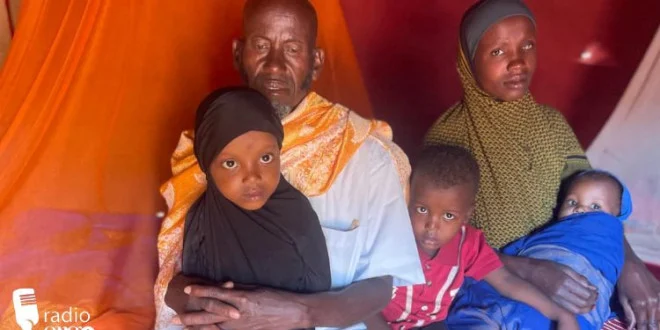
IDP father and his family join IDP camps after fleeing clan conflicts/File Photo/Ergo
What began as a dispute over farmland in Somalia’s Lower Shabelle region has quickly turned into a daily struggle for survival for families who escaped the violence with nothing more than the clothes on their backs.
More than 50 families have taken shelter in Buufow-Ba’ad village since early May, local authorities say. After fleeing fighting around Beder village, many are now facing severe shortages of food, clean water and shelter.
One of them is Kaltumo Farah Osman, who reached Buufow-Ba’ad on 15 May with her five children after clashes between two clan militias drove them from home.
Kaltumo, a widow, said she spends her days going from house to house, asking neighbours to share any cooked food they can spare. On days when no one can help, she and her children go without eating.
“Our living conditions are extremely difficult. There is hardly any food here. I have five children to care for. Sometimes we find something to eat and sometimes we don’t. Today I have nothing to give them except to let them sleep hungry,” she told Radio Ergo.
She has been raising the children alone since her husband died of diabetes in 2024. The family is now sleeping beneath a few cloth sheets tied together and propped up with sticks.
“We have nowhere to sleep. I tied up these pieces of cloth, but if it rains there is nowhere to protect my children from the cold. I hardly sleep at night because I am constantly worried about them,” she said.
The family fled a three-room house toilet in Beder after armed men ordered residents off the land at the heart of the dispute. In the rush to leave, they abandoned eight goats that had provided milk and income. Kaltumo believes the animals were either stolen or killed.
With no money for transport, Kaltumo and her children walked for 11 hours to reach Bufow-Ba’ad. Since arriving, she says, they have received no humanitarian aid.
For a family that had never before been displaced, the adjustment has been difficult. Kaltumo has looked in vain for domestic work in Shalanbood and Marka, but says employers are wary of hiring someone they do not know, and work is scarce.
She previously supported the household through domestic labour and occasional farm work in nearby areas. Three of her children have also been forced to stop attending Koranic school since leaving Beder.
Dahir Abdi Shakur Hussein, who fled Beder at the end of May with his family of seven, is facing the same strain. Each morning, he walks about five kilometres to Marka in hopes of finding food from local residents. On better days, he returns with about one kilogram of rice, enough to stretch across two days.
“We go around asking people in Marka for food. Sometimes someone gives us a kilo of sugar or rice, but many people have very little themselves. Our biggest problems are shelter and water. We have no plastic sheets to protect us if it rains, and we cannot afford to buy water,” Dahir told Radio Ergo.
Before the displacement, the family depended on seasonal agricultural labour that paid Dahir about $4 a day on leased farmland. Five of his children have also left Koranic school since the family fled.
He said the people of Beder were civilians who relied on farm work after years of shrinking agricultural production:
“Fighting over farmland forced us to leave. Armed men told us to leave if we wanted to stay alive. We were not fighters -we were ordinary people trying to earn a living.”
Earlier this year, Dahir had planned to plant crops on a five-hectare family farm he inherited, hoping to recover after previous seasons of water shortages. That plan collapsed when the conflict forced the family out. Many other displaced households are now living with the same uncertainty.
Fadumo Omar Haji, 60, and her family of six are staying with another family in Buufow-Ba’ad. Her daughter gathers firewood from nearby bushland, earning about 50 cents a day — far too little to feed everyone.
Fadumo, who has endured persistent headaches and ringing in her ears for the past two years, said her condition has worsened since she was displaced.
Before fleeing, she earned $3 to $4 a day selling milk in Janale, about three kilometres from Beder. The family left behind a two-hectare farm they had hoped to cultivate this season after recovering from earlier years of water shortages.
Instead, the fighting cut off irrigation canals, putting an end to any chance of planting crops.