Friday July 3, 2026
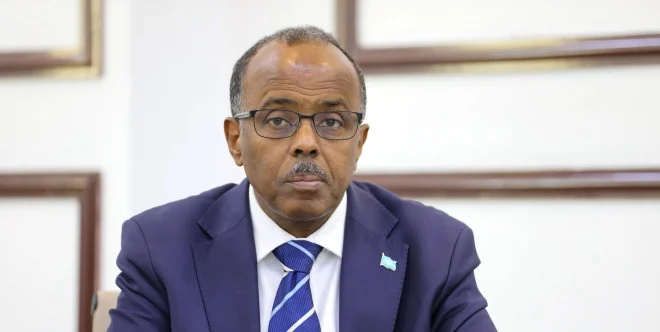
Mogadishu (AX) — Somalia’s State Minister for Foreign Affairs, Ali Bal’ad, has rejected a new International Crisis Group assessment that says al-Shabab surged back in 2025 and wiped out much of the territorial progress the federal government had claimed over the previous two years.
Writing on X, Ali Bal’ad argued that Somalia is too often cast in policy debates as a country stuck in a cycle of collapse, one that cannot secure itself, rebuild institutions or govern with authority.
“That narrative is not only incomplete; it is unfair,” he said.
The minister said the Federal Government of Somalia, under President Hassan Sheikh Mohamud, has spent the past four years juggling three daunting tasks at once: confronting a deeply rooted insurgency, reconstructing the national security forces and pushing ahead with a constitutional review process tied to elections and state-building.
“No serious student of post-conflict reconstruction would describe even one of these tasks as easy,” Ali Bal’ad wrote. “Somalia has been attempting all three at once, under fire, and with shrinking resources.”
The International Crisis Group report warned that widening political rifts and fading international backing are adding pressure on the Somali government and sharpening doubts about how much strain it can endure going forward.
It said al-Shabab, the al-Qaida-linked militant group, made significant gains in 2025, reclaiming much of the ground government forces had seized during the 2022-2023 offensive in central Somalia.
Government troops have since regrouped and consolidated control around Mogadishu, the report said, but much of central Somalia remains contested or under militant rule, leaving the conflict locked in a stalemate in which neither side has been able to secure a decisive edge.
The Crisis Group also said al-Shabab has adapted in the areas it controls, trying to strengthen ties with local communities while relying less on overt coercion. Those shifts, the report said, have helped the group deepen its hold.
At the same time, the report said, political infighting in Mogadishu is intensifying just as foreign aid is shrinking.
To help reverse the trend, it urged the government to reform military training, improve recruitment and retention, and bring federal member states more directly into planning against al-Shabab.
The group also called for stronger backing for state-level forces that can secure territory once it is retaken from militants.
Beyond the battlefield, the report said Somalia should also pursue non-military steps, including encouraging humanitarian agencies to expand aid delivery in al-Shabab-held areas to reduce the suffering of civilians.
The Crisis Group said a political settlement remains the most promising route out of Somalia’s protracted insurgency and urged Mogadishu to keep looking for openings to engage the group in dialogue.
Even so, the report concluded that Somalia’s war with al-Shabab remains deadlocked, with the fighting continuing to swing between government gains and militant counterattacks without a clear outcome in sight.