
Canjeero — Somali Fermented Pancakes
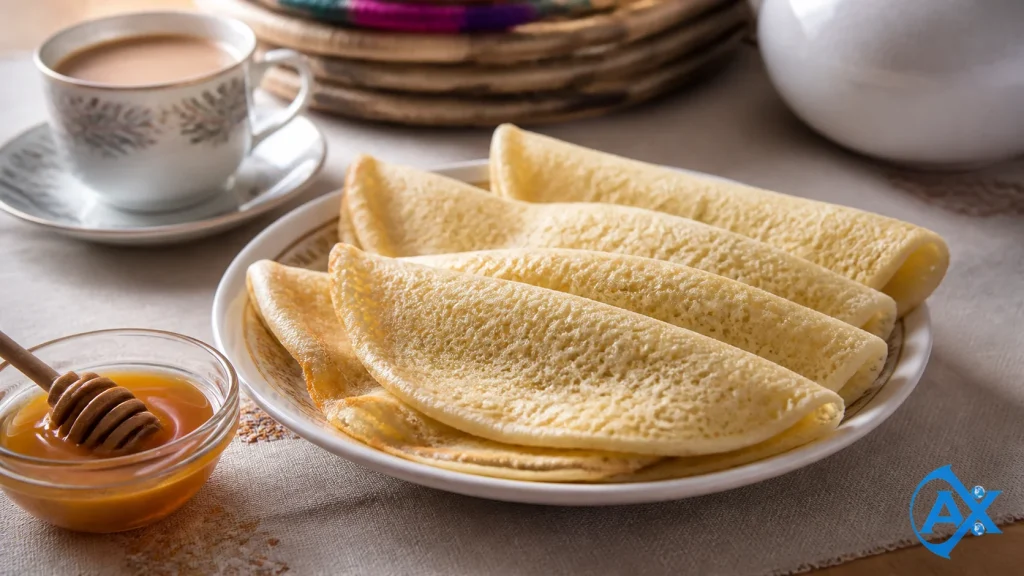
Somali fermented pancakes with a lacy, holed surface — the breakfast bread eaten with ghee and sugar, or torn into stew.
Method
- Mix the flour, cornmeal, yeast and sugar in a large bowl. Hold back the salt for now, as salt slows fermentation.
- Whisk in 3 cups of warm water until completely smooth. The batter should be noticeably thinner than pancake batter and pour in a steady stream.
- Cover and leave at room temperature for 8 to 12 hours, or overnight. It is ready when the surface is foamy, the batter has risen and fallen slightly, and it smells pleasantly sour.
- Stir in the salt and check the consistency. Add the remaining water a little at a time until the batter just coats a spoon thinly; thin batter is what produces the fine holes.
- Heat a non-stick frying pan over medium heat for 2 to 3 minutes, then wipe it with a very lightly oiled cloth. Too much oil stops the holes forming.
- Pour about ⅓ cup of batter into the centre of the pan, then immediately tilt and swirl the pan in a spiral so the batter spreads to a thin round about 20cm across.
- Cook without turning for 2 to 3 minutes. Holes will open across the surface, the top will set from the edges inwards, and the base will be pale gold.
- Cover the pan for the final 30 seconds if the centre is still wet. Lift the pancake out with a spatula; canjeero is cooked on one side only.
- Stack the pancakes holed-side up and keep them covered with a cloth while you cook the rest, stirring the batter briefly between each one.
How to make Canjeero — Somali Fermented Pancakes
Canjeero, known in some regions as laxoox, is the pancake that starts the Somali day. It is thinner and lacier than Ethiopian injera, and the batter is usually wheat-based rather than teff, with a shorter ferment that leaves it only mildly sour.
The ferment is the recipe
- Advertisement -
Almost everything that makes canjeero taste right happens overnight. The yeast and wild fermentation produce the acidity and the gas that opens the surface into fine holes. An under-fermented batter cooks into a plain, tight pancake; an over-fermented one turns sharply sour and collapses. In a warm kitchen, check it after 8 hours.
Swirl, do not spread
Canjeero is never spread with a ladle. The batter is poured into the middle and the pan is tilted in a circular motion so the batter runs outwards in a spiral. That movement, plus a thin batter and a lightly oiled pan, is what gives the characteristic lace.
How it is eaten
At breakfast it is served folded or rolled with sesame oil and sugar, with ghee, or with a glass of sweet spiced tea. Later in the day the same pancakes are torn into maraq or topped with suqaar. Leftover canjeero is often mashed with tea or soup into a dish called fuud.
Keeping a starter
Many cooks keep a cup of batter back from each batch and use it to start the next one, which shortens the ferment and deepens the flavour over time. Keep it refrigerated and bring it to room temperature before mixing a fresh batch.
Traditional Somali breakfast cookery, also known as laxoox. Editorially researched from widely documented household preparations, and not kitchen-tested by Axadle.
Contains gluten from wheat flour. Dairy-free and egg-free unless served with ghee or butter.

Join the conversation