
Baghrir — Moroccan Thousand-Hole Pancakes
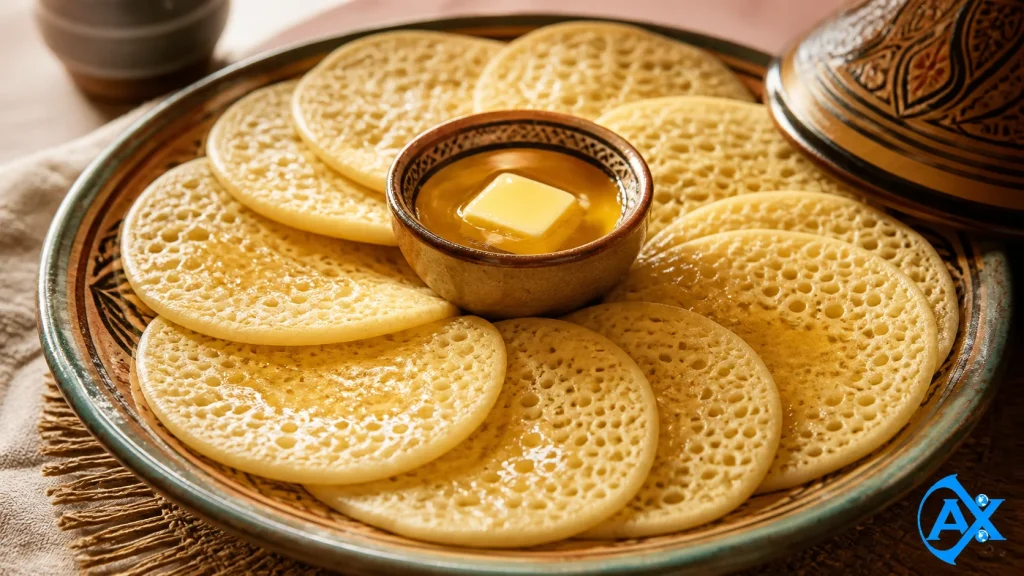
Moroccan semolina pancakes covered in a thousand tiny holes, cooked on one side and soaked in honey and butter.
Method
- Put the semolina, flour, yeast, baking powder, sugar, salt and warm water in a blender and blend on high for a full 2 minutes. Blending, rather than whisking, is what gives baghrir their fine, even holes.
- Pour into a bowl, cover and rest in a warm place for 30 to 40 minutes, until the surface is foamy and the batter has thickened slightly. It should still pour easily, like single cream.
- Do not stir the rested batter. Stirring knocks out the gas that creates the holes; ladle gently from the top.
- Heat a non-stick pan over medium heat with no oil at all. Oil prevents the holes from forming.
- Ladle about ⅓ cup of batter into the centre; it should spread by itself into a round roughly 15cm across. Resist the urge to tilt the pan.
- Cook for 2 to 3 minutes without turning. Holes will open across the whole surface, starting at the edges, and the top will set from wet to matte.
- The pancake is done when the surface is dry to the touch and no wet batter remains in the centre. Baghrir are never flipped.
- Lift onto a cloth in a single layer and let the first ones cool slightly before stacking, or they stick together.
- Warm the honey and butter together until melted and pour over the baghrir just before serving, or offer it in a bowl for dipping.
How to make Baghrir — Moroccan Thousand-Hole Pancakes
Baghrir are known as the thousand-hole pancakes, and the holes are the entire point: they trap the honey-butter syrup poured over them. They are a breakfast and tea-time staple in Morocco, and a Ramadan fixture alongside harira and chebakia.
Blend, do not whisk
- Advertisement -
A blender does two things a whisk cannot: it fully hydrates the semolina and it incorporates air evenly. Two minutes of blending is the single most important step, and the usual reason home-made baghrir come out with patchy holes.
Do not stir after resting
Once the batter has risen, treat it gently. Every stir releases the carbon dioxide that forms the holes during cooking. Ladle straight from the top of the bowl.
A dry pan
Baghrir are cooked on a completely dry non-stick surface over medium heat. Oil or butter in the pan seals the surface and the holes never appear. If the pancakes start sticking, the pan is too cool rather than too dry.
Serving
Honey and melted butter is classic; some households use argan oil and honey, or amlou, the almond and argan paste from the south. Leftovers reheat briefly in a dry pan and freeze well, stacked with paper between them.
Traditional Moroccan cookery; baghrir is eaten at breakfast and at tea time, and often appears during Ramadan. Editorially researched from widely documented preparations, and not kitchen-tested by Axadle.
Contains gluten from semolina and flour. Dairy-free unless served with butter; egg-free.

Join the conversation