SpaceX has achieved a breakthrough long central to the future of space travel: catching a returning Starship spacecraft in midair, a feat that could help make fully reusable rockets—and far cheaper launches—a reality.
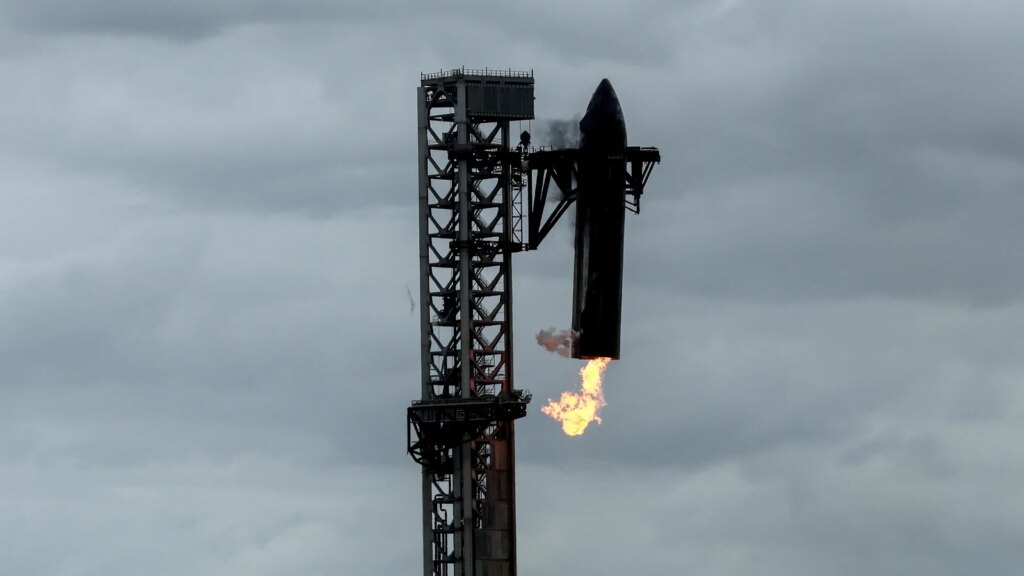
After emerging from a bank of clouds and enduring the searing heat of atmospheric re-entry, Starship descended over Starbase before gliding into position between the mechanical “chopstick arms” mounted above Launch Pad 2.
The landing represented a major advance in the space industry’s decades-old effort to build rocket systems that can be flown, recovered and launched again. Reusability could sharply reduce mission costs while allowing operators to increase the pace of launches.
“That was the Holy Grail of spaceflight, plummeting through fire to be snatched out of the air by steel. We caught a Starship and now, everything changes,” SpaceX spokesman Dan Huot said.
The demonstration came during the 15th test flight of the largest and most powerful rocket system ever built.
During its 22-hour mission, the Starship spacecraft—whose name is also used for the wider rocket system—completed 14 orbits of Earth and released 26 satellites for Mr Musk’s Starlink internet constellation.
SpaceX had previously caught returning booster rockets three times.
Capturing Starship presented a far greater challenge, however. The spacecraft descended from a much higher altitude and traveled considerably faster than the boosters recovered in earlier attempts.
Mr Musk congratulated the SpaceX team and shared videos showing the spacecraft suspended between the chopstick arms, writing that the vessel “looks great!”
Clayton Swope, an aerospace expert at the Center for Strategic and International Studies, described the mission as a “huge technical achievement” that demonstrated the viability of Starship as a fully reusable spacecraft.
“Let’s see how quickly they can do it again,” he added.
‘Giant swoosh’
SpaceX had plotted Starship’s return route to keep it away from populated areas as it crossed the continent, senior SpaceX engineer Lars Blackmore said.
The spacecraft passed over sparsely populated desert, threaded its way beyond towns and then performed what Mr Blackmore called a “giant swoosh maneuver” during its final approach. It looped around the cities of Texas’ Rio Grande Valley before heading toward the landing site from the east.
Some versions of Starship are intended to carry internet satellites and data centers into orbit. Other variants are being developed to transport people to the Moon and Mars.
US space agency NASA expects Starship to operate as a lunar lander for its Artemis mission. On Saturday, Administrator Jared Isaacman described the spacecraft’s recovery as “almost magic”.
“Making more believers by the day… one step closer to (the Moon),” he said on X.
Mr Musk sees Starship as the foundation of a fleet of “rapidly reusable” rockets, with the long-term ambition of launching as often as once an hour to place equipment such as internet satellites and data centers in space.
Refueling challenge
Mr Musk, the world’s richest person, has already reshaped the space industry through SpaceX’s partially reusable Falcon rockets, which routinely carry satellites into orbit and transport astronauts to the International Space Station.
But the Starship program has faced repeated delays as SpaceX tackles engineering problems that have no easy precedent. Among the most difficult is the unresolved challenge of transferring fuel to the spacecraft in orbit, a capability needed for missions to the Moon or Mars.
The company must also continue refining the Super Heavy booster, which suffered a technical problem during Friday’s descent and was forced to divert into the Gulf of Mexico.
After SpaceX’s high-profile stock market debut in June raised about $85.7 billion, the company has stepped up investment in manufacturing and launch infrastructure.
During a tour of its million-square-foot (93,000-square-meter) factory at Starbase on Friday, SpaceX officials told journalists that the facility can now produce one spaceship every two weeks and one booster every four weeks.