An Irish-led team of scientists took to the skies over the Atlantic on Wednesday, chasing totality to capture rare images of the Sun during the solar eclipse.
The group, which included astronomers from the Dublin Institute for Advanced Studies, flew towards Iceland aboard an Air Corps aircraft to document the total eclipse.
- Advertisement -
Professor Peter Gallagher, director of the DIAS Dunsink Observatory, said the sight of the Sun “disappear” at an altitude of 10,000 feet, roughly 600km west of Ireland, was “extremely eerie”.
He said the team secured a clear view of the Sun shortly before the eclipse began and observed its solar atmosphere for between two and three minutes.
Watch: The Irish Air Corps records the total eclipse (Credit: Irish Air Corps)
The scientists worked alongside colleagues from the European Space Agency and Italy’s National Institute for Astrophysics to photograph the event.
A specialised camera was used to record the corona, the inner region of the Sun’s atmosphere that becomes visible when the Moon blocks the bright solar disc during an eclipse.
While Ireland saw a partial eclipse today, an Air Corps C295 chased totality 350km off the west coast.
On board, scientists from @DIAS_Dublin, @tcddublin, @WeAreTUDublin & @INAF_astro, supported by @esa, captured rare images of the Sun’s corona.
101 Sqn, No. 1 Ops Wing pic.twitter.com/UW9XSDpC7y
— Irish Air Corps (@IrishAirCorps) August 12, 2026
Speaking on RTÉ’s Morning Ireland, Prof Gallagher said the team had only a few minutes to get everything right. The tension and concern, however, gave way to calm as totality arrived.
“You can’t overcome that human emotion of that strangeness.
“It reminds you of how small we are and that we are sitting on a ball of rock around a sun and planet in the middle of empty space.
“It’s that connection to the nature and the astronomical world that an eclipse really brings down to Earth quite literally.”
The Irish and international scientists who took part in the eclipse flight
Dr Laura Hayes, an assistant professor at the Dublin Institute for Advanced Studies, was also among those on board
“We prepared a lot, but the weather was the main thing we were concerned with. The fingers crossing worked and we flew into clear, beautiful skies and we witnessed the eclipse,” she told RTÉ’s Today with Claire Brock.
It was Dr Hayes’s first opportunity to see a total solar eclipse.
The aircraft descended below 10,000 feet, its cabin was depressurised and a window was opened to accommodate the telescope.
“And then all of a sudden – completely darkness. You could see the shadow coming over the sea. The cabin went completely dark,” Dr Hayes recounted.
On the ground, thousands of people gathered around the country to watch the rare partial eclipse, during which more than 90% of the Sun was obscured.
Phoenix Park in Dublin hosted one of the largest gatherings, drawing huge crowds for what many viewed as a once-in-a-generation astronomical spectacle.
Cheers and applause broke out as the light faded and the Moon reached its greatest coverage of the Sun.
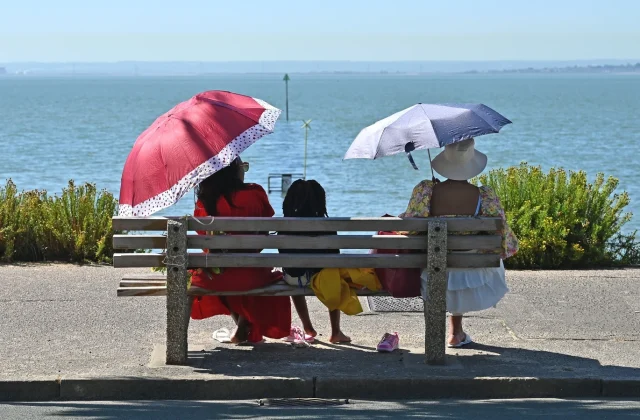
Anne and Florence Curley watch the solar eclipse during the European Athletics Championships in Birmingham, England
Watch: Dublin partial eclipse captured in timelapse
‘Thoroughly enjoyed it’ – hundreds gather in Armagh to watch eclipse
Cork stargazers gather in large numbers for partial eclipse
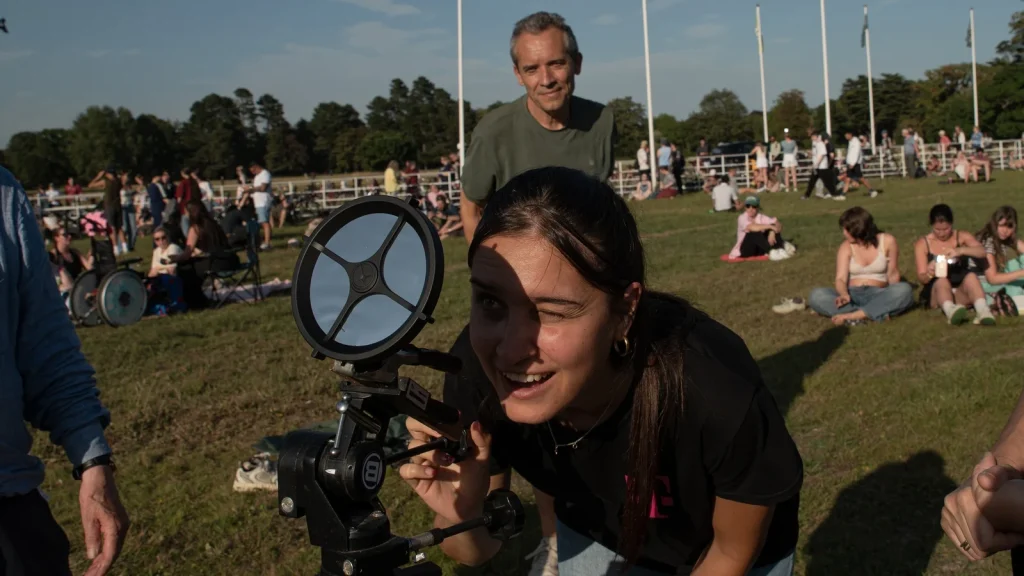
A telescope was set up to provide a safe way to view the eclipse, while others arrived with homemade viewers built from cereal boxes.
Colm Healey, from Dublin, said he had come because it was likely to be his only opportunity to witness such a rare celestial event.
He said: “It is great to see the crowds here and so many people that are interested. I have got my eclipse glasses so I’m well prepared.”
A family wearing solar glasses watches on during a partial solar eclipse in Dublin
Jack Donovan and Paul Cantwell had made the journey from Wicklow.
Mr Cantwell said: “We wanted to come because we’ll never see anything like it again. It’s such a rare occasion, it’s cool.”
“We haven’t got glasses but we’ll hopefully get a view through the telescope.”
Read more: Scientists aim to solve solar mystery during eclipseIceland, Spain experience ‘dream’ full solar eclipseIn pictures: Thousands watch rare solar eclipse
The team prepares its camera aboard the eclipse flight (Pic credit: Irish Air Corps)
At Croke Park, spectators watched the eclipse ahead of the friendly football match between Manchester United and Leeds United.
Two resourceful stewards used welding masks to protect their eyes while viewing the event.
Stewards in Croke Park wear welding helmets to watch the solar eclipse
Huge crowds gathered in Phoenix Park for the partial solar eclipse (Pic: Collins)
Viewing events were organised by the observatories at Dunsink in Dublin and Armagh, along with Blackrock Castle in Cork. Maynooth University in Co Kildare and Queen’s University Belfast also hosted public gatherings.
Several hundred people assembled at Armagh Observatory, where staff provided specialist telescopes for safe viewing.
Staff also handed out 400 pairs of approved eclipse glasses, all of which were claimed within minutes.
Many attendees had made their own eclipse viewers from cardboard boxes.
Hundreds more gathered at Bell’s Field in Cork city to watch the partial eclipse.
The eclipse appeared over Ireland shortly after 6pm, with the Sun reaching maximum coverage soon after 7pm.
A homemade eclipse viewer made using cereal boxes
Additional reporting PA