By Abubakr Al-Shamahi Saturday August 8, 2026
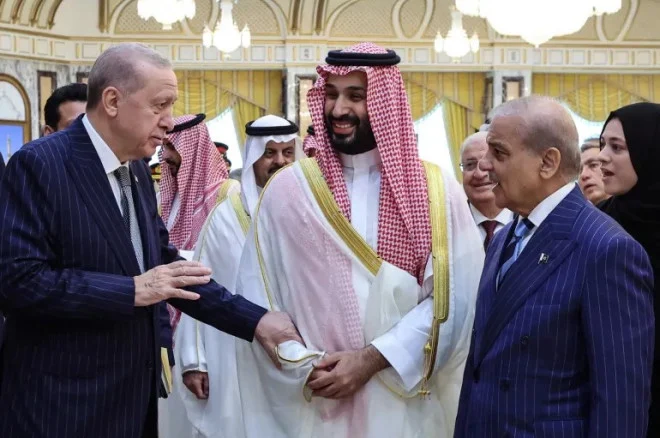
Turkiye’s President Recep Tayyip Erdogan, left, Saudi Arabia’s Crown Prince Mohammed bin Salman, centre, and Pakistan’s Prime Minister Shehbaz Sharif meet in Mecca on August 7 [AFP]
Turkiye, Saudi Arabia and Pakistan have announced a mutual defence pact, creating a new security alignment at a moment of profound upheaval across the Middle East.
Signed on Friday and known as the Mecca Joint Defence Pact, the agreement builds on a similar deal concluded between Riyadh and Islamabad last year.
Its significance extends beyond the three signatories. Experts say the pact could be the first step towards a broader regional alliance positioned between Israel and Iran — and wary of both.
While the signatories seek to project a message of strength and unity in the face of regional threats, they have also been cautious about framing the pact as a deterrent.
The governments involved have avoided directly antagonising their regional rivals, while the agreement’s precise obligations remain uncertain. It is not yet clear how far the pact would require one member to come to another’s defence.
“We haven’t seen the Mecca declaration yet. We believe it says an attack on one should be considered an attack on all — and ‘should be’ is the operative phrase because that does not mean ‘necessarily’,” Harlan Ullman, chairman of the Killowen Group advisory firm, told Al Jazeera.
The potential tests are already visible. Pakistan has been involved in a border conflict with Afghanistan since February and exchanged fire for several days with fellow nuclear-armed state India in May 2025.
Saudi Arabia, meanwhile, has faced repeated attacks by Iran and groups aligned with Tehran since the United States-Israeli war against Iran began in late February.
Turkiye has spent years fighting Kurdish armed groups inside and beyond its borders, while tensions between Ankara and Israel have also deepened.
Ullman and other experts say the pact’s practical implications will become clear only if one of those conflicts expands or directly threatens a partner.
“Supposing the Houthis in Yemen attack Saudi Arabia, does that bring in Turkiye? Does that bring in Pakistan? That remains to be seen,” Ullman said.
Shifting regional dynamics
The Middle East has undergone sweeping changes in recent years, particularly since the Hamas attack on Israel on October 7, 2023, and Israel’s subsequent genocide in Gaza.
Long-running tensions between Iran and Israel have also escalated into a regional war that remains unresolved.
Governments in the Middle East and beyond are now seeking ways to navigate the turmoil and prepare for what comes next.
In the face of shared dangers, several states appear willing to set aside old disputes and pursue a more pragmatic course.
The changing relationship between Turkiye and Saudi Arabia illustrates that shift. The 2018 killing of Saudi journalist Jamal Khashoggi at his country’s consulate in Istanbul caused a severe rupture between Riyadh and Ankara that endured for years.
By 2022, however, the two governments were putting those differences aside. Saudi Arabia was pursuing a broader regional deescalation strategy, while Turkiye was seeking stronger economic ties.
Since then, Israel and Iran have continued to pressure countries across the region while advancing competing visions for its future.
That pressure is understood to have encouraged closer cooperation among Pakistan, Saudi Arabia and Turkiye.
Establishing deterrence
The stated purpose of the Mecca Joint Defence Pact is to deter threats against its members.
As Al Jazeera correspondent Osamah Bin Javaid noted, the three countries offer markedly different capabilities.
“Each of these countries brings unique capabilities: Pakistan’s battle-hardened military, its munitions and nuclear arsenal, the only one in a Muslim-majority nation,” Bin Javaid said.
“Turkiye, a vital NATO member, brings world-class drone technology and sophisticated defence manufacturing. And Saudi Arabia provides the financial muscle to back it all up.”
The appeal of new military partnerships has grown as doubts mount over the reliability of the United States. Saudi Arabia, and Turkiye to a lesser degree, have traditionally viewed Washington as a central security partner.
But with US foreign policy under President Donald Trump becoming increasingly erratic, countries around the world are looking for additional options.
Analysts also say Israel appears to occupy the top position in US Middle East policy, prompting questions about Washington’s readiness to protect its other allies.
“The Trump administration has said that allies have got to fend for themselves,” Ullman said. “ It’s clear to me that our allies are looking elsewhere.”
Although Israel and Iran are widely viewed as threats in the region, the countries behind the Mecca pact have taken care not to present it as an alliance directed against a particular outside power.
Experts nevertheless say the concerns involving both countries are unmistakable.
“For all three states, Israel remains the biggest threat to regional security and stability,” Bin Javaid said.
“Iran closely follows within that threat matrix, especially for Saudi Arabia after Tehran’s attacks on Washington’s interests.”
In the view of many across the region, Israel — which once sought to normalise relations with Saudi Arabia — has shown since 2023 that it prefers military force to negotiations when confronting disputes.
Israeli Prime Minister Benjamin Netanyahu has also begun warning about the emergence of a “Sunni axis” — without explaining precisely what he means by the term.
Some experts argue that such warnings could become a self-fulfilling prophecy by encouraging Sunni-majority powers to coordinate more closely. Pakistan, Saudi Arabia and Turkiye all have Sunni majorities.
Iran has already attacked Saudi Arabia, while other strikes have been carried out by groups backed by Tehran. Saudi Arabia, in turn, has launched attacks against Iranian-backed groups in Iraq.
New members?
Whether the Mecca Joint Defence Pact will grow to include countries such as Egypt, Qatar, Syria and the United Arab Emirates (UAE) remains unknown.
The logic behind a larger alliance is clear. Sunni-majority states in the Middle East have frequently been divided, and some observers say those divisions have weakened their ability to respond to threats from Israel and Iran.
Yet historic rivalries and competing national priorities mean that expansion is far from guaranteed.
Syria, for example, is concentrating on rebuilding after a brutal 13-year war. Its location along Israel’s northern border may also make Damascus wary of joining an agreement that Israel could view as hostile.
Egypt, similarly, has indicated that economic recovery and the prevention of domestic instability are its main priorities.
It has previously been reluctant to join a Saudi-led maritime alliance intended to protect regional shipping routes, concerned that such a move could pull it into a wider conflict.
The UAE is another possible addition to the Saudi-Pakistan-Turkiye grouping. However, Abu Dhabi has repeatedly taken positions that differ from those of the other three governments, particularly on Yemen and its decision to normalise relations with Israel.
The US-backed Abraham Accords that resulted from that normalisation represent a separate regional grouping, one more closely aligned with Israel and potentially viewed as a counterweight to the countries in the Mecca alliance.
The complexity of the region’s relationships underlines the danger of declaring that Friday’s agreement has already created a new Middle Eastern order.
Regional partnerships have changed repeatedly over the past decades, and they can change again.
The pact’s real significance will be measured when its members face an actual test. Israel and Iran have demonstrated a willingness to enter war and accept its consequences. Will Saudi Arabia, Turkiye and Pakistan do the same for one another?
A crisis in the current Middle East could eventually force that choice. The responses of the three governments will show whether the Mecca pact represents the emergence of a genuine third regional axis.