Ontario Premier Doug Ford has sharply rejected US criticism of Canada’s response to spreading forest fires, calling the attacks “absolutely unacceptable” as thick smoke blankets a wide stretch of the United States.
“We’re trying to get through this,” Mr Ford said. If the US were battling wildfires under similar circumstances, he added, “we’re going to be down there to support our neighbors.”
President Donald Trump yesterday blamed what he described as incompetent Canadian forest management for the smoke, saying he would add the “incalculable cost” of confronting the pollution to existing tariffs on Canadian goods.
The White House did not immediately answer a request for comment on Mr Ford’s response.
“My heart breaks for the people who have lost their homes or their camps and their businesses,” Mr Ford said. He added that he had told his ministers there would be “no limit” on spending needed to protect communities across Ontario.
Ford urges Trump to remove softwood lumber tariffs
Mr Ford argued that if Mr Trump wants Canada to clear more of its forests, the US president should eliminate American tariffs on Canadian softwood lumber.
Allowing Canada to export its softwood lumber to the US without tariffs “would resolve a lot of the issues we face right now,” Mr Ford said.
Federal Emergencies Minister Eleanor Olszewski said late yesterday that Canadian Armed Forces aircraft would help evacuate Fort Hope residents in sparsely populated northwestern Ontario, where some of the fiercest fires are burning.
With few roads serving the region, local communities depend heavily on air transportation.
A wildfire burns in Boston Bar, British Columbia, Canada
Thousands of residents have already fled to cities farther south in Ontario.
Large forest fires have become an increasingly familiar threat in Canada, which contains some of the world’s most extensive forests.
Climate experts say higher temperatures are drying out timber and creating conditions that raise the risk of fire.
More favorable conditions forecast
Canada’s federal Natural Resources Department said 69 new fires were recorded overnight, bringing the nationwide total to 955.
Nearly 11,000 square miles (28,500 square km) have burned, an area that remains well below the five-year average.
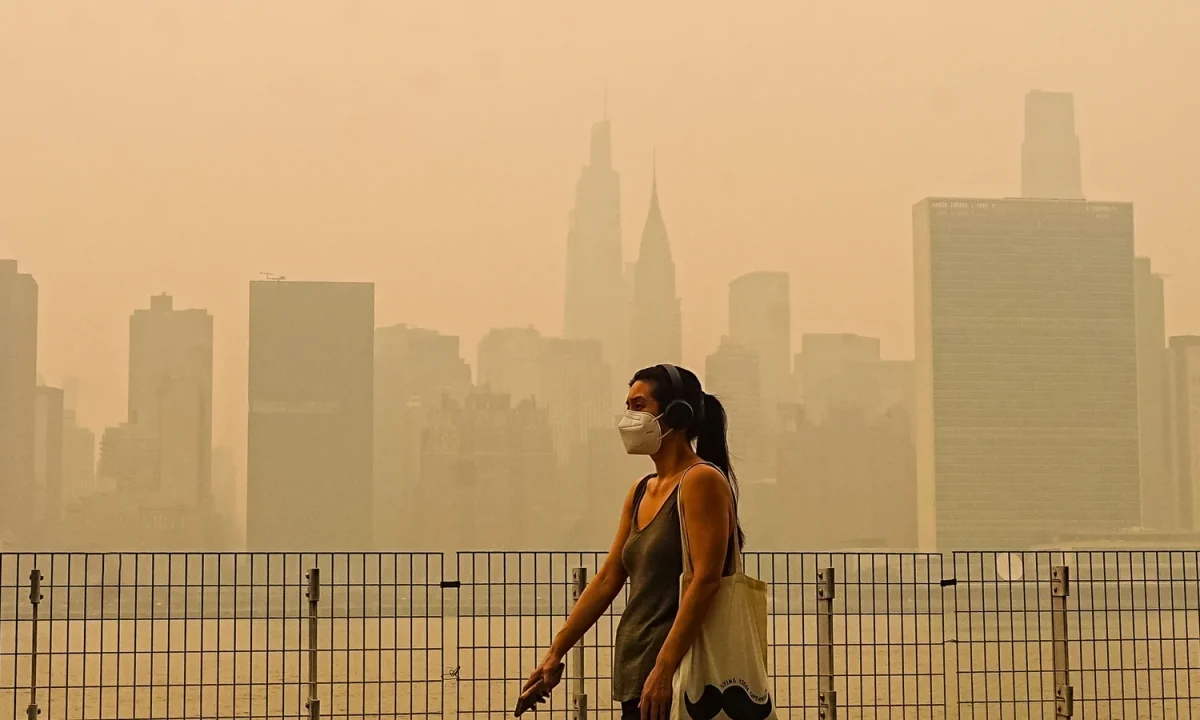
Even so, winds have pushed smoke across the Canada-US border, leading authorities to issue health warnings and air-quality alerts in parts of the United States.
We need your consent to load this rte-player contentWe use rte-player to manage extra content that can set cookies on your device and collect data about your activity. Please review their details and accept them to load the content.Manage Preferences
Earlier, the US Environmental Protection Agency’s AirNow site classified air quality as “unhealthy” across an area encompassing southern Ontario, eastern parts of Ohio and West Virginia, most of Pennsylvania and New Jersey, much of Virginia, and all of Maryland, Delaware and Washington DC.
Some areas of western Pennsylvania, including Pittsburgh, received a “very unhealthy” rating.
AirNow forecast that conditions in those locations would improve as the day progressed.
Smoke drifting from the Canadian wildfires will have only a limited effect on tomorrow’s soccer World Cup final at New York New Jersey Stadium, forecaster AccuWeather said on Friday.
Wildfire activity across Ontario has begun easing over the past 24 hours, while “much more favorable weather” is forecast for the coming days, according to Mike Harris, the Canadian province’s natural resources minister.