
Firefighting aircraft battled for a second day to contain a fast-moving wildfire south of Paris, as flames drove residents from their homes and a fresh heatwave tightened its grip on the region.
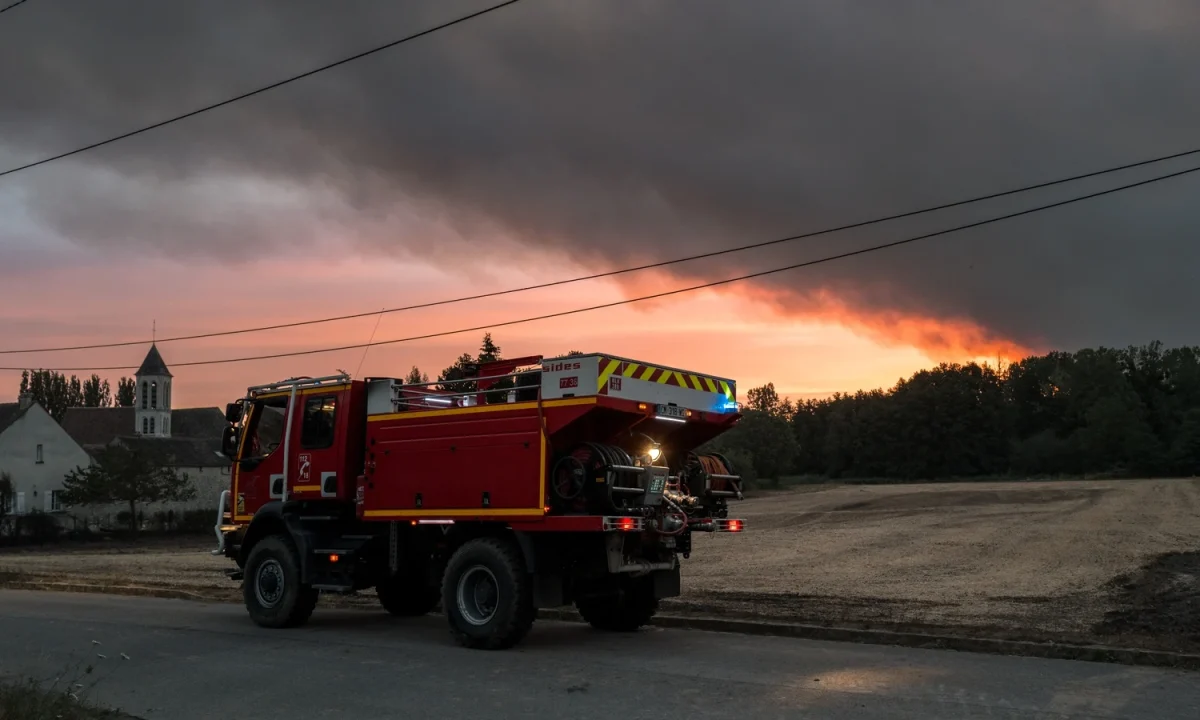
The blaze broke out yesterday afternoon in the vast Fontainebleau forest, about 60km southeast of the capital. Once a royal hunting preserve and now scattered with peaceful villages, the woodland was quickly engulfed as the fire gathered pace.
By early today, the rare wildfire in northern France had swept across 800 hectares – an area larger than Gibraltar – disrupting rail and motorway traffic during a busy holiday travel weekend.
“I have never seen this before in three decades,” said Didier Buguinet, a deputy mayor in Le Vaudoue, as flames burned along the edge of the village of roughly 750 people.
Authorities deployed firefighting planes yesterday to support crews on the ground, marking the first use of such aircraft in the greater Paris region.
A firefighting plane flies above the water in France
“Two Canadair planes are preparing to scoop up water from the Seine” river, officials in the Seine-et-Marne region on the outskirts of the capital said today on X.
The blaze disrupted traffic on the A6 motorway, which runs southeast from Paris, and sections of the highway remained closed today, according to Google Maps.
The national railway service, however, said cables damaged by the fire yesterday afternoon had been repaired, allowing normal high-speed services between Paris and the southeastern city of Lyon to resume.
Wildfire tears through Fontainebleau forest
Officials said this morning that the fire had already crossed 800 hectares and continued to spread, prompting the partial closure of the A6, France’s principal north-south motorway.
As darkness fell, firefighting aircraft were forced to halt their operations.
About 15 homes were evacuated in the nearby village of Vaudoué, while crews worked to protect several other communities in the area, according to the local Seine-et-Marne fire service.
Anxious residents gathered in the village, watching emergency vehicles speed by and making phone calls as they tried to learn whether their homes remained in danger.
Among those evacuated were Valerie and her husband Daniel, who recalled the moment authorities and firefighters ordered them to leave.
“We could see the ash falling,” Valerie told AFP as she sat near the war memorial in Vaudoué, uncertain where the couple would spend the night.
“We put the cats and dogs in the car… we could see the fire on both sides,” she said.
Around 15 homes were evacuated in the nearby village of Vaudoué
Third heatwave in under three months
France is enduring its third heatwave in less than three months, while fires have burned across several parts of the country during the past week.
The conditions mark the latest deadly spell of extreme weather, episodes that scientists say have become increasingly frequent in recent decades because of human-caused climate change.
Sophie Guiot showed AFP a photograph of a water-dropping aircraft passing above her home.
“My parents in the south of the country had been worrying about fires, but it’s here that it happened,” she said.
Official figures show France registered more than 2,000 excess deaths during the June heatwave, as well as 300 during the period of high temperatures in late May.
Wildfires have burned about 25,000 hectares across France since the beginning of the year – an area almost the size of Edinburgh and twice the total recorded during the same period last year, civil security director general Julien Marion said on Friday.
The blaze began yesterday about 60km southeast of Paris
High temperatures were forecast to persist until tomorrow’s Bastille Day celebrations, France’s national public holiday, according to the Meteo-France weather service.
Across the three heatwaves, temperature records have fallen in several European countries, while estimates from Belgium, Britain, France and Spain indicate that thousands of excess deaths have occurred.
At least 13 people were killed by a wildfire in southern Spain last week.
The June heatwaves would have been “virtually impossible” in the absence of climate change, according to scientists from the World Weather Attribution group.
Several other countries across Europe have also recorded unprecedented average temperatures.
In France, the intense heat prompted authorities to close three of the country’s nuclear power stations.
Organisers of the Tour de France also cut yesterday’s stage by 30km as temperatures along the route neared 40C.
Interior Minister Laurent Nuñez, whose office said he would visit Fontainebleau today, reported that forest fires had already burned 17,000 hectares this year.
After all the figures were counted, the total would reach 25,000 hectares – “twice as much as the same period” in 2025, he added.
Heatwave breaks records across central US
Across the Atlantic, a record-breaking heatwave scorched the central United States yesterday, toppling temperature records from the northern plains to the Rocky Mountains.
Temperatures peaked at 43C in Salt Lake City, Utah’s state capital, and Billings, Montana’s largest city, according to preliminary figures from the US National Weather Service.
The readings were the highest ever recorded in both cities since record-keeping began more than 150 years ago, eclipsing earlier peaks of about 42C.
The punishing heat has also complicated efforts to contain major wildfires in Colorado and Utah, with the extreme temperatures forecast to continue through tomorrow.