
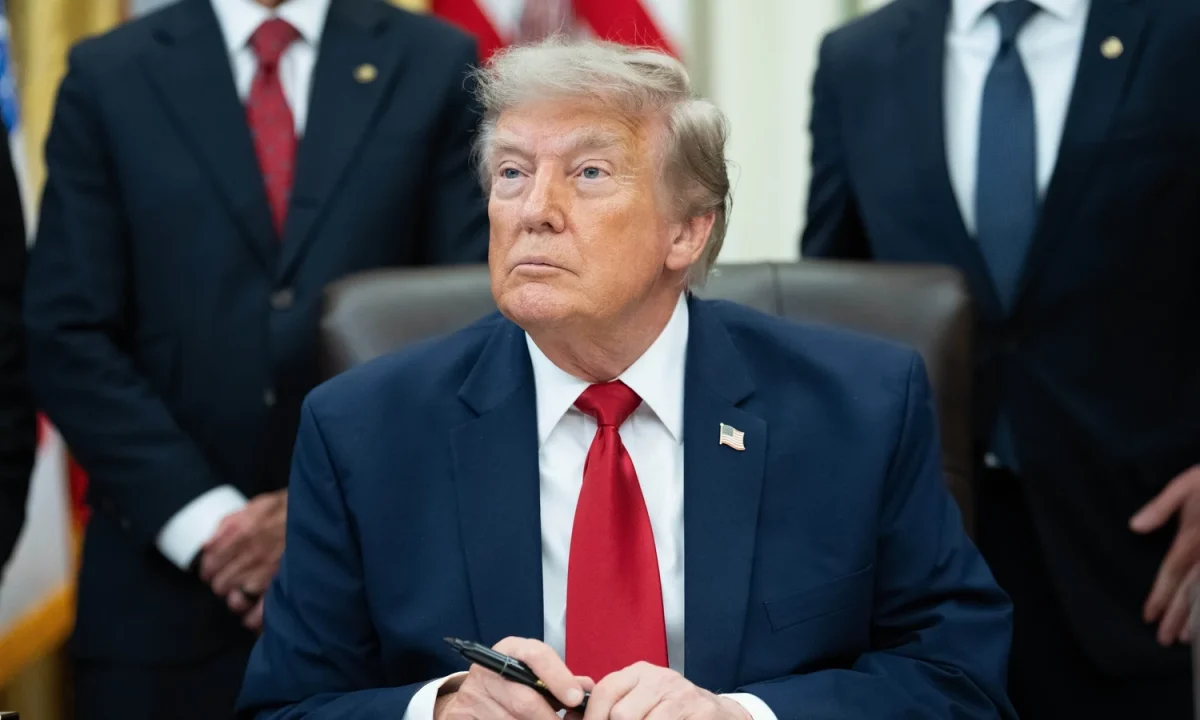
With tensions flaring across the Gulf, the United States launched a new round of strikes against Iran, a sharp escalation in the renewed hostilities—even as US President Donald Trump insisted a diplomatic off-ramp remains within reach.
“We’re going to hit them very hard tonight, and we’re going to hit them hard tomorrow,” Mr Trump told radio host Hugh Hewitt.
Not long afterward, US Central Command (CENTCOM) said the operation began at 9.45pm Irish time, extending the assault into a third straight night.
“These strikes will continue imposing a heavy cost on Iranian forces and degrade their ability to attack innocent civilians and commercial shipping in the Strait of Hormuz,” CENTCOM said.
Ships sail near the Strait of Hormuz off the UAE’s eastern coast at Khor Fakkan
The US military said it struck dozens of targets early yesterday, while Iran’s Revolutionary Guards announced new strikes on Bahrain, Jordan, Kuwait and Oman.
Mr Trump also issued a warning aimed at Pickaxe Mountain, a deeply buried nuclear site near Natanz where Western intelligence suspects Iran is building an undeclared enrichment facility.
“Tell the Iranians to be ready. Let them know we’re coming, there’s not a damn thing they can do about it,” he told Mr Hewitt.
‘Guardian of the Hormuz’
In a further step, CENTCOM—acting on Mr Trump’s orders—said it would reimpose a blockade on Iranian ports beginning at 9pm Irish time today. Oil prices jumped more than 9% as traders reacted to the prospect of a wider conflict.
Writing on Truth Social, Mr Trump said the United States would be “‘known as ‘THE GUARDIAN OF THE HORMUZ STRAIT'” and impose a 20% fee on all cargo shipped through the waterway.
Under the plan, Iran’s ports would again face a blockade, while Mr Trump said “all other countries will have fair and open use of the strait”.
Iranian Foreign Minister Abbas Araghchi quickly ridiculed the toll threat, posting on X that “POTUS is absolutely right” that whoever guarantees safe passage should be compensated—but that Iran would charge less.
“20% is of course too much,” he added.
Iranian Foreign Minister Abbas Araghchi ridiculed US President Donald Trump’s toll threat
The US has vehemently opposed Iran’s desire to charge tolls in the strait, which international law generally forbids.
Even as the fighting pointed in the opposite direction, Mr Trump said yesterday he still believed the standoff could be settled at the negotiating table.
“Yeah, I think a deal is possible. Sure, I do,” Mr Trump told reporters in the Oval Office. “We had a deal with them two days ago and then they said ‘Oh we can’t make that deal. We have to negotiate it further.'”
Iran’s foreign ministry spokesman Esmail Baghaei said that the June memorandum of understanding that formed the basis for the negotiations and lifted the US blockade was “in crisis”.
The previous blockade, in place from April to June, cut off Iranian oil exports and threatened a damaging shutdown of the industry.
Mr Baghaei said Iran would ignore its obligations under the deal if the United States did the same, but added that Iran was continuing talks with mediators from Qatar, Pakistan and Oman to prevent further escalation.
But analyst Bader Al-Saif said the rising tempo of attacks was more likely to postpone any lasting settlement than to force one.
“Both sides want to end the impasse on their own terms, and they are increasingly finding it difficult to do so. Hence the return to an increase in the scale of attacks,” said Mr Al-Saif, an associate fellow at Chatham House.
Iranian state media reported deaths in the latest US strikes, which it said targeted large areas across the south and west.
Read more: Oil gains over 4% as Trump says US reinstating Iran naval blockade
At least four explosions were heard yesterday east of Bandar Abbas, which sits on the Strait of Hormuz, Iranian state media reported, citing a reporter in the port city’s province.
At least 25 people have been killed in Iran since hostilities resumed last week, according to an AFP tally based on Iranian announcements.
United Nations Secretary-General Antonio Guterres expressed “deep concern” at the regional escalation, including attacks by both sides.
Iran’s Revolutionary Guards said they had struck US military targets and bases in Jordan and Kuwait, state media reported.
They added that said they had carried out a fresh wave of missile and drone strikes on Bahrain this morning, after the Gulf country urged citizens to take shelter as a siren sounded.
“Several weapons support warehouses, a satellite communications centre and the residential building for US forces in Bahrain were targeted,” Iranian state television IRIB quoted the Guards as saying.
Jordan’s army said it had intercepted four Iranian missiles.
The United Arab Emirates said this morning that Iran attacked two ships in the Strait of Hormuz, killing one crew member and wounding eight others.
“The Ministry of Defence condemned this flagrant attack, describing it as a grave violation and a clear breach of international law that threatens regional security and stability,” the defence ministry wrote on X.
Iran insists it only targets US interests in the Gulf, but the spokesman for Jordan’s military command said any collaboration by Gulf countries with the United States would be considered “an act of war”.