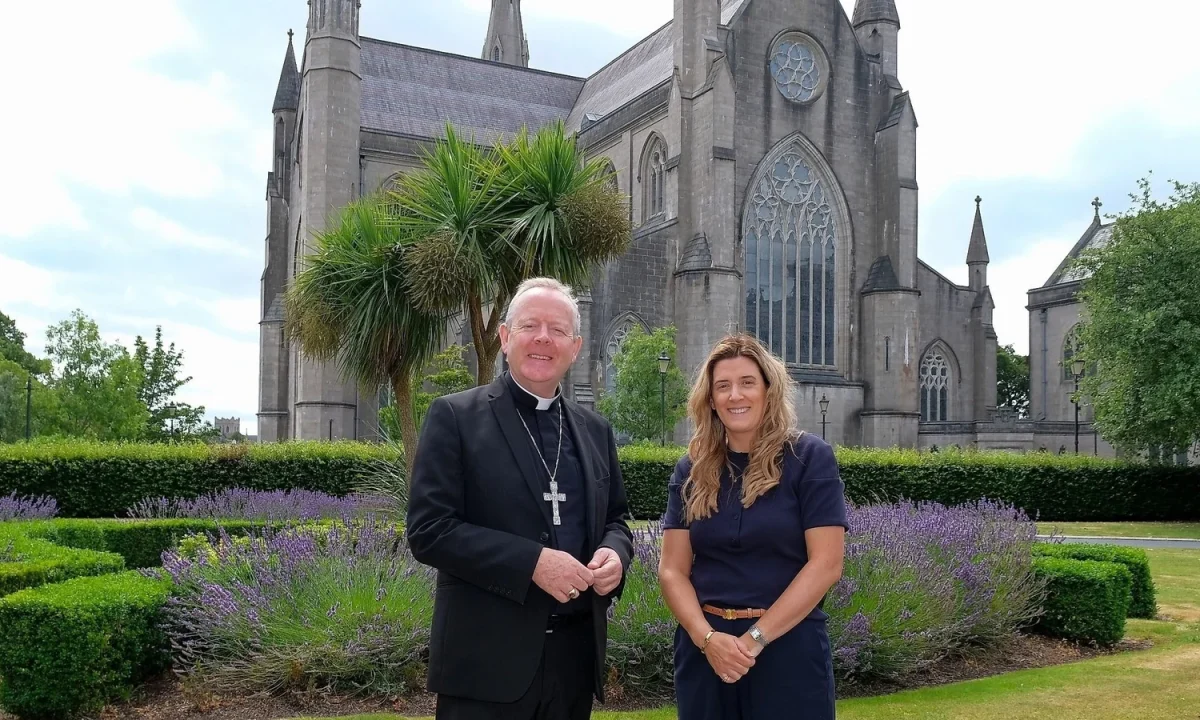
Artificial intelligence’s moral fault lines have moved from theory to the Archbishop’s residence in Armagh, where Archbishop Eamon Martin sat down with senior OpenAI Ireland figures to discuss Pope Leo’s encyclical letter, Magnifica Humanitas.
The document, published in May as the Pope’s first encyclical, placed the protection of human dignity at the centre of debate over artificial intelligence.
In it, Pope Leo cautioned against “a race for ever more powerful algorithms and larger datasets, driven by the desire to secure geopolitical or commercial dominance” and urged stronger regulation.
After its publication, Archbishop of Armagh Eamon Martin appealed to leaders across Irish public life, technology, education and business, healthcare, research, and faith communities to reflect seriously on how artificial intelligence is reshaping humanity.
Emma Redmond, Head of OpenAI Ireland, and Derek Nolan, the organisation’s Policy and Partnerships Lead for Ireland and the Nordics, met the Primate of All Ireland at his residence in Armagh this week.
In a statement following the meeting, the Archbishop said he appreciated OpenAI Ireland’s willingness to accept his invitation at what he described as a “historic crossroads” for humanity.
“I feel that our discussion was fruitful, especially in the context of the onus and responsibilities held by governments, companies and citizens in the ethical shaping of artificial intelligence on the island of Ireland, and universally.
“We agree that the common good of humanity can best be served by defending the dignity of workers and of every human person, especially the most vulnerable among us,” he said.
Ms Redmond said she welcomed the Archbishop’s attention to the ethical and social challenges posed by artificial intelligence, stressing that technological progress must remain rooted in the needs of people and society.
“OpenAI strives to ensure that advanced AI benefits everyone. We believe AI should expand people’s capabilities, not replace human judgment about what matters; be developed safely and responsibly; and create opportunities whose benefits are widely shared.
“Discussions like these are an important part of ensuring the development of AI is informed by a broad and inclusive range of perspectives and always focused on serving people and society,” she said.
Magnifica Humanitas emerged after a ‘ten-year dialogue’ that steadily sharpened the Holy See’s focus on Artificial Intelligence.
Following the encyclical’s release, Vatican News reported that Fr Brendan McGuire, the Irish-born parish priest of St Simon Parish of Los Altos in Silicon Valley, had become a “point of reference” and “a personal friend” to some leaders in the technology sector.
Among them is Christopher Olah, co-founder of Anthropic, who appeared alongside Pope Leo at the presentation of the encyclical two months ago.