By SERGIO RODRIGO RUÍZ, RENATA BRITO and SUMAN NAISHADHAMFriday July 31, 2026
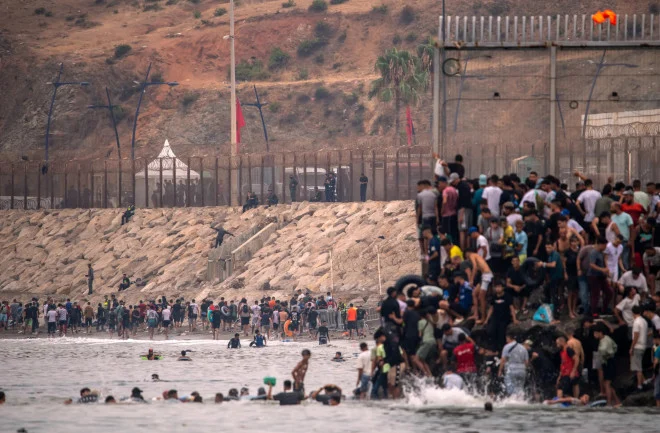
Ceuta was plunged into an unprecedented border emergency after roughly 60,000 migrants entered the Spanish territory from Morocco in just 24 hours — a figure equal to about 70% of the city’s usual population, according to its president.
At least 34 migrants died during the crossings.
“The situation that Ceuta is going through is absolutely unsustainable,” Juan Jesús Vivas said Friday.
The crisis erupted Thursday and spilled into Friday, as security forces confronted migrants on the Moroccan side of the frontier.
Visiting Ceuta on Friday, Spanish Prime Minister Pedro Sánchez denounced the breach as “a violation of Spain’s territorial integrity.”
Sánchez blamed human smugglers, saying they “deceive so many young people, and ultimately lead many of them to their deaths — whether in the ocean or, as in this case, at Spain’s border in the autonomous city of Ceuta.”
Live images from the border showed Moroccan forces using tear gas to disperse hundreds of migrants gathered on a hill above Ceuta. Others were still swimming toward the Spanish territory.
Meanwhile, large groups walked in the opposite direction, leaving Ceuta and heading back toward Morocco to return home.
Rachid Sbihi, head of a local workers association representing Civil Guard officers, described a “serious humanitarian crisis.” Thousands of migrants, including children traveling alone, were sleeping in parks and on sidewalks, he said, while others wandered through the streets without direction.
“People are still entering. The reinforcements, including Spanish military troops, that have arrived are only helping the injured and other humanitarian efforts,” he said. “It’s chaotic.”
Deaths amid the border turmoil
Of the 18 people who died, many drowned, Sbihi said. Others were killed in a stampede as crowds tried to cross the breakwater fence at Tarajal beach, an urban shoreline near a Moroccan border checkpoint.
Ahmed Karim, a 33-year-old Moroccan, said a shortage of work in his country drove him to cross into Ceuta.
“Many people want to go to Europe, America, but they don’t have the opportunity,” Karim said.
By Friday morning, buoys, shoes and other abandoned possessions were scattered across the water near the border fence.
Moroccan police sent additional officers to the area, deployed water cannons and fired warning shots into the air in an effort to stop further crossings, rights groups in Morocco said.
“Despite the heavy police presence, people crossed through the waterway, while the land border remained closed,” said Achraf Maimouni, a human rights activist in Fnideq, the Moroccan city next to Ceuta.
Those detained near the border were transported deeper into Morocco and away from Ceuta, he said, “but people are still coming.”
Morocco’s ambassador to Spain said she hoped those who entered the Spanish exclave from Morocco would go back. Karima Benyaich called conditions in Ceuta difficult and said the events had occurred against Morocco’s wishes.
“We have always prioritized legal, orderly and safe migration for all,” she said. Benyaich offered no explanation for what had prompted the mass crossing.
Authorities in Ceuta and Madrid, however, connected the surge to a recent Spanish Supreme Court ruling that migrants arriving by sea could not be immediately deported, unlike people who enter over land or scale the border fence.
Sánchez said smugglers had misunderstood the judgment, though he acknowledged the ruling may have contributed to the disorder.
“It appears that this interpretation of the Supreme Court’s ruling spread like wildfire over the past few hours through the networks of human trafficking organizations, triggering the kind of mass surge we witnessed yesterday,” Sánchez said.
Spain is one of Europe’s principal arrival points for migrants pursuing greater economic opportunity or fleeing violence in their countries of origin.
Ceuta sits on the North African coast. Migrants trying to reach it frequently swim about 3 miles (5 kilometers) from the Moroccan town of Fnideq to Spanish territory. Some depart instead from nearby Belyounech, where the crossing is shorter.
Spanish prime minister faces criticism at home and overseas
Sánchez has resisted the increasingly hard-line approach to migration seen elsewhere in Europe and in the U.S. As the Trump administration and several European governments tightened border controls and increased deportations, Spain moved earlier this year to provide residency and work permits to hundreds of thousands of migrants already living in the country without authorization.
The Socialist prime minister said the measure would benefit both the economy and the demographics of an aging Spain. It excluded migrants who entered irregularly after January 1, 2026.
Critics seized on the unrelenting images of young Moroccans arriving in Ceuta, arguing that Sánchez’s policy had encouraged more people to attempt to enter Spain.
“Sánchez allows Spain to be invaded through Ceuta,” Spanish conservative politician Isabel Díaz Ayuso wrote on X.
On Friday, Sánchez rejected any link between the migrant legalization initiative and the crisis unfolding in Ceuta.
The upheaval also reverberated beyond Spain. Italian Premier Giorgia Meloni threatened to suspend Italy’s participation in the open-border Schengen agreement with Spain “to defend our borders and ensure the safety of our citizens.” Italy does not share a border with Spain and is itself a major destination for tens of thousands of migrants crossing the Mediterranean from North Africa each year.
French Interior Minister Laurent Nunez also announced tighter checks along France’s border with Spain, saying on X that he had activated the Rapid Intervention Border Force.
“This crisis in Ceuta has nothing to do with the regularization of migrants adopted by the Government of Spain, as is being falsely claimed by some,” the Spanish government said in a statement late Thursday following Meloni’s announcement. Madrid also summoned Italy’s ambassador.
“This crisis stems from an interpretation of a Supreme Court’s decision, according to which people who swim illegally across the border cannot be returned,” the government said. It added that smugglers had exploited the decision to prey on vulnerable migrants.
Some Moroccan activists questioned that account, saying most migrants were unlikely to have known about such court rulings.
Crossing attempts spread to Spain’s other exclave
Moroccan migrants also tried to enter Melilla, Spain’s second territory on the northern edge of Africa.
Widespread disorder broke out in Bni Nsar, the Moroccan town bordering Melilla, where migrants hurled rocks at police and set police vehicles on fire, according to local news outlets and rights organizations. Those sources reported injuries among security officers and said dozens of would-be crossers were arrested.
Omar Naji, from the local branch of the Moroccan Association of Human Rights, told the AP that the attempts to enter Melilla appeared connected to the unfolding events in Ceuta.
Melilla, like Ceuta, is a Spanish autonomous city on the North African coastline. Many Moroccans regard both territories as occupied land.
Ceuta officials had warned of an approaching emergency
Earlier this week, Juan Jesús Vivas, who leads Ceuta’s regional government, warned that reception facilities were already over capacity as sea arrivals steadily climbed in the run-up to Thursday’s turmoil.
Spain’s Interior Ministry declined to verify how many migrants had reached Ceuta, saying its next migration report would be released Monday.
Spanish news organizations, citing unidentified government and security officials, put the number of arrivals over the previous 24 hours at between 30,000 and 49,000. A member of Spain’s Civil Guard, speaking anonymously because he was not authorized to provide figures to the media, said an estimated 49,000 people had crossed. That total represents more than half of Ceuta’s population of nearly 84,000.
Sbihi, from the Civil Guard workers association, said precise figures were hard to establish but estimated that tens of thousands of migrants had entered.
Ceuta has remained a Spanish possession since 1580. Its diverse population — Christians and Muslims, Spanish and Moroccan residents, and day workers — generally coexists in relative harmony.