
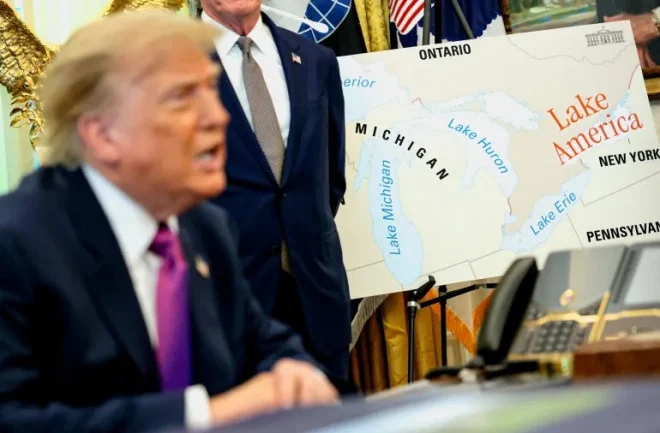
US President Donald Trump gestures beside a map labeling the body of water as “Lake America” during an Oval Office event to sign an executive order renaming Lake Ontario, at the White House in Washington, DC, on August 27, 2026 [Evan Vucci/Reuters]
Donald Trump’s campaign to redraw the map has reached the Canadian border, with the US president taking aim at one of North America’s Great Lakes.
- Advertisement -
As trade relations between Washington and Ottawa deteriorate, Trump has declared that the body of water shared by the United States and Canada should be renamed.
We examine what Trump ordered, whether he has the authority to change the lake’s name and whether governments, mapmakers and the wider world will accept “Lake America”.
What has Trump done?
At a Thursday news conference in the White House Oval Office, Trump signed an executive order directing that Lake Ontario be renamed Lake America.
The lake lies on the boundary between Canada’s province of Ontario and the US state of New York.
“Lake Ontario” is widely understood to come from the Wendat language of the Huron Indigenous people. The word “oniatarí:io” is thought to refer to a “lake of shining waters”, a “great lake” or a “beautiful lake”.
“The name Ontario is witness to a native presence that existed before the establishment of the United States and Canada, and which is crucial for expressing the historical depth of North America to students and wider communities,” Derek Alderman, the chancellor’s professor of geography at the University of Tennessee, told Al Jazeera.
“Trump’s executive order similarly is an attempt at erasing Indigenous culture from the map, exerting not just an ‘America-first’ ideology across the continent but a decidedly neocolonial geographic imagination in which the map and its names become tools for narrowing whose histories and contributions matter.”
The lake also gave its name to the Canadian province of Ontario, established in 1867.
Its name has endured previous efforts at replacement. French authorities attempted to rename the lake during the 17th and 18th centuries, while 17th-century maps used “Lac Ontario” in place of earlier names honouring French officials or saints.
Why has Trump done this?
Trump said the renaming would take effect “immediately” and connected the move to his dispute with Ottawa, accusing Canada of “ripping us off for a long time”.
“Well, they haven’t treated us well. The Canadian officials have treated us very badly. They’re nasty people,” Trump said.
“So the lake change – the Lake of America – was something I’ve been thinking about for a long time, actually.”
But the executive order itself gives the secretary of the interior 30 days to pursue the change in consultation with the Board on Geographic Names. The interior secretary is Doug Burgum, although the order does not identify him by name.
Relations between the US and Canada have been tense since Trump’s first presidency, which ran from 2017 to 2021. The two countries are now in another tariff confrontation after trade negotiations broke down.
Trump last week announced 50 percent tariffs on nearly $20bn in Canadian goods. Canadian Prime Minister Mark Carney has responded by promising “dollar-for-dollar” tariffs on US products beginning September 8.
“I don’t anticipate that the Lake Ontario name change will do anything to assist [in] the trade war with Canada,” Alderman said.
“I believe the name change, because of the way it is being carried out in such an abrupt, unilateral and vitriolic way by the president, could likely damage the United States’s ability to negotiate, given how much the Lake America mandate is inflaming opinions and defensive posture anxieties in Canada.”
How has Canada reacted?
Canadian Prime Minister Carney rejected the order and defended the lake’s established name.
“The name is more than 400 years old, predating both the Confederation of Canada and the Declaration of Independence of the United States of America,” Carney wrote in an X post on Thursday.
“Canadians also know that naming reality means calling it Lake Ontario – then, now and always.”
Ontario Premier Doug Ford also posted on X: “It’s Lake Ontario to Canadians and the rest of the world. Now and forever.”
Tim Houston, premier of the eastern maritime province of Nova Scotia, wrote: “We’re into some real foolishness now. It’s Lake Ontario, buddy.”
Is there opposition to this in the US?
Trump may be able to use “Lake America” for federal purposes in the US, but the proposal is facing resistance inside the country as well.
New York Governor Kathy Hochul, a Democrat, said she would not adopt the president’s preferred name. “New York won’t be calling it that,” Hochul wrote on X in response to the White House announcement.
Alderman said the order does not control how US private organisations, including companies, nonprofits and news outlets, refer to the lake.
“Research has long shown that there can be a disconnect between a new naming being carried out officially by leaders and the ordinary people and their communities using and retaining the older name. That possible dissonance or disconnect can, at the end of the day, shape and in fact lessen the power of a federal mandate,” he added.
Can Trump really change the name of a lake?
He can change the name used by the US government, but he cannot compel everyone else to adopt it.
No single international authority has the power to decide what every country must call a body of water shared across borders.
There are also no universal international laws prescribing one official name for a shared maritime area or a disputed territory.
The International Hydrographic Bureau, or IHB, does standardise names while overseeing the surveying and charting of the world’s seas, oceans and other navigable waters.
The United Nations Group of Experts on Geographical Names, known as UNGEGN, issues guidance on geographical nomenclature and helps standardise names, but it has no enforcement power.
Within the US, geographic names fall under the authority of the US Board on Geographic Names. Its website says the board “discourages name changes unless there is a compelling reason”.
The board reports to the secretary of the interior and therefore operates under the administration in power.
“While it is not perfect, it at least establishes an institutional procedure for review, consultation, evidence gathering, and consideration of competing claims before a geographic name is changed,” Alderman said.
In practical terms, no international institution can stop Trump from changing the name used by US agencies. Equally, no such body can require Canada or other countries to use the new designation.
“What we see at this moment, and with [Trump’s] previous renaming of the Gulf of Mexico, is a unilateral naming by decree or angry whim with seemingly no public discussion or real government consideration of impacts and consequences. The cost at stake with this renaming Lake Ontario is the loss of yet another democratic process in the United States,” Alderman added.
Canada has already made clear that its official usage will remain unchanged.
“He can do what he wants within legal limits. That said, this will be challenged and because it is a transnational water body, no other jurisdiction needs to abide. Ontario and Canada certainly will not,” Gail Krantzberg, a professor at Canada’s McMaster University, told Al Jazeera.
“Federal agencies will need to change their maps. Canadians reject the name, remember that Ontario – derived from the Wendat word Ontari’io – spans centuries and remains unchanged in Canada and international usage,” added Krantzberg, whose expertise includes public policy, the Great Lakes and water resource management and governance.
Have other countries fallen out over the names of bodies of water?Diplomatic tensions between neighbouring countries have led to long-running naming disputes over maritime areas.
Japan and South Korea have spent decades disagreeing over the sea between them. Japan calls it the Sea of Japan, while South Korea insists on the name East Sea.
The South China Sea is similarly contested. The Philippines says parts of the waters should be called the West Philippine Sea, while Vietnam uses the name East Sea.
Iran refers to the Persian Gulf, a name Arab countries commonly replace with Arabian Gulf.
Has Trump renamed other places?
Yes. In January last year, Trump signed an executive order seeking to restore the name Mount McKinley to Alaska’s highest peak. The mountain had been called Mount McKinley after former Republican US President William McKinley, who served from 1897 to 1901.
The peak was first given the name Mount McKinley in 1896, although Indigenous Alaskans had long called it Mount Denali, meaning the “high one”. Alaska officially adopted Denali in 1975 and pressed the federal government to follow suit. Former Democratic President Barack Obama changed the federal name from McKinley to Denali in 2015.
Trump also signed an executive order in January last year directing that the Gulf of Mexico be called the Gulf of America. The move angered Mexican President Claudia Sheinbaum.
The Gulf of Mexico is bordered by Cuba, Mexico’s eastern states and US states along the Gulf Coast.
The waterway has carried the name Gulf of Mexico for about 400 years. English geographer Richard Hakluyt referred to it as “Gulfe of Mexico” in his 1589 book, The Principall Navigations, Voiages and Discoveries of the English Nation. In Mexico, it is also known by the Spanish name El Golfo de Mexico.
Will international bodies and mapping agencies follow Trump’s orders?Just as foreign governments do not have to accept Trump’s preferred terminology, international organisations are not obligated to follow it.
The United Nations, for instance, continues to use established names for disputed bodies of water, including the Gulf of Mexico.
Google Maps handles some contested place names differently according to the location of the user.
In January, Google said its mapping service would display Gulf of America instead of Gulf of Mexico and Mount McKinley instead of Mount Denali for users in the US. Elsewhere, the gulf would appear as “Gulf of Mexico (Gulf of America)”.
“When official names vary between countries, Maps users see their official local name. Everyone in the rest of the world sees both names. That applies here too,” Google said in an X post at the time.
The company uses the same approach for other locations whose names are disputed.
Japan’s map users see the Sea of Japan for the waters between Japan and the Korean Peninsula. Users in both North and South Korea see East Sea.
Outside those countries, Google Maps identifies the waterway as “Sea of Japan (East Sea)”.
“As a university educator, I worry about what broader educational and psychological deficits will be passed down to American classrooms required to use Lake America (as well as Gulf of America),” Alderman said.
“Those classrooms run the risk of communicating a myopic sense of place that diminishes Indigenous histories and the United States’s deep connections with Canada, Mexico, the Caribbean, Central and South America. The cost of the executive order is not simply an old name, but fuller awareness of the globe.”