
With Somalia’s political crisis threatening to widen, mediators are working to bring the government and opposition toward agreement on elections that are both fair and genuinely competitive.
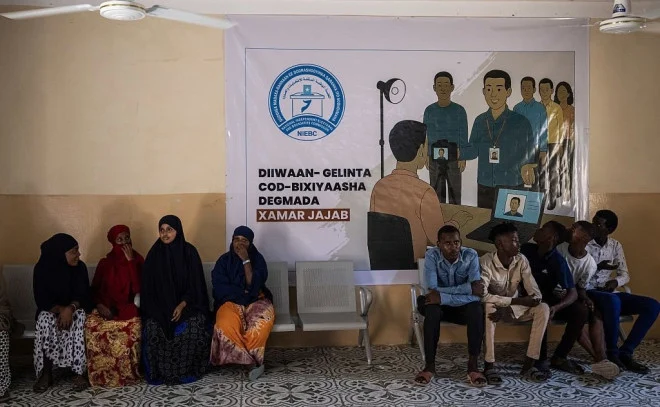
People wait to register to vote at a registration center in front of a National Independent Electoral Boundaries Commission poster, Mogadishu, Somalia, April 23, 2025. (Getty Images Photo)
- Advertisement -
The crisis intensified in May 2026 after the government unilaterally extended its expired mandate. The opposition rejected the move and urged supporters to protest. By June, the political standoff had turned violent, with clashes in Mogadishu on June 3-4 prompting international intervention. Türkiye took the lead in efforts to halt the fighting and later joined a four-member mediation team comprising the United States, the United Kingdom, the European Union and the United Nations.
The mediation process initially involved the U.S. Charge d’Affaires and the British Ambassador before the EU and the U.N. joined the effort. Together with Türkiye, this group has considerable influence over Somalia’s political affairs. International donors, working through the World Bank and the International Monetary Fund (IMF), finance more than 60% of the country’s budget.
Somali groups have acknowledged Türkiye’s ambition to strengthen bilateral ties. Ankara has invested in security, oil exploration, the blue economy and a spaceport. It has also hosted talks between Somalia and North Western State of Somalia and helped settle the maritime access dispute between Somalia and Ethiopia through the Ankara Declaration.
As a result, most of Somalia’s competing political groups have met with Ankara’s mediation team. Many actors see a convergence of interests between the two countries. Yet Türkiye’s extensive investments and interests have also led Somali leaders to insist that Ankara act as a neutral mediator and help secure a fair, competitive process for a peaceful political transition. They have urged Türkiye to engage more broadly with Somalia’s political forces and ensure that its role is viewed as constructive and impartial. In a letter to President Recep Tayyip Erdoğan, political leaders identified three priorities: neutrality, wider engagement and support for constructive political dialogue.
Key points of dispute
Although the Quartet and Türkiye have been mediating between the rival camps, the parties remain divided over several fundamental issues: how to define the transition, which electoral system to adopt, the size of electoral constituencies, the role of political parties, the structure of the election commission and responsibility for election security.
The government calls its proposed model “one person, one vote” (1P1V). It supports a party-based system featuring open-list proportional representation, one nationwide constituency, an unspecified proportional formula for converting votes into seats and a unified election commission appointed by the government. Villa Somalia also maintains that it should oversee election security.
The opposition refers to its preferred system as a “direct election.” It proposes a candidate-based, single-member plurality model, with 275 constituencies reflecting clan power-sharing and each seat contested separately. It favors a first-past-the-post formula, a two-tier election commission and a special agreement on election security. It also seeks a separate arrangement for the 57 legislators representing Northern Dir clans.
Despite these disagreements, the government and opposition share an important point of agreement: parliamentary seats will remain reserved for the sub-clans that have historically held them. The House of the People has 275 seats, while the Senate has 54. That understanding on clan power-sharing helps clarify the debate over the other disputed issues.
Under those conditions, the government’s proposal for a single national constituency has little practical meaning because each seat is already assigned to a particular clan community. Its proposal to apply proportional representation within a single-member political district is also internally inconsistent. In such districts, the first-past-the-post system applies, with the candidate receiving the most votes taking the seat.
Political parties also face practical limitations. Clan-based power-sharing remains central to Somalia’s political system, the government lacks complete control across the country and no population census exists. Against that backdrop, the government’s plan to use a formula to convert votes into seats, while selecting representatives on behalf of clans, could undermine confidence in the fairness and credibility of the election.
Because parliamentary seats are already reserved for specific clans, voters should instead be able to choose directly among individual candidates from the community that has historically occupied each seat. Such a system would provide a clearer measure of accountability.
The two sides are similarly divided over the election commission. The government wants a single national body, while the opposition favors a two-tier commission operating at both national and state levels. With limited time remaining, one inclusive commission could be the more efficient option, provided all sides agree to it and it includes representatives of the government, opposition and civil society. The states, which are aligned either with the government or the opposition, would consequently be represented.
State-level elections present another obstacle. The government has already appointed the administrations of South-West and Galmudug and is expected to do the same in Hir-Shabelle. The structural problems in those three states cannot realistically be settled before the deadline. For now, the opposition should concentrate on the national elections.
Not to repeat civil war
Before the process moves forward, the Quartet and Türkiye should recall how Somalia’s state was driven into crisis. Competition over power and resources lies at the heart of the country’s civil war. In 1969, the military seized power, suspended the constitution and banned political parties. Opposition groups responded by crossing into Ethiopia to fight the government, a chain of events that ultimately led to civil war and the collapse of the state.
There are troubling parallels in today’s political process. Mediators addressing the 2026 transition must therefore weigh the consequences of decisions that could deepen the confrontation and remember the human and institutional costs of Somalia’s past conflict.
The Quartet and Türkiye possess substantial leverage over Somalia’s rival political camps. Ankara, in particular, is well placed to help because it maintains relationships with both the government and the opposition. The mediators should use that influence to press both sides to negotiate in good faith. They must also promote a fair, competitive process conducted on a level playing field—one that preserves the central political settlement of clan power-sharing and gives the eventual outcome legitimacy.
________________________
About the authorAuthor, research professor at the University of Mogadishu