
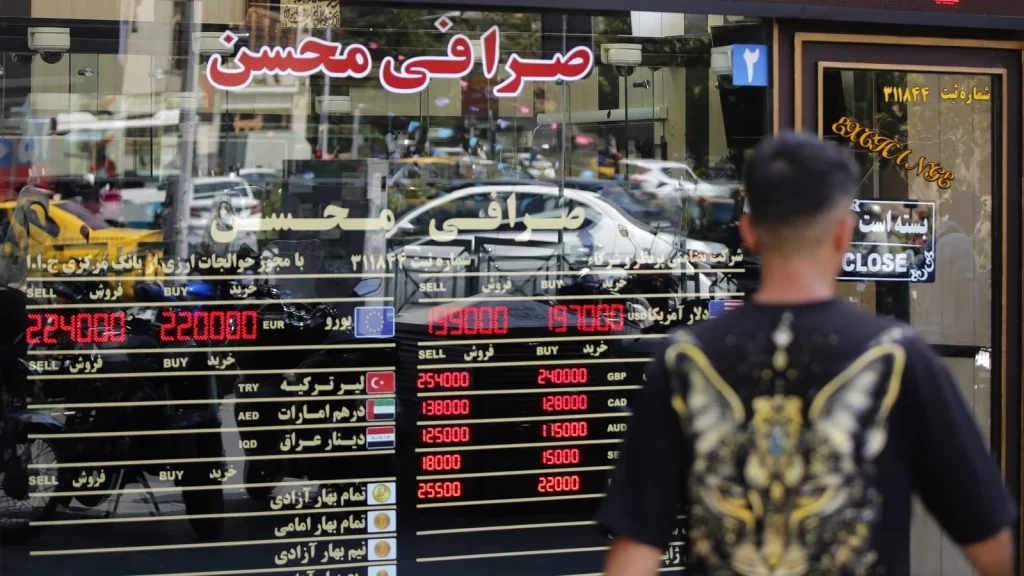
Iran has vowed to answer an expanded US sanctions campaign that Washington says is aimed at cutting off the country’s economic lifeline.
Tehran, however, says it expects key trading partners to withstand the pressure and continue doing business with Iran.
- Advertisement -
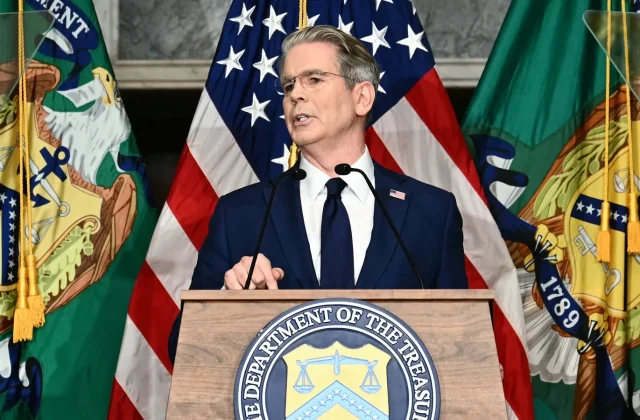
US Treasury Secretary Scott Bessent announced the measures yesterday, stopping short of the harshest penalties but warning that countries still trading with Iran could ultimately lose access to the dollar-based financial system.
“Around the globe, our objective is to sever every economic lifeline that sustains this tyrannical regime until Tehran stands alone,” Mr Bessent told a press conference.
US Treasury Secretary Scott Bessent speaking at a press conference in Washington, DC
The Treasury Department imposed sanctions on 60 individuals, entities and vessels. The targets did not include Chinese financial institutions suspected of helping facilitate Iran’s oil trade.
Asked whether Chinese banks conducting business with Iran could be sanctioned, Mr Bessent said “no one is above the reach of US sanctions”.
Iran had warned before the announcement that it could respond militarily and further reduce oil exports from the Gulf if Washington introduced new economic measures.
Following the announcement, Iranian Economy Minister Ali Madanizadeh said, “we are fully prepared for the US sanctions”.
“Naturally, the enemies intend to launch an economic terrorist attack on us, but we also have our own tools and know-how to play the game. Our defence is no longer so defensive, the enemies should wait for an attack,” Mr Madanizadeh added.
He said neither China nor Russia had “accepted” the US measures and forecast that other countries would also oppose them.
China has been the largest buyer of Iranian oil for several years
Brigadier General Hossein Mohebbi, a spokesperson for Iran’s Islamic Revolutionary Guard Corps, threatened to strike key US interests and energy chokepoints if Iran’s infrastructure came under attack, according to local news reports.
Neither side has carried out major strikes in weeks, but the war has shown little indication of moving towards a diplomatic settlement.
As the conflict continues, the US is exploring new ways to halt Iranian attacks on ships in the Gulf and, more recently through its allies, in the Red Sea.
Chinese oil trade
Oil prices nevertheless dropped by more than $2 (€1.71) per barrel yesterday, even as investors prepared for the possibility of further supply disruptions across the Middle East.
Asked why he had avoided imposing penalties on Iran and refused to name the countries that could eventually be targeted, Mr Bessent said, “why would I want to blow up the global financial system”?
He said the intention was to give governments and companies time to cut their links with Iran.
US President Donald Trump pictured with China’s President Xi Jinping in Beijing on 14 May
Mr Bessent had previously called for cooperation from China, which has been the largest buyer of Iranian oil for several years. But the US blockade of Iran’s ports, reintroduced in mid-July, has already reduced the flow of Iranian oil to China.
China’s Foreign Ministry said sanctions and pressure campaigns were ineffective, adding that Beijing would take whatever steps were needed to safeguard its interests.
The statements came before expected talks next month between President Donald Trump and Chinese President Xi Jinping.