
US President Donald Trump has denied that Washington and Tehran are holding or planning talks, while posting a map that labeled the Strait of Hormuz as “NEW US Territory” in another pointed message aimed at Iran.
The waterway was effectively closed by Tehran after war erupted between the US and Iran on 28 February. In peacetime, the strait carries about one fifth of the world’s oil and LNG supplies.
- Advertisement -
As the conflict approaches its six-month mark with no clear path to an end, Mr Trump has repeatedly threatened to claim sovereignty over the strategically vital passage.
His envoy and son-in-law, Jared Kushner, said yesterday that the two countries were engaged in “very positive and active conversations”. Mr Trump, however, rejected that characterization.
“The Hormuz Strait is open and operating. All water mines have been removed or detonated,” he added.
US sources described recent exchanges with Iran as “positive”, but said Mr Trump had chosen to pause and instructed his team not to resume engagement until Tehran was prepared to reach an agreement.
Mr Trump later shared a Truth Social map portraying the Strait of Hormuz as “NEW US Territory”.
He first floated the possibility of a US takeover on Friday, saying in a light-hearted tone that he would soon declare the strait American territory. Iran responded that the waterway “will remain Iranian”.
Mr Trump returned to the proposal yesterday during remarks to reporters in the Oval Office, where he suggested that taking control of the strait would be a worthwhile step.
Iran and Oman deal on Hormuz now a priority, Qatar says
Qatar, which has played a central role in efforts to mediate the stalled peace process, said it was seeking an agreement between Iran and Oman over the Strait of Hormuz. Doha said such a deal could help restart negotiations aimed at ending the wider Middle East war.
Iran’s top negotiator, Mohammad Baqer Qalibaf, said in remarks carried by state media that the strait would remain closed until the US fulfilled the terms of an interim agreement signed with Iran in June.
Those demands include an end to the US blockade of Iranian ports, the removal of oil sanctions, the release of Tehran’s frozen assets and a halt to threats and military operations on all fronts, Mr Qalibaf told parliament.
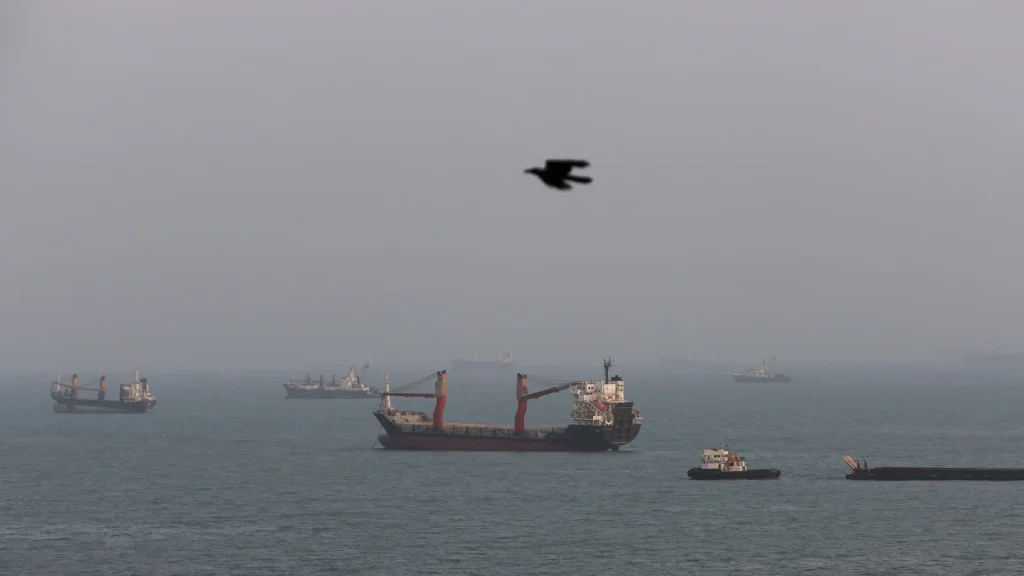
Two youths look at ships anchored in the Strait of Hormuz off the coast of Bandar Abbas, Iran
After the June ceasefire agreement, some vessels attempted to navigate through waters closer to Oman, seeking to avoid Iran and its demand for toll payments.
Tehran and Muscat have spent weeks discussing how shipping should operate through the waterway. Iran recently said that the two countries had agreed on the geographical coordinates of the route intended for all maritime traffic.
“We are also awaiting an agreement between the Sultanate of Oman and Iran regarding the Strait, which would enable us to return to the framework of negotiations,” Qatari foreign ministry spokesman Majed Al Ansari told reporters.
“The agreement over the Strait of Hormuz would make it much easier for us to resume the talks between the United States and Iran,” he added.
A memorandum of understanding reached by the US and Iran in June fell apart over the question of who would manage the strait.
Iran has demanded that ships obtain permission and pay transit service fees before passing through the waterway, a policy opposed by the US and several countries in the region. Vessels that attempt to cross without permission have been targeted by Tehran.
Mr Trump has threatened to bomb Oman if it “gets in the way” of an agreement with Iran over the strait. He has also demanded that Tehran surrender in a war that has become an increasingly difficult political issue at home and has left him facing mounting pressure.
We need your consent to load this rte-player contentWe use rte-player to manage extra content and collect data about your activity. Please review their details and accept them to load the content.Manage Preferences
UAE says Iran launched two missiles at it
Meanwhile, the UAE’s defence ministry said it had detected two ballistic missiles launched from Iran towards the Gulf state.
According to the ministry, one missile fell inside UAE territorial waters and the other landed outside them. It said the country remained prepared to respond to any threat.
Iran has not immediately commented on the claim.
Earlier, residents received a brief phone alert warning of “potential missile threats”. The defence ministry said it had detected missiles “directed towards the country” for the first time in several months.
“Due to the current situation, potential missile threats, immediately seek a safe place in the closest secure building,” the interior ministry said in the alert, which was withdrawn shortly afterwards.
It was the first warning of its kind since a false alarm in June and a July alert over an attack that ultimately did not enter UAE territory. The previous missile warning had been issued in early May.
The Emirati defence ministry said it had “detected a missile threat directed towards the country”.
Tankers operated by state-owned oil company ADNOC have also come under repeated attack in recent weeks.
When the Middle East war began on 28 February, the UAE was hit harder by Iranian attacks than any other country in the region, with almost 3,000 missiles and drones directed at its territory.
After a June memorandum of understanding between the two sides took effect — an arrangement that has since collapsed — the UAE reported no further attacks, even as other Gulf states continued to come under fire.
‘Fully offensive’ military posture – Iran
Earlier, a senior Iranian official said Tehran would adopt a “fully offensive” military posture after efforts to negotiate a permanent end to the conflict with the US stalled.
“Iranian entities must be prepared to escalate tensions in the Strait of Hormuz and wider region, as Iran will be ready to make decisions and take action on difficult decisions,” the official said. Tehran would launch a “timely and precise” military attack to break the US naval blockade if diplomatic efforts failed, he added.
A car with replicas of missiles and an image of Iran’s new Supreme Leader Mojtaba Khamenei (R)
Back channel to IRGC
Amid the deteriorating situation, media reports pointed to a possible diplomatic opening: Mr Trump had established back-channel contacts with the Islamic Revolutionary Guard Corps, which has expanded its influence during the war and controls significant parts of Iran’s military and economy.
Axios, citing two people with direct knowledge of the discussions, reported that former Director of National Intelligence Tulsi Gabbard spoke with an Iraqi Kurdish leader who has close links to the IRGC. Through that intermediary, the US reportedly sent a message to IRGC commander General Ahmad Vahidi.
Fox News subsequently reported that Mr Trump confirmed the account in a telephone interview.
Axios said the Trump administration had questioned whether Iranian negotiators involved in formal talks genuinely represented the IRGC. The report came as Reuters described Gen Vahidi as an increasingly pivotal figure.
Gen Vahidi said he was aligned with Iran’s negotiators, according to Axios.
“I can’t go into the details of it, but I will say that the conversations between the US government and different areas of the Iranian government at all areas is probably more robust than it’s maybe ever been,” Jared Kushner, Trump’s son-in-law and special envoy, told Fox News Channel’s Chief Foreign Correspondent Trey Yingst in a separate interview yesterday.
Latest Middle East stories