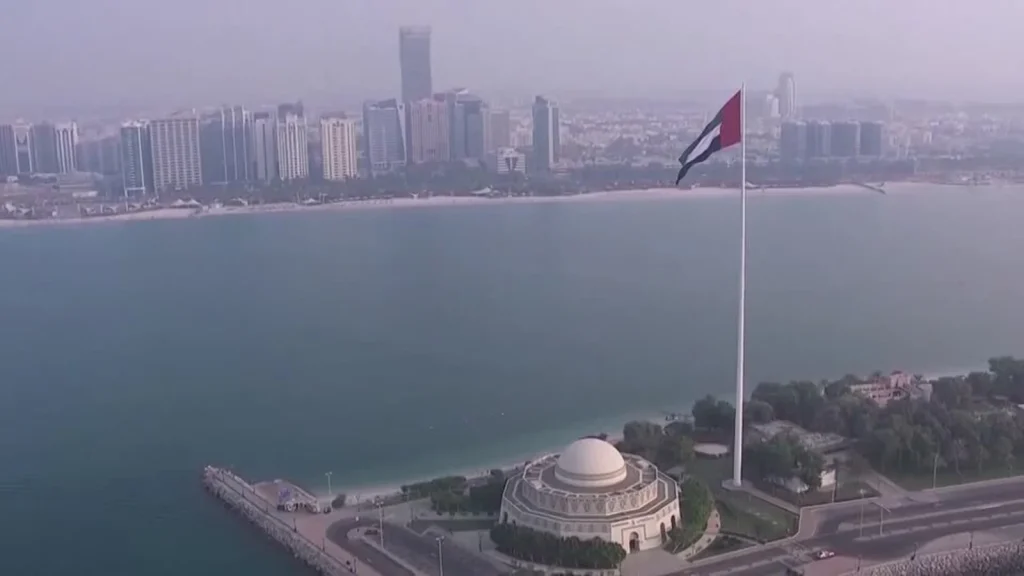
The United Arab Emirates’ defence ministry says it detected two ballistic missiles launched from Iran, marking the first reported incident of its kind since a strike hit Fujairah port on 4 May.
Based on its assessment, the ministry said the missiles were aimed at “maritime traffic”.
- Advertisement -
Both projectiles fell into the sea, according to the statement.
Iranian foreign ministry spokesperson Esmaeil Baghaei dismissed the UAE’s account as “baseless”.
The launch came after a 60-day period for US-Iranian peace talks ended on Monday without a breakthrough, intensifying fears that the conflict could escalate again. The fighting has disrupted shipping through the Strait of Hormuz since February.
Iranian spokesperson Esmaeil Baghaei described the UAE’s statement as ‘baseless’
“The defence ministry affirms its full readiness to deal with any threats and firmly confront anything that aims to destabilise the state’s security,” it said.
The UAE’s interior ministry sent residents a phone alert yesterday saying the situation was safe and urging them to return to normal activities. The message followed an earlier warning about a possible missile threat.
The UAE has recently accused Iran of attacking vessels operated by its state-owned ADNOC while they were travelling through the Strait of Hormuz.
Iran has not claimed responsibility for those attacks.
Iran’s Revolutionary Guards have previously warned that they could act against ships using the strait if the vessels are connected to Tehran’s adversaries or disregard Iranian instructions.
Shipping slows through Strait of Hormuz
Commercial traffic through the Strait of Hormuz slowed today, according to data, as most ship owners continued to avoid the strategic waterway amid uncertainty over when a blockade imposed during the Iran war might be lifted.
Kpler data showed that six commodity vessels passed through the strait yesterday, down from nine the previous day and below the 10-day average of 11 crossings.
Vessels entering the waterway included an empty very large crude carrier that travelled along the Omani side of the strait, together with two tankers—one medium-range vessel and one intermediate vessel.
Two medium-range fuel tankers and a post-Panamax vessel were recorded leaving the strait.
Just six ships passed through the Strait of Hormuz yesterday
US President Donald Trump said yesterday that no talks were under way with Iran and maintained that the Strait of Hormuz was open, contradicting Iran’s claim that the passage remained closed to shipping.
Before the war, the waterway carried one-fifth of global crude oil and liquefied natural gas shipments.
Security concerns have also reduced oil deliveries to the world’s largest importer. Two Chinese shipping giants that transported half of China’s Middle Eastern oil imports before the war have kept their tankers away from both the Strait of Hormuz and Bab el-Mandeb since late July, according to tanker tracker Vortexa and a ship broker.
At Bab el-Mandeb in the Red Sea, where Yemen’s Houthi movement announced a naval blockade of Saudi Arabia on July 20, Kpler data recorded 30 weekend crossings by commodity vessels, up from 19 the previous week.
No Saudi oil shipments were tracked.
Iran still open to talks
Iran remains willing to engage in dialogue with the US but does not equate negotiations with surrender, Mohammad Mokhber, an adviser to Iran’s supreme leader, said yesterday, according to the semi-official Fars news agency.
Mr Mokhber said military pressure and sanctions would not weaken Iran’s resolve. He said the country would defend its security, dignity and allies while insisting that it was not seeking war.
Although Iran’s leadership has sought to project resilience during the conflict, three Iranian officials said its leaders were concerned that further economic punishment could deepen hardship, trigger renewed unrest and weaken the Islamic Republic’s legitimacy.
Thousands of people have died in the conflict, most of them in Iran and Lebanon. Iran has attacked US military bases and infrastructure in Oman, Jordan, Kuwait, Israel, the United Arab Emirates and Saudi Arabia.
Benchmark Brent crude futures climbed sharply during the conflict, reaching $126 a barrel—about 75% above pre-war levels. Brent settled 20 cents higher yesterday at just over $91 a barrel.
A US administration official repeated warnings that Washington could intensify efforts to target Iran’s economy after imposing multiple rounds of sanctions.
“There are many levers the president can crank harder in the weeks and months ahead,” the official said.
Latest Middle East stories