
By: Mohamed Mukhtar IbrahimSunday August 2, 2026
With foreign assistance contracting, fiscal pressures intensifying and humanitarian demands rising, Somalia can ill afford to let more than $1 billion in pledged development funds remain unused.
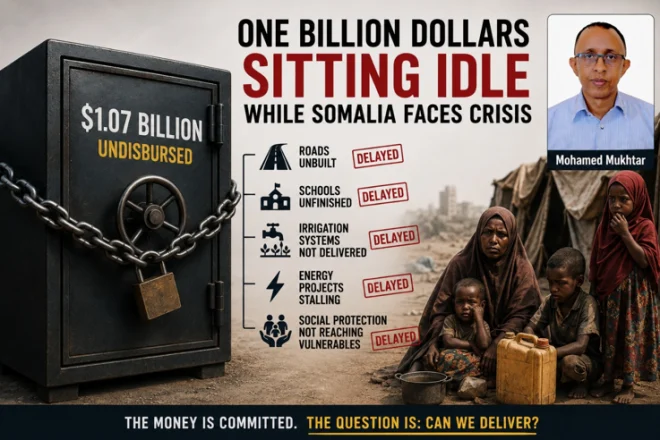
The latest portfolio review puts Somalia’s active World Bank portfolio at approximately $3.07 billion. About $1.07 billion—nearly 35 percent—has yet to be disbursed. Some recently approved projects would naturally require time to move into implementation, but the review indicates that many other programs have faced extended delays despite pressing development needs.
Overall sector performance is sharply uneven. Health leads the portfolio with an 80.2% disbursement rate, followed by social protection and labor at 78.3% and development policy financing at 73.4%, indicating comparatively strong implementation in those areas. Water and resilience has reached 51.4%, agriculture and food systems 48.7%, and public works and infrastructure 37.2%. The weakest results are concentrated in sectors central to long-term economic change: education has disbursed 30.8% of approved funding, energy 24.2%, fisheries 17.4%, and digital technology just 13.9%. The figures point to stronger delivery of social services and safety-net programs than of the infrastructure and productive activities needed to expand the economy, create jobs and support private-sector development.
Why Implementation Continues to Fall Short
Procurement stands out in the review as the biggest obstacle to implementation. The report calls it “the thorniest issue” affecting programs financed by both the World Bank and African Development Bank. It says government officials often have vested interests in contract awards and allegedly seek kickbacks and bribes to steer contracts toward unqualified companies. Such conduct can prolong the procurement process while also damaging the quality of completed projects. The review also points to weak leadership capacity across ministries, departments, agencies and Project Implementation Units (PIUs). In addition, insufficient coordination from the Office of the Prime Minister allows some implementing agencies to operate outside central oversight, making it harder for the government to track progress and address bottlenecks.
Problems continue after contracts are awarded. The review says companies without the technical qualifications or capacity required for the work are frequently selected, resulting in delays, weak performance and cost overruns.
Political divisions add another layer of difficulty. Since many development projects are carried out at the state level, disputes between the Federal Government and the Federal Member States over political authority and intergovernmental relations have left numerous projects stalled or significantly delayed. Procurement failures, governance weaknesses, limited institutional capacity, poor coordination, inadequate contractors and federal-state disputes therefore reinforce one another, producing a broader implementation crisis rather than a series of isolated technical setbacks.
The Fiscal Context Has Fundamentally Changed
For much of the past decade, Somalia depended on a steady expansion of donor support to offset its limited domestic revenue. That fiscal landscape has changed.
Humanitarian assistance is falling as competing global crises draw donor attention and resources. Conflicts in Ukraine, Gaza, Sudan and elsewhere have placed additional demands on international budgets. Development partners are also facing financial pressures at home and seeking stronger evidence that overseas programs are delivering results.
The recent Iran-Israel conflict highlighted Somalia’s economic exposure. Rising global shipping costs disrupted trade, reduced activity at ports including Mogadishu, and put further pressure on customs receipts. Meanwhile, the country’s domestic revenue base remains narrow, restricting the government’s ability to fund development independently.
In these circumstances, every committed development dollar carries greater weight. An undisbursed dollar is not merely funds waiting to be released; it can represent a road left unfinished, a school still incomplete, an irrigation system farmers never receive, an electricity project held back, or a social protection program that fails to reach vulnerable households.
The Cost of Political Fragmentation
Administrative weaknesses do not fully explain the delays. Political fragmentation also plays a role. Projects financed at the national level often require cooperation between the Federal Government and Federal Member States, while political disagreements can hold up procurement, implementation, supervision and the selection of beneficiaries.
Development funding should not become another victim of political rivalry. Whatever constitutional or electoral disputes divide the parties, all political actors have an interest in completing schools and roads, equipping health facilities and strengthening livelihoods. Each month lost to delay affects Somali citizens, not political institutions.
From Resource Mobilization to Resource Utilization
Somalia’s development strategy for years centered on securing external financing. The country has made substantial progress in mobilizing concessional resources from institutions including the World Bank and African Development Bank.
The challenge has now shifted.
The key question is no longer whether Somalia can obtain development finance, but whether it can use those funds efficiently and within schedule. Better implementation does not necessarily depend on securing additional money. It depends on stronger procurement systems, more capable project management, tighter accountability, improved coordination through the Office of the Prime Minister, quicker decisions and closer cooperation between federal and state institutions. These are governance reforms, not financial ones.
A National Development Imperative
Somalia’s development needs remain vast. Millions of people require social protection, while infrastructure shortfalls continue to restrict economic growth. Electricity costs are among the highest in Africa, climate shocks threaten livelihoods and unemployment—especially among young people—remains exceptionally high.
Given these conditions, Somalia cannot afford to leave more than $1 billion in already committed development financing undisbursed.
Each delayed project postpones economic growth.
Each deferred investment diminishes resilience.
Each implementation obstacle leaves the country less prepared for future economic shocks.
In the current fiscal climate, effective implementation is not simply a matter of sound public administration. It is an economic necessity.
_________________________
Mohamed Mukhtar Ibrahim can be reached by email at [email protected]