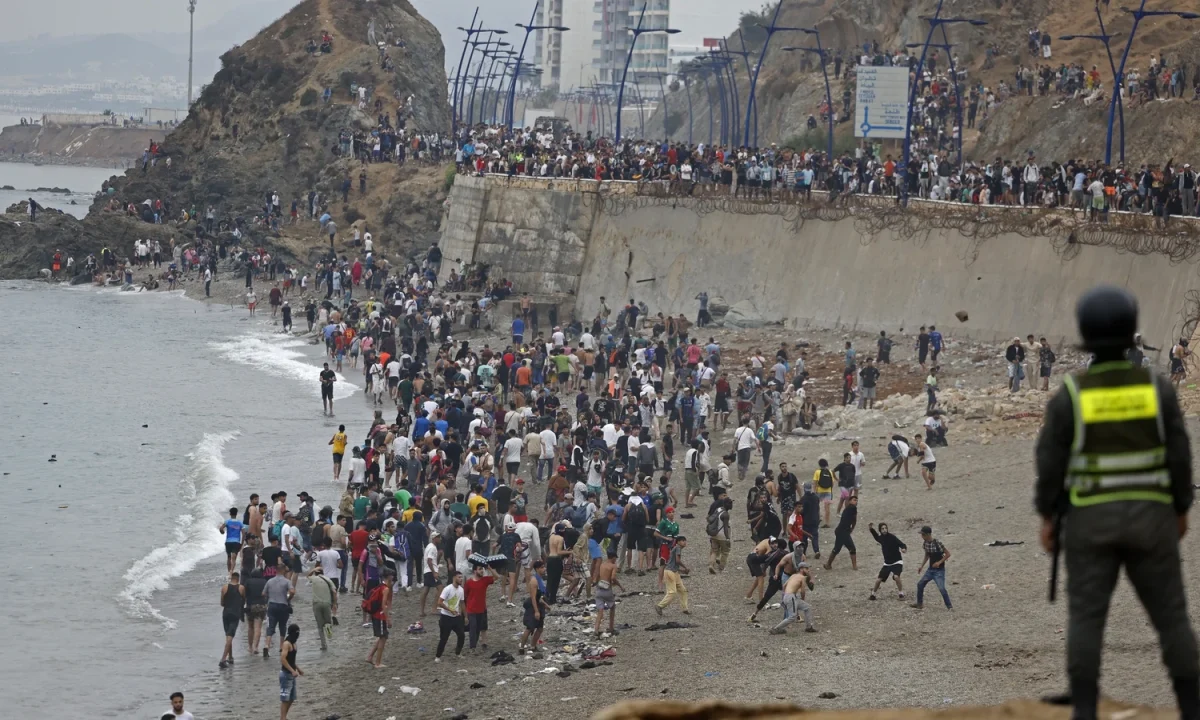
Italy said it would suspend the European Union’s passport-free Schengen arrangements with Spain after a mass influx of migrants into the Spanish territory of Ceuta from neighbouring Morocco.
Although Italy and Spain do not share a land border, the move — which is likely to provoke Madrid — will affect air and sea travel between the countries. Passengers will be required to present passports before entering.
The Schengen Area permits passport-free movement across 29 European countries, but member states may temporarily restore border checks over security or public-order concerns.
Italy’s interior ministry said it had also reached an agreement with France to tighten controls along the Franco-Italian land border, in an effort to stop undocumented migrants from crossing.
Watch: Moment migrants rush into Spain’s Ceuta from Morocco
The decision to suspend the Schengen arrangements followed Spain’s announcement that it had brought the surge under control, with most of the more than 50,000 people who crossed the border returning voluntarily.
Ms Meloni’s coalition, elected in 2022 on a pledge to curb illegal immigration, has come under mounting pressure from a new far-right party headed by former army general Roberto Vannacci. His anti-migrant messaging has found support among some voters.
As migration once again moved to the centre of the political debate, the Italian government sought to project a hard line on border security. Centre-left opponents accused it of responding to populist pressure.
“The problem is that this is a purely demagogic proposal, as usual designed for domestic consumption and to compete with Vannacci, without solving anything at all,” said Piero De Luca, a senior politician with the centre-left Democratic Party.
Ceuta and Melilla, Spanish autonomous cities in northern Morocco, are home to the European Union’s only land borders with Africa. Both regularly see migrants attempt to cross into Europe, but the scale of yesterday’s surge appeared to be without precedent.
Spain’s Interior Ministry said about 50,000 people had crossed since yesterday morning, while estimating that roughly 37,500 had already turned back.
Juan Jesus Vivas, the head of Ceuta’s local government, said the number of people who had crossed over the previous couple of days could be as high as 60,000.
Security forces vehicles lined up in the Spanish territory of Ceuta
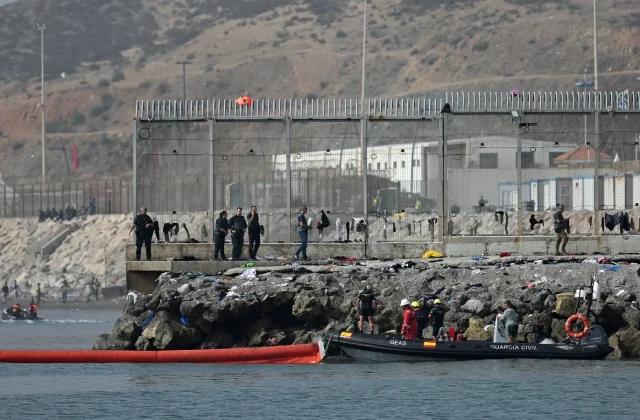
The Spanish government’s representative in Ceuta said 57 bodies had been recovered on the Spanish side of the border, warning that the death toll could rise because of additional casualties in Morocco. Some people drowned, while others were crushed as they tried to climb the breakwater supporting the border fence.
Moroccan forces used batons and tear gas to push back crowds at the gates of Ceuta, attempting to stop further groups from forcing their way into the small Spanish territory, which extends into the Mediterranean from Morocco on a narrow strip of sandy land.
The border crisis exposed divisions across Europe, where leaders from other EU states urged Spain to ensure the episode remained contained.
Right-wing parties across the continent blamed the surge on what they described as Spain’s relatively relaxed migration policies, including an amnesty granted this year to hundreds of thousands of unauthorised migrants.
France said it was strengthening checks along its border with Spain.
People gather along the fence at the site of clashes near Fnideq, on the Morocco-Spain border
US President Donald Trump, a longstanding critic of Spain’s Socialist government, also commented on the situation in Ceuta.
“That’s going to be us in three years if the wrong side gets in,” Fox News cited him as saying, in a reference to the next presidential election.
At the border, Reuters saw Moroccan riot police deploy tear gas against people gathered near the fences. Water cannon trucks were brought in, while the burned-out remains of a bus and seven cars were visible after clashes with the crowds.
Spanish military vehicles stood in formation along parts of the border, while dozens of migrants watched from a hilltop on the Moroccan side, unable to get across.
Several hundred people were seen heading back to Morocco through official crossings and gaps in the fence. Some said they had been unable to find food or shelter in Ceuta.
Spanish Prime Minister Pedro Sanchez travelled to Ceuta today, where protesters greeted him with insults.
He described the mass crossing as “a violation of Spain’s territorial sovereignty” and said the authorities were accelerating the repatriation of those who had entered illegally, with Morocco’s full cooperation.
Moroccan security forces using water canon to disperse the crowds near Fnideq
In a post on X, the Spanish Guardia Civil police association AUGC said there had not been enough officers monitoring the fence during yesterday’s surge, leaving them unable to prevent the mass crossing.
Territorial Policy Minister Angel Victor Torres said one possible factor behind the surge was a Supreme Court ruling earlier this month. The ruling said migrants intercepted at sea while trying to reach Ceuta or Melilla could not be summarily turned away at the border. Experts, however, said it did not prevent their eventual expulsion.
On the Moroccan side, thousands of migrants poured into the town of Fnideq overnight despite a reinforced security presence that blocked most crossing attempts. Some began leaving the town again later today.
While the main crossing appeared to have been sealed, groups travelled along the coast in search of ways around the fence.
Migration remains one of Europe’s most polarising political issues, as far-right parties gain ground and much of the mainstream political establishment supports stricter controls.
Spain’s government has stood apart from the wider European shift towards tighter rules, insisting that it remains opposed to illegal crossings while arguing that immigrants benefit the country and contribute to its rapidly expanding economy.
It introduced a mass amnesty that prompted hundreds of thousands of people to apply for legal residency over the past several months.