

By Diana Imanene Monday July 13, 2026
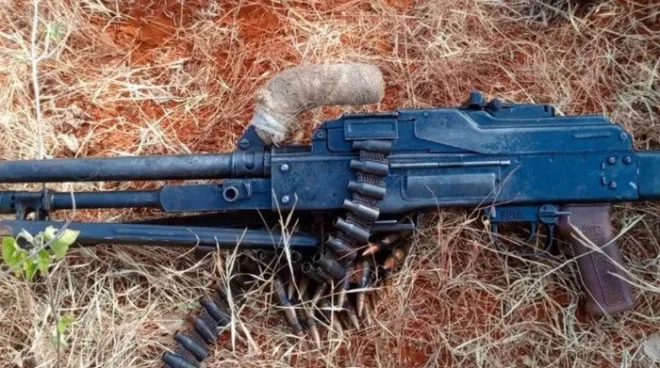
Weapon recovered at the crime scene, July 12, 2026 Photo
Kenyan security forces struck a makeshift militant camp near the Somalia border on Sunday morning, killing at least 11 suspected Al-Shabaab fighters and seizing weapons and documents that authorities say shed new light on the group’s funding mechanisms.
Police said the raid, executed by the Special Operations Group (SOG) with aerial backing, followed intelligence that roughly 30 militants had assembled at the camp to plan an attack on a village along the Mandera border. The operation left 11 militants dead and seven others seriously injured, while the remaining fighters reportedly fled back into Somalia.
Officers recovered three PKM machine guns, about 409 rounds of ammunition, and several documents believed to belong to the extremist group. Authorities described the action as a pre-emptive move intended to disrupt a planned assault and prevent another cross-border terror incident in the North Eastern region.
Among the material seized were receipts that officials said resemble mandatory religious tax records allegedly issued by Al-Shabaab. Investigators believe the documents offer fresh intelligence on how the group finances operations and manages areas under its control through taxation and checkpoint collections.
Security agencies said the recovered records bolster existing assessments that Al-Shabaab maintains an organised revenue collection network across parts of Somalia, using those funds to support attacks and sustain militant activity.
The Mandera raid forms part of an intensified security campaign aimed at dismantling terrorist cells along the Kenya-Somalia frontier, where authorities have increasingly relied on intelligence-led strikes to avert planned attacks.
The operation follows an unrelated arrest earlier this week at the Kina Vehicle Checkpoint in Isiolo County, where officers detained a suspect alleged to be linked to an illegal firearms and ammunition trafficking ring operating across Tana River, Isiolo, Meru, and Garissa counties.
Police said some weapons tied to that network were believed to be destined for Nairobi, a development officials say underlines ongoing efforts to break both terrorist and criminal supply chains.
Security sources noted that stepped-up surveillance, intelligence gathering and coordinated operations have significantly reduced cross-border terror incidents in recent years, though Al-Shabaab persists in attempting to infiltrate Kenya via the North Eastern region.
Kenya has kept counterterrorism measures along the Somalia border at a high level since launching Operation Linda Nchi in 2011, following a wave of cross-border attacks and kidnappings that targeted tourists and aid workers.
Authorities said Sunday’s raid highlights the continued reliance on intelligence-led interventions to intercept militants before attacks can be carried out, while also producing information that could aid future counterterrorism investigations.