By: Mohamed Sheikh Omar IbrahimWednesday August 5, 2026
Some losses are felt not only in the moment a person dies, but in the sudden disappearance of the presence that quietly shaped your life. You notice it in familiar places, in routines that no longer make sense, and in the instinct to turn toward someone who is no longer there.
My father was that kind of presence.
He never formally announced our journeys. At some point during the final ten days of Ramadan, he would simply tell me that we were going to Makkah. For almost a decade, that became our pattern: praying side by side in the Haram, walking through the courtyards after Taraweeh, drinking tea late into the night and discussing faith, family and the challenge of living with integrity in a complicated world.
This year, I went back to Makkah alone. In that solitude, I came to understand the most important lesson my father had given me—not through instruction, but through example. Fatherhood, I now believe, is a form of leadership. It is not leadership defined by titles or public platforms. It is influence absorbed quietly by a child, often without awareness, and recognized only years later in the adult that child becomes.
My father was born in rural Somalia, where opportunity was limited and stability could never be assumed. As a young man, he traveled alone to Mogadishu in pursuit of an education. He worked during the day and studied at night. In time, he became fluent in several languages and devoted his life to his faith and his community. His distinction lay less in his accomplishments than in the manner in which he carried them: without complaint, without vanity and without seeking credit he had not earned.
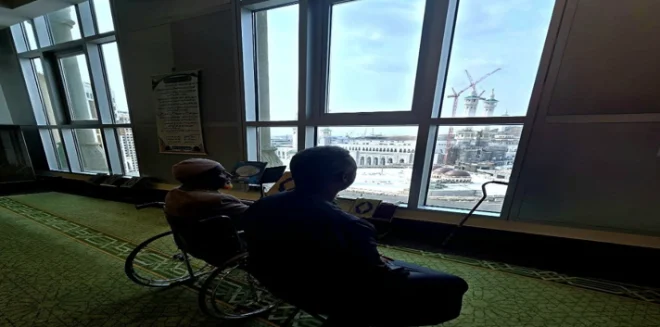
In the Haram, grief becomes tangible. The marble courtyards continue to shine beneath the lights. The adhan still moves through the air in its ancient cadence. Millions of pilgrims continue their unbroken circling of the Kaaba, a procession that has endured for centuries and will continue after every one of us is gone. The Haram does not stop for an individual’s sorrow. Yet every part of it carried a memory: the entrance we used, the place where we sat after prayer, the late-night walk back to the hotel, weary but never eager to end the conversation. More than once, I turned slightly as if I were about to speak to him, or slowed my pace as though he might still be catching up.
I learned that absence is not simply emptiness. It can become a presence in its own right—following you into shared places and taking the seat once occupied by someone you loved.
Several days into my stay, my phone brought up a memory from exactly one year earlier. On that same date, my father and I had performed Umrah together. We had stood before the Kaaba and raised our hands in dua’a. At the time, it felt like another journey in a long series of journeys. I did not know it would be our last. Most of us never do.
Faith asks us to hold this life lightly. We are repeatedly reminded that every soul will return to its Creator, that this world is temporary and that the things we pursue here are not the things that endure. A truth heard so often can become familiar enough to lose its force. In the Haram, standing there without my father, I felt its full weight.
رَّبِ ارْحَمْهُمَا كَمَا رَبَّيَانِي صَغِيرًا
“My Lord, have mercy upon them as they raised me when I was small.”
For many of us in the Somali diaspora—and throughout the wider African Muslim world—parents hold a distinctive place in our lives. They are more than relatives. They are living archives, preserving stories of displacement, sacrifice and reinvention that their children, raised in other countries and under different circumstances, often understand only in part.
My father left rural Somalia with very little and built his life through discipline and faith. He created opportunities for his children in places he himself had never seen. Millions of families dispersed around the world share some version of this story: a generation that bore costs its children largely escaped, and that seldom demanded recognition in return. When such a person dies, the loss reaches beyond the relationship itself. Something else disappears—a form of knowledge, a way of finding your bearings, a quiet voice that has shown you how to stand without ever declaring that it was doing so. You discover how much you depended on it only after it falls silent.
As I walked those paths in Makkah during the last Ramadan, I understood something that had previously escaped me. The experiences I had regarded as routine—the tea after prayer, the unhurried walk to the hotel, the conversations with no destination—were not ordinary stretches of time. They were the relationship itself. They were among the most precious hours I shared with my father, though I did not recognize their value while they were unfolding. That may be loss’s cruelest gift: it brings clarity to things that can no longer be reached.
My father is no longer physically present beside me in those courtyards. But parts of him remain in the way I pray, in the principles that guide my choices and in the discipline I try, imperfectly but sincerely, to bring to my life. This, I believe, is the true meaning of a parent’s legacy. It is not primarily what a parent leaves in material terms, but what is planted within a child over years, quietly and almost imperceptibly.
He did not seek the spotlight. Recognition and position were never his pursuits. He understood what many people spend their lives failing to see: lasting influence is neither loud nor immediate. It grows through steady character, through the treatment of others when nothing is to be gained and through decisions made when no one is watching. In Somali, we call this dhowrsanaan—the quiet discipline of protecting one’s integrity, reputation and principles. It is not merely a matter of following rules. It concerns who you are when no one is enforcing them. My father practiced it every day.
That was the leadership he taught me, never through formal lectures but through what I observed. I watched him listen before speaking. I watched him reject fadhi-ku-dirir, the political maneuvering and tribal posturing that so often consume our communities and leave them diminished. Again and again, he chose the more difficult course: reconciliation instead of division, patience instead of reaction and service instead of applause. He evaluated people by their character, not their clan. In a society shaped by deep loyalties and rivalries, that was not an accidental stance. It was a conscious decision that demanded moral courage.
One verse he often returned to expresses the weight of that responsibility:
“Indeed, We offered the Trust to the heavens and the earth and the mountains, but they declined to bear it and feared it; yet man undertook it.” (Surah Al-Ahzab, 33:72)
He understood the verse not as praise of human power, but as a warning. Even the mountains, he would say, recoiled from the burden. Genuine leadership is a responsibility before it is an honor. Anyone who approaches it in the opposite order has already missed its meaning. To him, every position of responsibility was an amanah—a trust placed in your care for the benefit of others, one for which you would be answerable not only to those around you but ultimately to Allah. That accountability was practical rather than theoretical. It shaped even the decisions no one else witnessed: those made at home, within the family and in the quiet spaces where there is no audience.
I have spent years working in professional settings concerned with leadership—its demands, its formation and the ways it is sustained. Yet the more I learn, the more often I return to my earliest teacher: my father. Titles pass. Positions end. Power fades. The lessons a father imparts through years of observation and listening can remain.
I write this knowing that many others carry a similar absence. Across our community, people have lost parents in recent years—some unexpectedly, some after prolonged illness and some far from home. Diaspora grief has its own character. It is experienced across borders, often without the full support of a nearby community and while ordinary responsibilities continue as though nothing has changed. If you are living through that loss, I hope these words find you.
If your parents are still alive, be present with them. Do not make it performative; they will recognize the difference. Sit beside them. Protect time for the ordinary moments. Share the tea. Take the walk. Make the journey you keep promising to make next year. One day, you may return to a place filled with memories and realize that the moments you dismissed as small were the ones that mattered most.
May Allah have mercy on my father’s soul, raise his station and grant him the highest levels of Jannah. May He also give us the wisdom to value those who remain beside us, before we are left looking for them in the spaces they once filled.