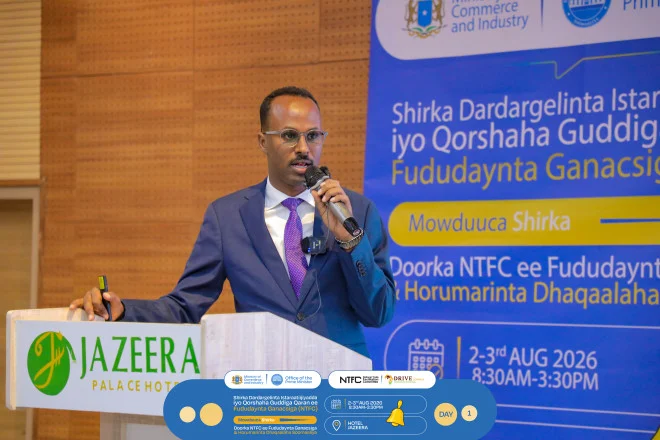
By Sadaq MohamedMonday August 3, 2026
Somalia’s entry into regional trade markets will mean little unless the country can produce more, meet export standards and move goods efficiently across its borders. After securing full EAC membership in March 2024, Somalia took another step this week when President Hassan Sheikh Mohamud signed the AfCFTA Agreement into law. The next challenge is converting that access into measurable trade.
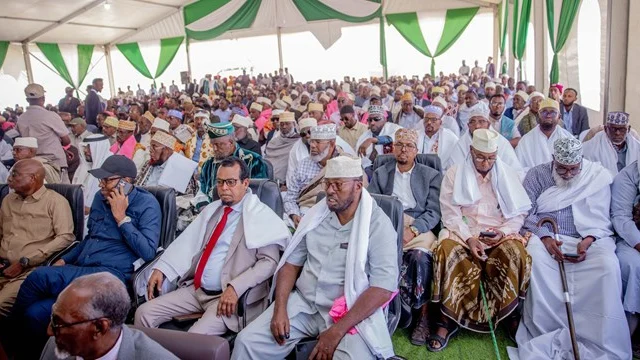
At the two-day NTFC Strategic Induction and Roadmap Workshop, which ended in Mogadishu today, we examined 2024 merchandise trade figures that underline the scale of the task. Somalia exported about $1.56 billion in goods while importing roughly $9.18 billion, producing a merchandise trade deficit of approximately $7.62 billion. New markets offer an opportunity, but the gains will depend on what Somalia can produce and how quickly it can tackle the obstacles confronting traders.
The discussions focused squarely on implementation and the cross-government coordination it demands. Market access must now be matched by practical systems that make trade faster, more predictable and less expensive.
In his official opening remarks, Deputy Prime Minister Salah Ahmed Jama stressed that trade facilitation cannot be assigned to a single ministry. Trade policy must align with industrial production, standards and value addition. Its success should ultimately be visible in the number of Somali products reaching regional and international buyers under Somalia’s name.
Operating from the Office of the Prime Minister, the National Trade Facilitation Committee provides a forum where government institutions and businesses can address problems that span several agencies. The priority is to align those institutions around the issues traders encounter at ports, borders and markets.
Somalia has identified and scheduled 19 priority legal and policy instruments, covering areas such as rules of origin, competition and consumer protection, special economic zones and intellectual property. Digital platforms will not solve institutional weaknesses on their own. Clear responsibilities and compatible procedures must come first; otherwise, digitalisation risks transferring confusion from paper files to computer screens.
In the livestock sector, trade facilitation begins well before animals arrive at a port. It requires effective animal-health controls, credible quarantine services, dependable veterinary certificates, functioning laboratories and, once operational, traceability through SOMLITS.
A breakdown anywhere in that chain weakens pastoralists’ bargaining position, delays exporters and undermines buyers’ confidence. Reform must therefore be designed to cut costs and uncertainty for pastoralists, women traders, small businesses and established companies alike.
The HoA DRIVE Somalia project is supporting efforts involving standards, testing, certification, the Trade Information Portal, the planned National Single Window and improved livestock systems. These tools must work together with SOMCAS, SOMLITS and electronic veterinary certification rather than operate as separate systems.
Physical checkpoints, repeated documentation, uncoordinated inspections and unclear fees also require attention. Traders should provide information once, undergo coordinated controls and understand the applicable requirements before their goods begin moving.
Our trade scorecard will monitor certificate turnaround times, the publication of documents and fees, duplicate inspections, cargo-release times and the handling of reported non-tariff barriers. Administrative records will be assessed alongside feedback from the private sector, with particular attention to women, pastoralists and small traders. Progress will be measured by the days, costs and uncertainty removed from the trading process.
The workshop set out initial measures and assigned lead agencies to guide the technical working groups. As NTFC Coordinator, I will push for every bottleneck to have one institutional owner, one deadline and one publicly reported measure of progress. Somalia’s regional memberships must help lower trade costs, build stronger businesses and enable more Somali products to compete in actual markets.
_____________________
Sadaq Mohamed is the National Trade Facilitation Coordinator at the Office of the Prime Minister.