
Somalia’s Supreme Court has set an electoral standard that two elections it approved failed to meet.
Analysis
- Advertisement -
MOGADISHU, 25 August — Somalia’s Federal Supreme Court has annulled Galmudug’s state assembly and local council elections, finding that they “were not conducted in accordance with Somalia’s Constitution and Electoral Law” and declaring the results void. The ruling rejected the National Independent Electoral and Boundaries Commission’s claim that an election result cannot be contested if no complaint was submitted on polling day. The same argument underpinned the court’s certification of Mogadishu’s district council elections five months earlier. On 28 March, the court ratified the Banadir results because “no official complaints were filed during the legal period.” On 25 May, it upheld South West State’s assembly and council elections, concluding that they “strictly comply with the country’s legal framework.” On 24 August, it voided the Galmudug vote and ordered a re-run. All three elections were managed by the same commission, under the same 2024 National Electoral Law and the same chairman, within an eight-month period. The latest judgment does not revisit the earlier decisions. But the requirements it spells out — the first time a Somali court has set them out in detail — include deadlines that available records show the other two elections also missed. What the court said the law requires The five judges, sitting as the Electoral Division under Chief Justice Baashe Yusuf Ahmed, ruled that an election date must be announced at least 90 days in advance. A meeting with political parties that produces no written date does not meet that requirement. Campaigning must begin 45 days before polling and end 48 hours beforehand. Voter registration must be completed before the process advances; a provisional register must be published within two months, while the final roll must be provided to the Interior Ministry and political parties 30 days before voting. Candidate lists must be submitted 120 working days before the election, with the commission verifying and publishing the final list about 100 working days before polling. Results must identify individual winners and their seats, rather than merely stating party totals. Station-level results must also be posted and returned for every polling station. The judges further held that the commission cannot alter statutory deadlines through an internal regulation, ruling that such an effort exceeded its authority. A breach of electoral law is not simply a procedural defect when it affects the credibility or integrity of the result; under Article 82, it makes the election void. The court also found party members competent to testify against the electoral authority, reasoning that people closest to the process are best placed to explain what occurred. It rejected two procedural arguments from the commission as well: that the petition had been filed too late and that no complaint had been submitted on election day.
Mogadishu: final candidate list released one day before voting
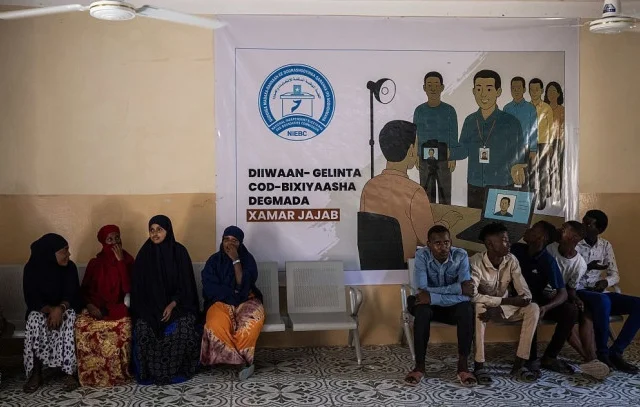
Banadir held elections on 25 December 2025 for 390 district councillors in 16 of Mogadishu’s 20 districts. Kahda, Daarusalam, Garasbaley and Gubadley — four districts created after 1991 and among the capital’s main areas hosting displaced people — were excluded. Residents there were instructed to vote in neighbouring Dharkenley. The commission announced the 25 December polling date on 30 November, giving voters 25 days’ notice instead of the 90 days now affirmed by the court. Political parties submitted candidate lists from 25 November to 11 December, just two to four weeks before polling rather than 120 working days. The final list was published on 24 December, the day before the vote, while voter-card collection began on 22 December. Neither a provisional nor a final voter register was made public. The commission released only aggregate registration figures, on 18 October. Results were announced on 27 December as party vote and seat totals. Political parties complained publicly that the commission had not shown which seats each party had won in each district or identified the winning candidates. The registration process itself was disputed. Of 923,220 records, 4,330 were removed as duplicates, leaving 918,890 registrations — approximately one-third of the capital’s estimated population. A Somali Public Agenda survey of 201 residents, published in December, found that 62 per cent of registered voters had not been asked for identification, 29 per cent said they had been registered without consent and 39 per cent had been registered in a district where they did not live. Somali Guardian and Axadle separately reported registration drives at Bakara market and bus stations. A PeaceRep researcher recorded that proof of registration was required to pass checkpoints around the city. Commission chairman Abdikarim Ahmed Hassan described the allegations of coercion as “false, baseless, and deliberately misleading.” Turnout figures remain contested. Reports of the commission’s announcement cited two incompatible totals: an itemised account listed 233,314 ballots cast, including 210,586 valid votes, while other reports gave a figure of 503,916. The lower total would represent turnout of roughly 25 per cent. Six days after counting ended, the commission changed the Waaberi district tally for Hormar iyo Midnimo Qaran, the party of former South West president Sharif Hassan Sheikh Aden, from 2,968 votes to 407. The difference was transferred to the ruling Justice and Solidarity Party. The commission said an internal verification had uncovered a data-entry error. The party rejected that explanation, accused the commission of damaging the process’s credibility and indicated that it would challenge the result in the Supreme Court. Three months later, the court certified the election, citing the absence of complaints filed within the legal period. The 390 councillors took their oaths on 2 April. Baidoa: candidate deadline changed the day before the planned vote
South West State held elections on 10 May 2026 for 95 assembly seats and 297 local council seats in 13 districts across Bay, Bakool and Lower Shabelle. The vote followed the Somali National Army’s capture of Baidoa on 30 March and the resignation of President Abdiaziz Hassan Mohamed “Laftagareen”. He later withdrew the resignation, said the letter carrying his name had been fabricated and stated that he had left under nearly two months of military pressure. The commission announced on 6 April that voting would take place on 28 April, providing 22 days’ notice. On 27 April, one day before the scheduled poll, it announced that the deadline for candidate applications had been postponed. The election was subsequently moved to 10 May. Electoral law requires registration to close and the final register to be circulated 30 days before polling. Instead, registration was reopened in Baidoa and Xudur for an additional ten days in April, following a request from political parties. Results announced on 14 May listed party seat totals. Of 376,212 registered voters, 132,430 cast ballots, representing turnout of about 35 per cent. Before the results were released, candidates Ilyaas Ali Nuur and Sharif Hassan Sheikh Aden publicly alleged that the process had been tampered with. The Justice and Solidarity Party won 51 of the 95 assembly seats and 148 of the 297 council seats. Eleven days later, the Supreme Court validated the results, ruling that the election met all legal requirements. Galmudug: turnout reported at 92 per cent
Galmudug voted on 30 July for 89 assembly seats and 243 local council seats across 11 districts. The election date was postponed twice, moving from 20 July to 25 July and then to 30 July. Shortly before the second postponement, commission chairman Abdikarim Ahmed Hassan had said publicly: “We will not change the election schedule that was previously set for July 25.” Registration began in Dhuusamareeb in June 2025, 13 months before polling. Voters were allowed to use temporary certificates instead of voter cards. The commission reported that 197,971 ballots had been cast from 215,860 registered voters, producing turnout of about 92 per cent. That compared with roughly 35 per cent in South West State and about 25 per cent in Mogadishu, based on the lower itemised figure. Results announced on 3 August awarded the Justice and Solidarity Party 63 of the 89 assembly seats and 115 council seats. Towfiiq, which was allocated 12 assembly seats, released its own tally claiming it had won 47. The party demanded an independent audit of ballots from ten districts and petitioned the court. One commission, three rulings
The commission was established by law in November 2024. Its 18 commissioners were approved by the Council of Ministers, both houses of parliament and a presidential decree. Abdikarim Ahmed Hassan, elected chairman in December 2024, managed President Hassan Sheikh Mohamud’s 2022 campaign. In an Al Jazeera article published in December, academic Afyare Abdi Elmi said the government “has appointed 18 commissioners, all backed by the ruling Justice and Solidarity Party.” The International Crisis Group has said the commission “lacks clear independence mechanisms.” In June, Kaab TV reported that the chairman attended a Mogadishu meeting organised to build support for the ruling party’s candidate in Galmudug. In January, the UN Office for Project Services, with European Union funding, issued a tender for an “independent assessment of the Banadir local elections”. It cited “concerns about limited independent oversight, uneven participation, and transparency issues”. The assessment has not been published. What Next
The Supreme Court directed the commission to conduct fresh elections in Galmudug “at the earliest reasonable time”. Existing state institutions will remain in place until legally elected successors take office. The judgment did not establish a supervisory process or require election observers, despite the petitioner’s request. The same commission that administered the annulled election will oversee the re-run. No date has been announced. The ruling came as Somalia remained locked in a dispute over the federal government’s mandate. Parliament’s four-year term ended in April and the president’s in May. Constitutional amendments adopted in March, however, say both terms were extended to five years, moving national elections to 2027. Opposition groups, Puntland State and Jubaland reject the amended provisions. Talks between the government and opposition broke down on 28 July after more than two months of mediation by the Quad+1 — the UN, European Union, United States, United Kingdom and Turkey. Public reaction to the judgment has been limited. Towfiiq chairman Sheikh Shakir welcomed the decision and urged supporters to respond peacefully. It exposed divisions within the ruling party’s own parliamentary bench: Galmudug MP Cagaweyne called the ruling “oppression, with no transparency or explanation,” while other party figures backed it. The commission has not commented, and neither the federal government nor the Galmudug administration has issued a statement. No international partner has responded. The court has also not explained why the standard it applied in August was absent from its March and May rulings. The unresolved issue is therefore not whether Galmudug’s election was lawful. It is whether, by the court’s newly stated reasoning, the other two elections were lawful either. AXADLETM