By Nuri AdenThursday August 13, 2026
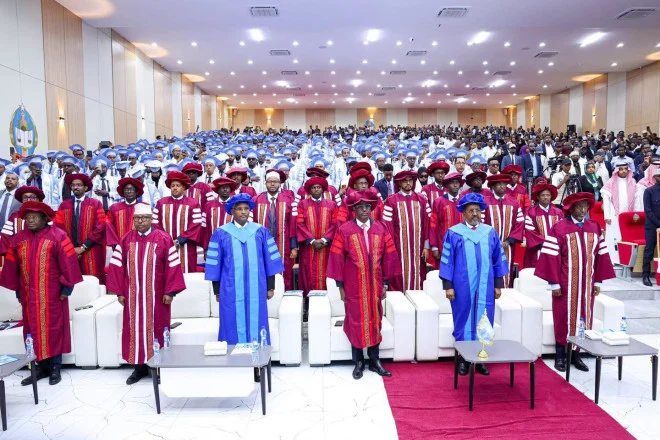
More than 500 students have graduated from Somalia’s Institute of Security and Strategic Studies in its first-ever cohort, a landmark step in the government’s drive to build more professional, capable and analytically focused security institutions.
- Advertisement -
The graduates completed three programmes at the institute, which operates under Somalia’s National Intelligence and Security Agency (NISA).
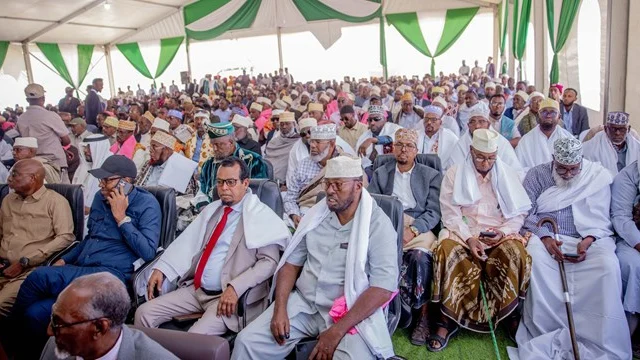
President Hassan Sheikh Mohamud attended Wednesday’s ceremony and congratulated the graduates, calling on them to use their academic preparation and professional skills to advance Somalia’s security, stability and state institutions.
Hassan said the country’s security agencies required personnel with strong knowledge, professional competence and operational ability. He described investment in human capital as central to developing effective national security institutions.
The president also commended reforms at the institute, citing improvements to its curriculum, academic standards and professional training programmes.
NISA Director Mahad Salad, Minister of Internal Security Senator General Abdullahi Sheikh Ismail Fartaag, Minister of Education, Culture and Higher Education Farah Sheikh Abdulkadir and Somali National University President Mohamed Mohamud Mohamed attended the event. Military and security officials, academics, instructors, graduates and other guests were also present.
Building a professional security sector
The graduation comes as Somalia continues to face a complex security landscape, including attacks by al-Shabaab, an al-Qaeda-linked terrorist group that has targeted government, military and civilian sites.
Somali security forces are carrying out counter-insurgency operations against the group and gradually taking on greater responsibility for national security. At the same time, the government is working to improve command structures, intelligence capabilities, operational coordination and professional standards across its security institutions.
In that context, the institute’s security and strategic studies programmes are intended to pair operational preparation with academic and analytical expertise.
Established in 2019, the institute was created to strengthen the professional knowledge and capabilities of personnel serving in Somalia’s security institutions.
Its programmes address the wider field of security and strategic studies, including national security, strategic planning, intelligence, conflict, risk assessment, security governance and institutional resilience.
The focus on formal education reflects a broader push to professionalise and institutionalise Somalia’s security sector. Training, specialised knowledge and evidence-based decision-making are increasingly viewed as vital to building lasting institutional capability.
From operational training to strategic capacity
The institute’s inaugural graduating class gives Somalia a new pool of personnel equipped not only for security operations but also for the analytical and strategic work underpinning national security.
The government has likewise placed greater emphasis on modern technology and professional training as it seeks to create security institutions capable of responding to changing threats.
For Somalia, the task goes beyond battlefield operations. Sustainable security depends on institutions that can gather and analyse intelligence, identify emerging threats, coordinate responses and support accountable security governance.
The graduation thus marks more than the end of an academic course. It forms part of a wider effort to develop the human capital and institutional foundations required for Somalia’s transition to a more professional and self-reliant national security system.