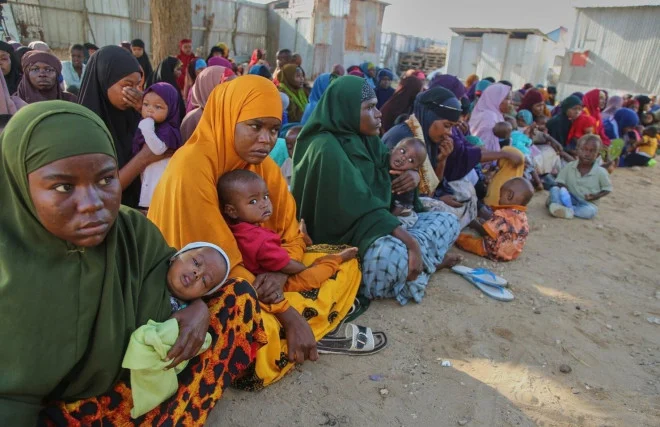
Somali women displaced by drought sit at Feynuus Nutrition Centre on the outskirts of the capital, Mogadishu, Somalia Wednesday, Aug. 19, 2026. (AP Photo/Farah Abdi Warsameh)
MOGADISHU, Somalia — Somalia’s hunger crisis is deepening as six million people face acute food insecurity, yet the World Food Program has just a fraction of the funding it had in 2022, when its emergency response helped prevent famine, the agency’s acting chief told The Associated Press.
- Advertisement -
“We can only do the bare minimum,” WFP acting executive director Carl Skau said Wednesday while visiting a nutrition center on the outskirts of Mogadishu. “We’re only providing these nutrition supplies to the children that are really the worst hit.”
International aid cuts and the diversion of donor money to other humanitarian emergencies have left the WFP unable to broaden its operations in Somalia, Skau said.
Millions of people at risk but far less aid
The WFP estimates that 1.9 million Somali children under age 5 will experience acute malnutrition this year. Nearly 500,000 of them are expected to need urgent treatment for severe acute malnutrition. The United Nations says about 30% of the country’s population is facing critical levels of food insecurity.
“We had 10 times more resources than now,” Skau said, recalling the 2022 hunger emergency, which followed a prolonged drought. “We were able to step in, and we prevented a famine here in Somalia.”
“We know what’s going on, we have the capacity, we have the experience of dealing with this. We just need the resources now to do it.”
The effects of the latest crisis — fueled by drought, conflict and widespread displacement — are visible at the Feynuus Health Center in Mogadishu’s Kahda district. Dozens of women clutching babies waited under a large tree or crowded onto the veranda of the corrugated-metal building for assistance.
Inside, health workers lowered children into a blue weighing sling, checked them for signs of malnutrition and handed out therapeutic food.
One desperate mother tells her story
Halima Mohamed Hassan, a mother of six, walked nearly 3 kilometers (2 miles) to the center while carrying her malnourished 4-year-old child. Pregnant and exhausted, she said she had gone two days without food. Her last meal was plain rice.
Health workers gave the child a special nutrient-dense food. Hassan said her other children were malnourished as well, but she could not bring them all to the facility.
“I could not carry all of them,” she said.
Hassan said she fled Somalia’s Lower Shabelle region four months ago after her husband died of malnutrition. As food and water grew scarce, the family also faced increasing danger from conflict.
She and her children spent four nights walking before reaching a camp for internally displaced people on the outskirts of Mogadishu.
Hassan now lives in a makeshift shelter with her widowed mother and her mother’s four other children. The two women search for occasional work washing clothes in nearby neighborhoods to support a household of 12.
A health center tries its best to help
The Feynuus center treats between 250 and 350 patients each day, most of them displaced women and children who arrived from areas outside Mogadishu, said Abdirahman Barkhad, program director of Youth Link Somalia, the organization that runs the facility.
Barkhad said roughly 10 health and nutrition centers in the surrounding area had shut down after humanitarian funding declined, placing additional strain on the facilities that remain open.
“We have witnessed children collapsing, because their families do not have enough food,” he said.
Mohamud Moallim Abdulle, commissioner of the Somali Disaster Management Agency, called the country’s food crisis “extremely alarming.”
He said an estimated 1.85 million children are malnourished, about 6 million people are affected by drought and 2 million urgently require assistance.
They don’t know where their next meal is
During a visit this week to Burhakaba, Skau said mothers identified drought, insecurity and rising food prices as the main forces driving the crisis. Some had lost their crops and abandoned their homes. Others walked three or four hours to reach health facilities because aid workers could not get to their communities.
“I spoke to women with eight to 10 children,” Skau said. “They don’t know where the next meal is going to come from.”
Humanitarian work has also become more costly because Somalia is battling a 20-year-long insurgency by the al-Shabab militant group. In areas where roads are too dangerous for staff and supplies, the WFP must use aircraft, while some communities remain beyond its reach, Skau said.
He said the conflict in the Middle East was adding further pressure by pushing up fuel and food prices, restricting agricultural supplies and directing donor funding toward other emergencies.
After her child received food at the center, Hassan started the journey back to the displacement camp. Her five other children were still there, hungry and waiting, she said. She would need to make the trip again, bringing them to the center one at a time.