How Fisheries, Ports, and Trade Are Reshaping Livelihoods Along the Somali Coast
By Axadle Times Editorial Team
- Advertisement -
For decades, Somalia’s coastline—stretching more than 3,300 kilometers along the Indian Ocean and the Gulf of Aden—has been viewed primarily through the lens of conflict, piracy, and instability. Today, however, a different story is unfolding along the country’s shores.
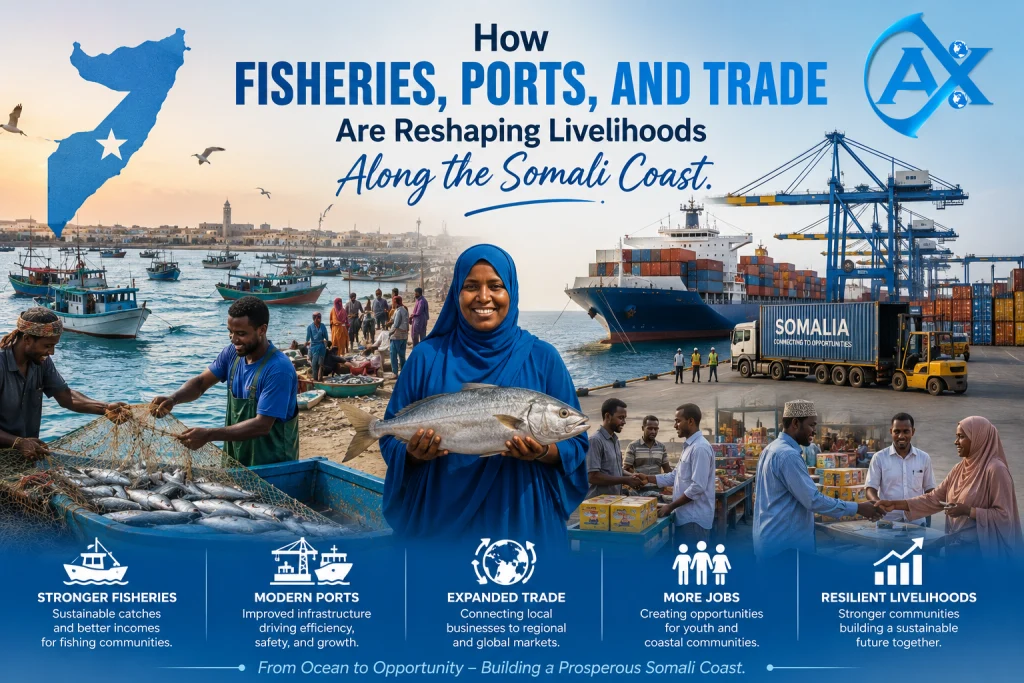
From bustling fishing communities in Puntland to expanding port facilities in Mogadishu, Kismayo, and Berbera, Somalia’s coastal economy is gradually emerging as one of the country’s most promising engines of growth. Investments in fisheries, maritime trade, logistics, and infrastructure are creating new opportunities for thousands of families who depend on the sea for their livelihoods.
While significant challenges remain, local entrepreneurs, fishermen, traders, and policymakers are increasingly betting on the blue economy as a pathway toward long-term prosperity.
The Untapped Potential of Africa’s Longest Coastline
Somalia possesses the longest coastline on mainland Africa, giving it access to some of the richest fishing grounds in the Western Indian Ocean.
Marine experts estimate that Somali waters contain abundant stocks of tuna, lobster, sardines, mackerel, and other high-value species. Yet for years, insecurity, limited infrastructure, and weak regulatory systems prevented the country from fully benefiting from these resources.
According to local fishing associations, many coastal communities continue to rely on traditional fishing methods using small boats and basic equipment. Despite these limitations, fishing remains a critical source of income and food security for thousands of households.
Government officials and development partners argue that modernizing the fisheries sector could generate substantial economic benefits, create employment opportunities, and reduce dependence on imports.
Fishing Communities Seeing New Opportunities
Along Somalia’s coastline, signs of economic recovery are becoming increasingly visible.
In towns such as Bosaso, Eyl, Kismayo, and Hobyo, fishermen report growing demand for locally caught seafood in both domestic and regional markets. Improvements in transportation networks and cold-storage facilities have allowed more products to reach consumers while maintaining quality standards.
Young entrepreneurs are also entering the sector, establishing fish processing businesses, ice production facilities, and export operations targeting markets in the Middle East and beyond.
For many coastal residents, the expansion of fishing-related industries represents more than economic growth—it offers an alternative to unemployment and irregular migration.
Community leaders say that investments in modern fishing vessels, training programs, and access to financing could dramatically increase production while improving incomes for local families.
Ports Driving Economic Transformation
Somalia’s ports are becoming increasingly important gateways for trade and investment.
The Port of Mogadishu remains the country’s busiest maritime hub, handling a significant share of imports and exports. Recent modernization efforts have improved cargo handling capacity and operational efficiency, helping facilitate commercial activity across the country.
Meanwhile, the Port of Kismayo serves as a strategic trade center for southern Somalia, connecting local producers to regional markets.
In Puntland, Bosaso Port continues to play a vital role in commerce across the Gulf of Aden, supporting trade links with neighboring countries and international shipping routes.
Analysts say improved port infrastructure not only strengthens trade but also attracts private investment, creates jobs, and generates government revenue that can be reinvested in public services.
The Growing Importance of Maritime Trade
Somalia occupies one of the world’s most strategically important maritime locations.
Major international shipping lanes pass near Somali waters, connecting Europe, the Middle East, Asia, and Africa. As regional trade volumes continue to grow, Somalia is increasingly positioned to benefit from its geographic advantage.
Business leaders note that expanding logistics services, warehousing, and transport infrastructure could help transform coastal cities into commercial hubs serving both domestic and international markets.
Cross-border trade with countries across the Horn of Africa and the Arabian Peninsula is also contributing to economic activity, particularly in livestock exports, fisheries products, and consumer goods.
Experts argue that improved customs systems and stronger maritime governance will be essential to maximizing these opportunities.
Challenges Remain
Despite encouraging developments, Somalia’s coastal economy still faces significant obstacles.
Illegal, unreported, and unregulated fishing remains a major concern for local communities and authorities. Fishermen frequently report the presence of foreign vessels operating in Somali waters, reducing catches available to local operators.
Infrastructure gaps also continue to limit growth. Many fishing communities lack adequate cold storage facilities, processing centers, reliable electricity, and modern transportation links.
Climate change presents an additional challenge, with changing weather patterns and environmental pressures affecting marine ecosystems and coastal livelihoods.
Security concerns, although significantly improved in many areas, continue to influence investment decisions and development efforts.
Building a Sustainable Blue Economy
Economists and maritime experts increasingly point to the blue economy as a key pillar of Somalia’s future development strategy.
Beyond fisheries and ports, opportunities exist in marine tourism, renewable energy, shipping services, aquaculture, and coastal infrastructure development.
To unlock this potential, experts recommend stronger maritime governance, investment in education and vocational training, expanded access to finance for small businesses, and improved environmental protections.
International partners have also emphasized the importance of helping Somalia develop sustainable management systems that balance economic growth with conservation of marine resources.
A Coastline of Opportunity
For generations, Somalia’s coastline has sustained communities through trade, fishing, and maritime commerce. Today, as infrastructure improves and economic activity expands, many coastal residents see renewed hope for the future.
The transformation remains a work in progress, but the direction is increasingly clear: Somalia’s coast is no longer viewed solely as a frontier of challenges. It is becoming a frontier of opportunity.
If current investments continue and reforms are sustained, the country’s vast maritime resources could play a defining role in creating jobs, boosting exports, and strengthening economic resilience for years to come.
For many Somalis living along the shore, rebuilding the coastal economy is not merely an economic project—it is a pathway toward stability, prosperity, and a more connected future.