A data-driven look at how security incidents have shifted across Somalia’s capital since 2021
MOGADISHU, Somalia — Security in Mogadishu has undergone significant changes over the past five years, reflecting both progress in urban stabilization efforts and the continued threat posed by Al-Shabaab insurgents.
- Advertisement -
An analysis of incident data, public security reports, and conflict-monitoring databases reveals a city that remains vulnerable to terrorism and political violence but has also seen important shifts in the nature, frequency, and geographic distribution of attacks.
From Large-Scale Bombings to Targeted Attacks
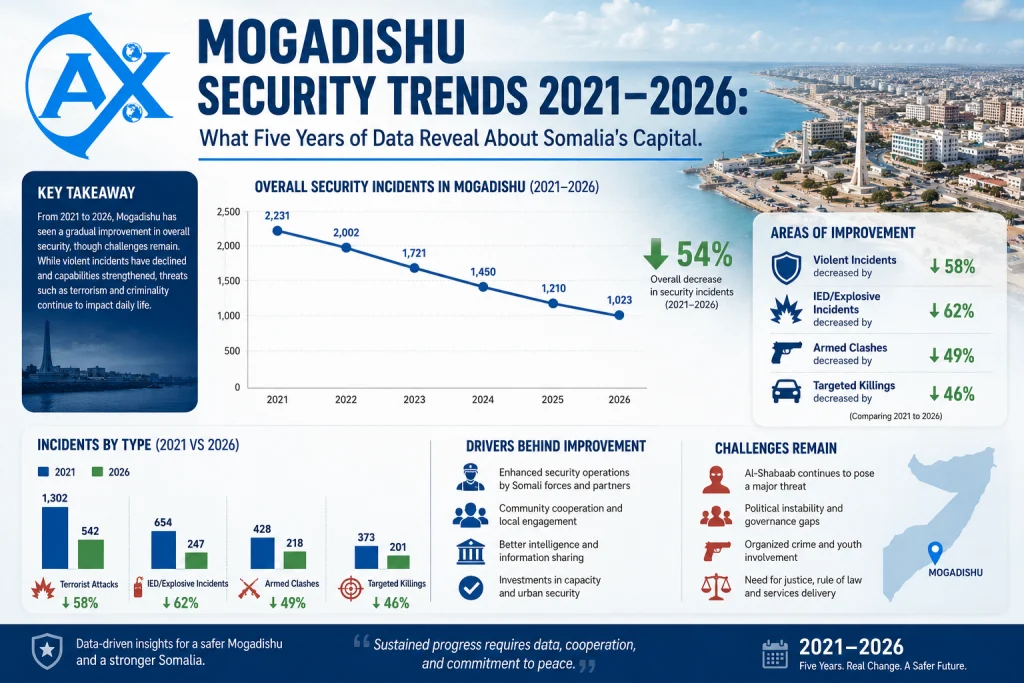
Between 2021 and 2026, Mogadishu’s security landscape evolved from frequent large-scale bombings targeting government facilities and public spaces toward a greater reliance on improvised explosive devices (IEDs), assassinations, and targeted attacks.
Security analysts note that Al-Shabaab increasingly adapted its tactics as federal and international forces expanded military operations across central and southern Somalia. Rather than focusing solely on high-profile mass-casualty attacks, the group increasingly targeted security personnel, government officials, and strategic infrastructure. (BTI 2026)
Incident Hotspots Across the Capital
Recent conflict-monitoring data identifies several districts as recurring security hotspots.
According to ACLED data cited by the European Union Agency for Asylum, Benadir Region recorded 830 security incidents between April 2023 and March 2025, resulting in 869 fatalities. Daynile recorded the highest number of incidents, followed by Hodan and Dharkenley districts. (European Union Agency for Asylum)
These districts serve as key transit corridors and contain major government facilities, military installations, and densely populated residential areas, making them frequent targets for both insurgent attacks and security operations.
The Persistent Threat of Al-Shabaab
Despite sustained military offensives, Al-Shabaab remains the dominant security threat facing Mogadishu.
Data reviewed by international monitoring organizations indicates that the group was involved in hundreds of incidents across Benadir over the past two years. Many attacks involved clashes with Somali security forces, while others directly targeted civilians. (European Union Agency for Asylum)
The group’s ability to infiltrate urban areas, conduct bombings, and launch complex attacks continues to challenge security agencies.
Major incidents during the period included attacks on hotels, government facilities, military positions, and detention centers. In 2024, an attempted prison breakout involving Al-Shabaab inmates resulted in multiple deaths inside Mogadishu Central Prison. (Wikipedia)
Technology and Surveillance Expand
One of the most visible changes in Mogadishu’s security strategy has been the expansion of surveillance infrastructure.
Authorities have installed thousands of security cameras across key districts and commercial areas in an effort to monitor suspicious activities, identify attackers, and improve rapid response capabilities. Officials say the system has contributed to greater situational awareness and deterrence. (Reuters)
While many residents welcome enhanced security measures, some business owners have reported concerns about becoming targets after participating in surveillance initiatives. (Reuters)
Civilian Impact Remains Significant
Although security operations have disrupted numerous militant networks, civilians continue to bear a substantial burden.
Conflict-related violence, targeted assassinations, bombings, and periodic clashes have contributed to deaths, injuries, displacement, and economic disruption. Human rights organizations and international observers continue to document civilian casualties linked to both insurgent attacks and military operations. (Human Rights Watch)
The humanitarian consequences extend beyond immediate casualties, affecting livelihoods, business activity, education, and public confidence.
Signs of Improvement
Despite ongoing threats, many residents describe today’s Mogadishu as markedly different from the city of five years ago.
Expanded security patrols, improved coordination among security agencies, increased use of technology, and infrastructure development have helped restore activity in commercial districts and public spaces. Businesses remain open longer, investment has increased, and public movement across parts of the city has become more routine. (Facebook)
These gains, however, remain fragile and dependent on continued security sector reforms and sustained pressure on militant networks.
Looking Ahead
As Somalia prepares for major political and governance milestones in the coming years, Mogadishu’s security trajectory will remain a critical indicator of national stability.
The data suggests that while the frequency and nature of attacks have evolved, the capital remains at the center of Somalia’s broader struggle against insurgency, political violence, and organized security threats.
The next five years will likely determine whether current improvements can be consolidated into lasting security gains—or whether militant groups can adapt once again to exploit emerging vulnerabilities.
Key Findings
- 830 recorded security incidents in Benadir between April 2023 and March 2025.
- 869 fatalities linked to recorded incidents during the same period.
- Daynile, Hodan, and Dharkenley remain among the most affected districts.
- Al-Shabaab continues to account for a large share of security incidents.
- Security cameras and urban surveillance have expanded significantly since 2024.
- Large-scale bombings have declined relative to more targeted attacks and IED operations.
- Civilian casualties remain a major concern despite improved security measures. (European Union Agency for Asylum)
This format is suitable for a Google Discover-friendly analysis piece and can also be enhanced with charts showing:
- Incidents by year (2021–2026)
- Fatalities by year
- Most affected districts
- Attack type trends (IED, assassination, complex attack, armed clash)
- Security incidents heat map of Mogadishu.