Investigation: Tracing Aid Delivery Across the Horn of Africa
Following Humanitarian Assistance from Donor to Community
- Advertisement -
By Axadle Times Investigations Desk
As droughts, floods, conflict, displacement, and food insecurity continue to affect millions across the Horn of Africa, billions of dollars in humanitarian assistance flow into the region each year. Governments, international agencies, charities, and private donors contribute funds intended to support vulnerable communities in countries including Somalia, Ethiopia, Kenya, Sudan, South Sudan, and Djibouti.
Yet a fundamental question remains difficult to answer: How much of that aid ultimately reaches the people it was intended to help?
Axadle Times launched an investigation to trace the journey of humanitarian assistance from donor commitments to local communities, examining the layers of administration, logistics, security challenges, and accountability systems that shape aid delivery across the region.
The Aid Pipeline
Humanitarian aid often begins thousands of kilometers away from the communities it serves.
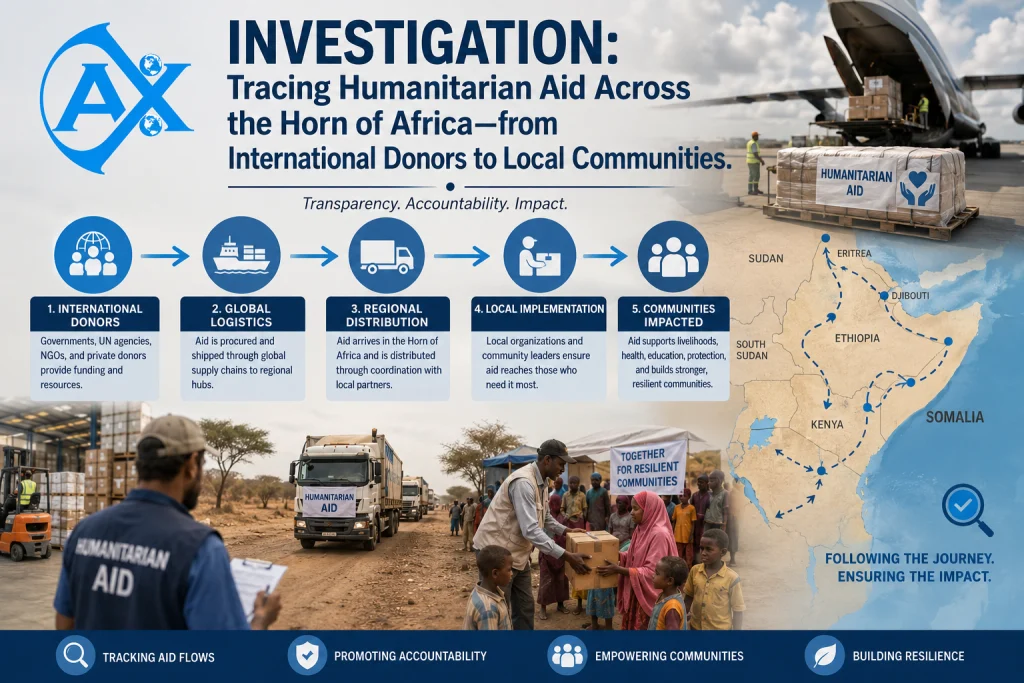
Funding may originate from foreign governments, multilateral institutions, private foundations, or public fundraising campaigns. These resources are then allocated through international organizations, United Nations agencies, development banks, and large humanitarian NGOs.
Before assistance reaches beneficiaries, it frequently passes through multiple stages:
- Donor allocation
- International agency management
- National coordination mechanisms
- Implementing partners
- Local organizations
- Community distribution networks
Each stage serves an operational purpose, but every additional layer can increase administrative costs, delays, and oversight challenges.
Aid experts describe the process as a complex chain where transparency can become increasingly difficult to maintain.
The Cost of Delivery
Moving food, medicine, shelter materials, and cash assistance into remote or conflict-affected regions presents significant logistical obstacles.
Road infrastructure remains limited in many parts of the Horn of Africa. Seasonal flooding can cut off communities for weeks. Security risks often require additional transportation measures and protection arrangements.
Humanitarian organizations argue that operational expenses are necessary to ensure aid reaches vulnerable populations safely and efficiently. However, critics say the public often lacks visibility into how much funding is consumed by administration, coordination, transportation, and security before assistance reaches beneficiaries.
In several humanitarian responses reviewed by Axadle Times, implementation costs represented a substantial portion of total project expenditures, highlighting the ongoing debate over aid efficiency and value for money.
Local Communities Report Gaps
Interviews conducted in affected communities revealed recurring concerns.
Some residents reported delays between aid announcements and actual deliveries. Others described beneficiary lists that failed to reflect changing needs on the ground.
In areas affected by displacement, population movements can rapidly outpace aid planning, leaving newly arrived families without support while previously registered beneficiaries continue receiving assistance.
Community leaders interviewed for this investigation also cited communication gaps between aid agencies and recipients, with many residents uncertain about eligibility criteria, complaint mechanisms, or distribution schedules.
The Rise of Cash-Based Assistance
Cash transfers have become increasingly common across the Horn of Africa.
Humanitarian agencies argue that cash assistance offers several advantages:
- Faster delivery
- Greater dignity and choice for recipients
- Lower transportation costs
- Support for local markets
Digital payment systems have improved accountability by creating electronic transaction records. However, challenges remain in areas with limited mobile coverage, weak financial infrastructure, or concerns about exclusion of vulnerable groups without access to technology.
While many experts see cash programming as a positive development, monitoring how funds are used and ensuring equitable access remain critical concerns.
Security Challenges
Conflict and insecurity continue to complicate humanitarian operations in parts of the region.
Aid organizations often face difficult decisions regarding access negotiations, staff safety, and operational continuity. Restricted access can prevent independent verification of distributions and make monitoring more difficult.
Humanitarian groups maintain that reaching vulnerable populations requires flexibility and engagement with local realities. Transparency advocates argue that stronger oversight mechanisms are necessary wherever monitoring opportunities are limited.
Balancing access and accountability remains one of the sector’s most persistent challenges.
Local Organizations Seek Greater Role
A recurring theme throughout this investigation was the growing call for greater involvement of local organizations.
Community-based groups frequently possess deeper knowledge of local conditions, stronger community relationships, and lower operating costs than international actors.
Many local organizations argue that they receive only a small fraction of humanitarian funding directly, despite being responsible for much of the implementation work on the ground.
Advocates of aid reform say shifting more resources and decision-making authority to local actors could improve both efficiency and accountability.
Tracking Transparency
Several humanitarian agencies have adopted new transparency initiatives in recent years.
Public databases, financial disclosures, digital beneficiary registration systems, and independent audits have expanded visibility into aid operations. However, transparency standards vary widely across organizations and countries.
Experts interviewed by Axadle Times emphasized that transparency is most effective when communities themselves can verify information and report concerns without fear of retaliation.
“Accountability should not stop at donor reporting,” one humanitarian analyst noted. “It must include the people the aid is intended to serve.”
The Bottom Line
The Horn of Africa remains one of the world’s most aid-dependent regions, and humanitarian assistance continues to save lives during crises.
Yet this investigation found that the journey from donor pledge to community impact is often longer and more complicated than many donors realize.
While most aid programs are designed with the goal of reaching vulnerable populations, gaps in transparency, logistics, coordination, and accountability can reduce effectiveness along the way.
For millions of people facing food insecurity, displacement, and economic hardship, the true measure of humanitarian assistance is not the amount pledged, but the assistance that ultimately arrives when it is needed most.
As humanitarian needs continue to grow across the region, strengthening accountability throughout the aid chain may prove just as important as securing additional funding.