
Greek Moussaka
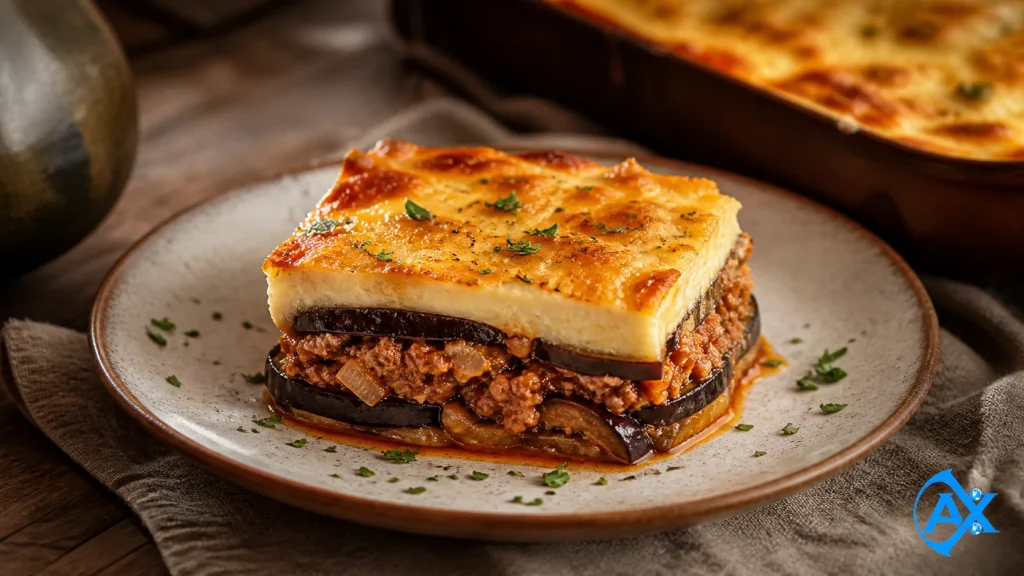
Layers of roasted aubergine and cinnamon-scented lamb under a thick béchamel, baked until set and rested before cutting.
Method
- Salt the aubergine slices on both sides and leave in a colander for 30 minutes. Rinse and pat completely dry; this draws out bitterness and stops them soaking up oil.
- Brush the slices with olive oil and roast at 200°C for 20 to 25 minutes, turning once, until golden and soft. Roasting rather than frying keeps the dish from turning greasy. Roast the potato slices alongside for 20 minutes if using.
- Meanwhile, cook the onions in olive oil over medium heat for 8 minutes, add the garlic for 1 minute, then add the mince and brown it well for 8 to 10 minutes, breaking it up.
- Add the tomato paste, cook for 2 minutes, then the wine, and let it bubble away for 3 minutes. Add the tomatoes, cinnamon stick, allspice and bay leaves.
- Simmer uncovered for 30 to 40 minutes until the sauce is thick with no free liquid. A wet meat layer will soak the whole dish. Discard the cinnamon and bay, and season.
- For the béchamel, melt the butter, whisk in the flour and cook for 2 minutes without colouring. Add the warm milk gradually, whisking constantly, and cook until very thick, 8 to 10 minutes.
- Off the heat, beat in the nutmeg, most of the cheese and then the egg yolks one at a time. The sauce should be thick enough to hold a ribbon on the surface.
- Layer in a deep dish: potatoes if using, then half the aubergine, all the meat sauce, then the remaining aubergine. Spread the béchamel over the top and scatter with the remaining cheese.
- Bake at 180°C for 45 to 50 minutes until deep golden and set. Rest for at least 30 minutes before cutting; moussaka served straight from the oven collapses on the plate.
How to make Greek Moussaka
Moussaka is the dish Greek cooks are judged on, and it rewards patience at every stage. Three components are made separately — roasted aubergine, a spiced meat sauce and a thick béchamel — then layered and baked into a single set, sliceable whole.
Dry layers, clean slices
- Advertisement -
Every common failure is a moisture problem. Salt and dry the aubergines, roast rather than fry them, and reduce the meat sauce until no liquid pools when you draw a spoon through it. Each wet layer makes the finished dish sag.
A béchamel that sets
This is a much thicker béchamel than you would pour over pasta. Cook it until it is genuinely heavy, then enrich with yolks and cheese off the heat so the eggs do not scramble. That thickness is what lets the top layer hold its shape when cut.
The spicing
Cinnamon and allspice in the meat sauce are what make it Greek rather than Italian. Use a whole cinnamon stick, removed before layering, for warmth without a dominant flavour.
Rest before serving
Thirty minutes out of the oven is the minimum, and an hour is better. Moussaka is often better the next day, reheated in portions, once the layers have fully set.
Traditional Greek cookery; the layered version with béchamel became standard in the twentieth century. Editorially researched from widely documented preparations, and not kitchen-tested by Axadle.
Contains dairy from milk, butter and cheese, gluten from the flour in the béchamel, and egg.

Join the conversation