
Gemista — Greek Stuffed Vegetables
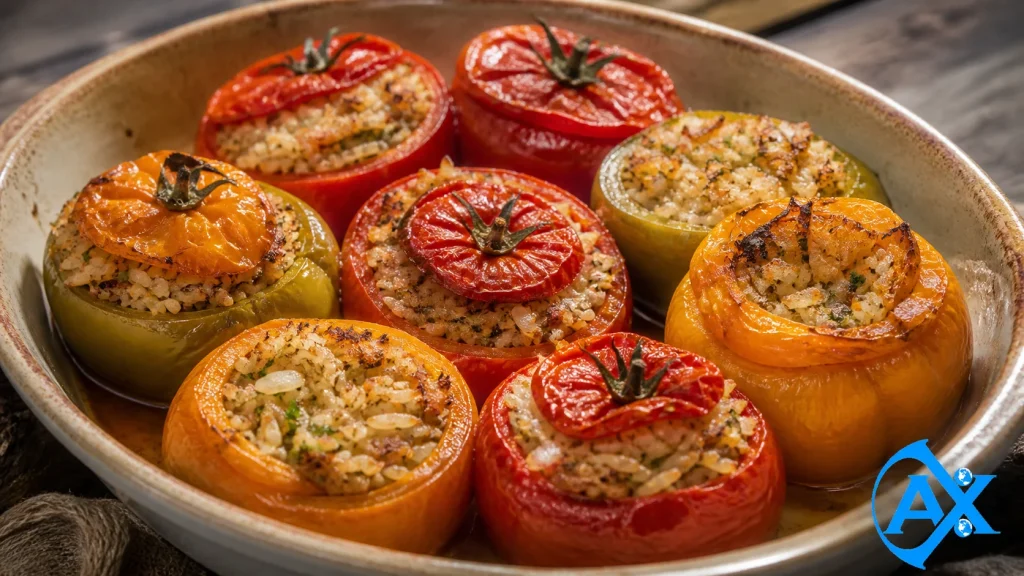
Greek tomatoes and peppers stuffed with herbed rice and baked slowly with potatoes in plenty of olive oil.
Method
- Slice the tops off the tomatoes and keep them as lids. Scoop out the flesh with a spoon, leaving the shells intact, and blend or chop the flesh.
- Cut the tops off the peppers and remove the seeds and white membranes.
- Salt the inside of each tomato shell lightly and stand them upside down to drain for 10 minutes.
- Cook the onions in ⅓ cup of the olive oil over medium heat for 10 minutes until soft, then add the garlic for 1 minute.
- Add the rice and stir for 2 minutes, then the blended tomato flesh, tomato paste, sugar, herbs, salt and pepper. Cook for 5 minutes until the rice has absorbed some liquid but is still well short of cooked — it must have room to swell inside the vegetables.
- Stand the shells in a deep baking dish and fill each about three-quarters full with the rice mixture, leaving space for expansion, then put the lids back on.
- Tuck the potato wedges into the gaps between the vegetables, season them and pour over the remaining olive oil and the hot water.
- Cover the dish with foil and bake at 180°C for 50 minutes.
- Remove the foil and bake for a further 25 to 30 minutes, until the tops are blistered and lightly charred, the rice is tender and the potatoes are golden. Rest for 20 minutes and serve warm or at room temperature.
How to make Gemista — Greek Stuffed Vegetables
Gemista is high-summer cooking in Greece, made when tomatoes and peppers are cheap and ripe. The dish sits in the oven for well over an hour and is then left to cool, because like most ladera — Greek dishes cooked in olive oil — it tastes best warm rather than hot.
Undercook the rice
- Advertisement -
The filling goes in barely started. Rice swells considerably inside the vegetables as it absorbs their juices, and shells packed with fully cooked rice either burst or end up stodgy. Three-quarters full is the rule.
Use the scooped flesh
The tomato pulp is not waste; it is the liquid the rice cooks in. Blend it and stir it into the filling, along with a little sugar to balance the acidity.
Potatoes in the gaps
Wedges tucked between the stuffed vegetables stop them toppling, and they absorb the oil and juices, turning soft and savoury. Many Greeks consider them the best part.
Serving
Serve warm or at room temperature with bread and feta. Gemista keeps for three days refrigerated and is traditionally eaten cold from the fridge the next day.
Traditional Greek summer cookery; gemista is made when tomatoes and peppers are at their best. Editorially researched from widely documented preparations, and not kitchen-tested by Axadle.
Naturally free from gluten, dairy, egg and nuts in this version. Feta, if added, contains dairy.

Join the conversation