With one of France’s fiercest postwar wildfires still tearing through the southwest, President Emmanuel Macron has told exhausted fire crews to brace for a punishing fight that could stretch for weeks.
“The coming weeks will be tough and we have to hold out,” he said during a visit to a crisis centre in Bordeaux, the winemaking hub near the fire zone.
The vast forest blaze, burning between the city and the Atlantic coast since Wednesday, has consumed 42,000 hectares of woodland – an area bigger than the US city of Detroit – and left around 240 families without homes.
At the height of the summer holiday season, both tourists and local residents have been forced to evacuate.
An aerial view shows scorched land in the town of Le Porge in southwest France
Mr Macron promised that the state would stand behind the national response to what has become one of the largest fires France has faced since World War II.
“We will be there, and together we are going to win this battle, and we will also be there over the long term,” he said.
Once the flames are finally out, he said, France would need to think beyond simple restoration: “we’ll have to replant and rebuild a different forest because this forest is not the same”.
That new approach, he said, was necessary because of the “conditions of climate change in which we will live”.
Lieutenant Colonel David Annotel, of the National Federation of Firefighters of France, told RTL earlier that authorities may need “many weeks, probably several months” before they can say the fire is fully extinguished.
An aerial picture captures smoke rising from woodland near Le Porge in southwestern France
In Paris, Interior Minister Laurent Nuñez warned reporters that “the fire is not contained, which means it’s still burning”.
“We really need to remain extremely cautious,” he added.
The European Union is increasing the number of firefighting aircraft and helicopters being sent to support the operation, according to the bloc’s crisis management chief.
“We currently have nine aerial assets deployed on site and tomorrow we will have 11, drawn from our European strategic reserve,” EU commissioner Hadja Lahbib said.
Ms Lahbib said the equipment dispatched from the EU-controlled central fleet includes water-bombing aircraft and Black Hawk helicopters.
She said six aircraft from the EU fleet have so far been sent to Spain.
Ms Lahbib said the scale of the simultaneous emergencies had placed heavy pressure on the EU’s shared firefighting resources.
“Extreme conditions are looming for Hungary, Slovakia and the Czech Republic, in addition to France, the Iberian Peninsula, and North Africa – where the situation is expected to worsen, including in Portugal starting today,” Ms Lahbib said.
She said the EU’s emergency mechanism was activated 19 times in 2025 to help countries respond to wildfires.
“This year, I think we’re obviously going to top that number,” she said.
The EU is sending more firefighting aircraft and helicopters to help crews confront the blaze
Overnight drizzle brought a brief measure of relief for firefighters in France, but crews, farmers and volunteers are still racing to knock down as much of the fire as possible before temperatures rise again tomorrow.
Tractors fitted with land-clearing blades, pickups hauling water tanks and logging trucks moved quickly along a road to join a line of fire engines southwest of Bordeaux.
Farmer and wood transporter Christopher Bonnefond, 25, said he and three colleagues had set off before dawn from another part of France to lend a hand.
“We want to help,” he said in the village of Marcheprime, adding: “I’m a hunter and I want nature to stay like it is.”
Farmers spray water on hotspots as they support firefighters in Saint-Jean-d’Illac, near Bordeaux
At a water station close to the fire, he stood on top of a huge plastic cistern normally used for manure as a pipe pumped it full.
“It’s a huge time-saver” for the firefighters, he said.
Farther north in the forest, smouldering pine trees and charred trunks bordered the road while firefighting planes passed overhead.
A specially adapted A400M military transport aircraft released tonnes of fire retardant over the blaze, the army said.
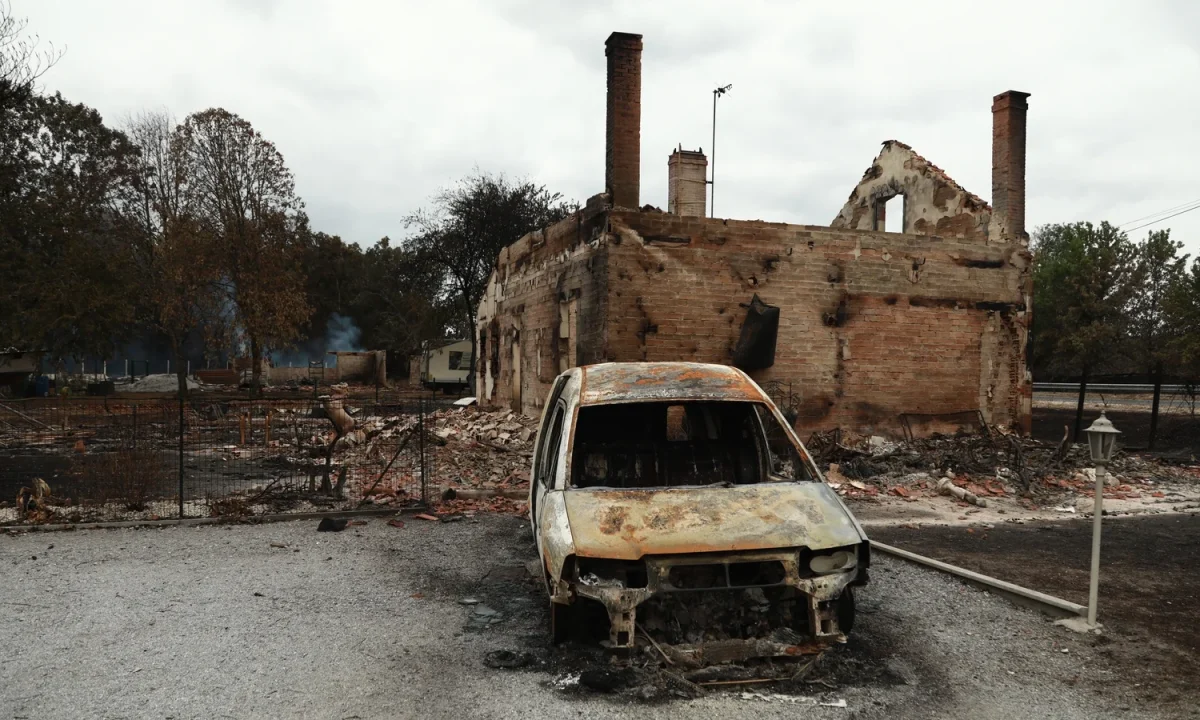
Near the village of Le Temple, three burned-out car shells and a destroyed trailer lay in a garden, with smoke still lifting from the blackened forest nearby.
‘There’s ash everywhere,’ says Irish woman in Bordeaux
Finance minister Roland Lescure said insurers had agreed to cover housing costs for displaced people, “whether or not their home has been damaged”.
The fire has generated a “pyrocumulonimbus” – an immense fire cloud capable of producing its own winds, lightning and, at times, tornadoes that can ignite further blazes, according to France’s national firefighters federation, which said the phenomenon had never previously been recorded in the country.
Watch: France braces for fresh heatwave as fires continue
We need your consent to load this rte-player contentWe use rte-player to manage extra content that can set cookies on your device and collect data about your activity. Please review their details and accept them to load the content.Manage Preferences
France’s weather office is forecasting more heat from tomorrow, with temperatures potentially reaching 40C alongside dry winds.
“All the conditions are in place for the fire to start up again,” Philippe de Gonneville, mayor of the village of Lege-Cap-Ferret, told AFP.
Authorities have said fires have burned through 115,000 hectares in France since the beginning of the year.
Earlier this month, flames swept through the UNESCO-listed Fontainebleau forest outside Paris, destroying 2,000 hectares.
Read more:’There’s ash everywhere,’ says Irish woman in BordeauxWildfire was like ‘volcano about to erupt’, say tourists