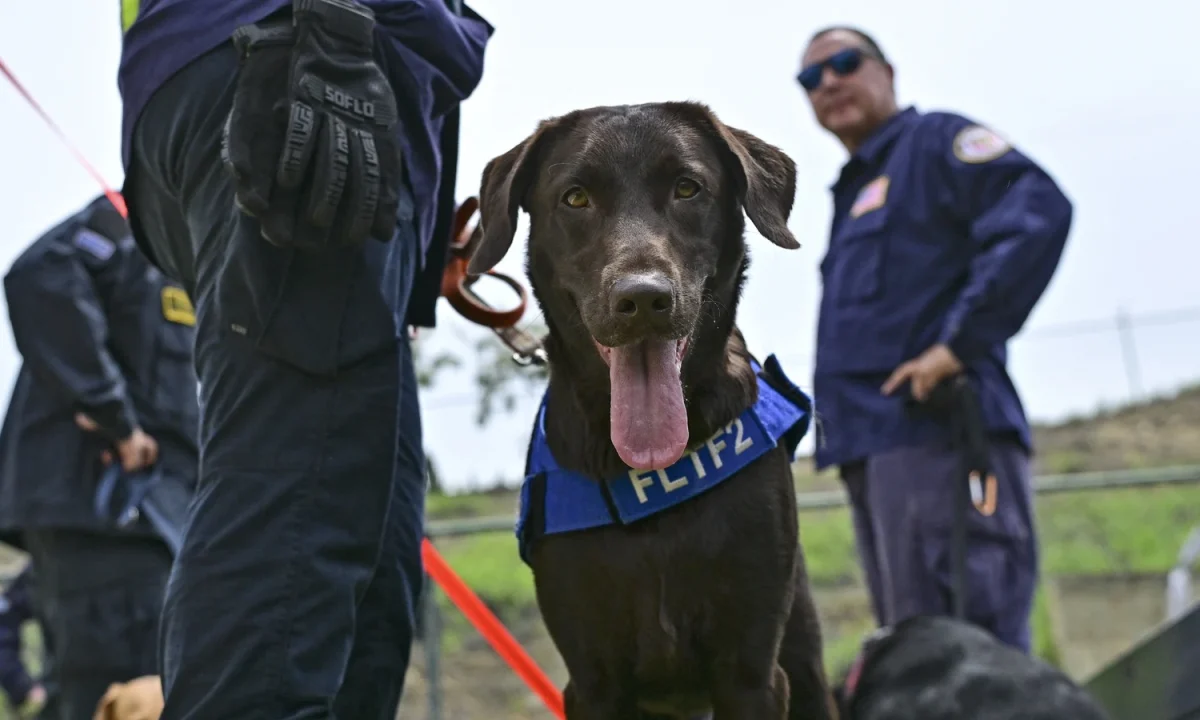
In the shattered concrete and twisted steel left by Venezuela’s twin earthquakes, Sisu works with the single-minded drive of a dog chasing her favorite prize: an orange and blue ball.
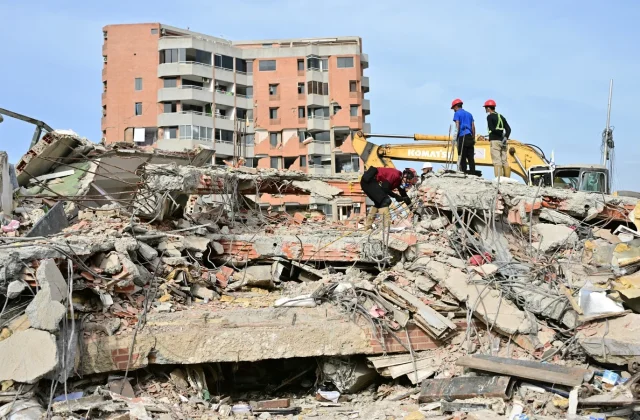
Strapped into a blue harness, the restless brown Labrador retriever picks her way across the debris of buildings that collapsed in the earthquakes of 24 June.
She is hunting for life with only her nose to guide her.
That instinct has made dogs like Sisu—part of the US rescue contingent, Florida Task Force 2—indispensable as crews race the clock to find people trapped alive.
But the dogs played a key role.
Alexander Parada with Piper, a Labrador retriever, who rescued two people in Venezuela
When teams reach a site where survivors may be entombed, the animals are often the first to go in. Across the coastal La Guaira area, the two quakes brought down dozens of residential complexes, turning neighborhoods into piles of broken floors and fractured walls.
“Their work is based on detecting where there are humans” by picking up on temperature, body odour and the carbon dioxide victims exhale, said Alexander Parada of Florida Task Force 2. At his side was Piper, a Labrador retriever who rescued two people in Venezuela on her first mission.
“They do a job we can’t do.”
When a dog signals an alert, handlers bring in a second animal to verify it, said Sylvia Arango, a canine handler since 1998 who manages Sisu.
Only after that do rescuers use tools such as radar or cameras to tighten the search area and pinpoint where victims might be.
Search dogs can sweep wide sections of debris quickly, Mr Parada said, accelerating the hunt when every hour counts—especially as the likelihood of finding survivors drops after the first 72 hours.
‘Safe’
Sisu was among more than 120 four-legged rescuers from a dozen countries sent to speed operations across multiple La Guaira communities, the hardest hit by the powerful 7.2 and 7.5 magnitude earthquakes.
Some, like Tsunami, a local border collie with one blue eye and one brown eye, became symbols of resilience for Venezuelans: Tsunami, once rescued from abuse, was now helping save others.
And like the people beside them, the dogs worked 12-hour shifts, repeatedly heading into hazardous, unstable terrain.
The animals operated in the high temperatures of La Guaira, exposing themselves to dehydration and abrasions to their fur
In La Guaira’s high temperatures, the animals faced dehydration and scrapes to their fur—wear and tear that showed on Sisu’s neck.
They threaded through rubble and even squeezed into narrow tunnels formed by collapsed walls, columns and beams, nosing through chaos for any trace of survivors.
For some, the danger became physical: operations left a number of the dogs with injuries and fractures.
Still, risk is baked into the assignment.
“The minute that we walk onto those rubble piles, there’s no guarantee that we’re going to be safe,” Ms Arango said. “We have to trust our training.”
Sylvia Arango, a canine handler since 1998 manages Sisu
Puppy love moments
So what makes a rescue dog? Handlers say it takes more than raw energy—it demands a dog willing to move without hesitation across shifting ground and jagged debris.
For Ms Arango, the essentials are a strong temperament and an eager instinct to investigate what others might avoid.
While this American team relies largely on Labrador Retrievers, it also includes Border Collies, Golden Retrievers, Belgian Malinois and German Shepherds.
Yesterday, 10 days after the earthquakes that have left 2,954 dead and thousands still missing, Brazilian and Spanish missions were still combing ruined zones with their dogs.
But for Sisu and Piper, the assignment was ending—time to stow their toys and prepare for the journey home.
As operations wrapped up, Ms Arango said what stayed with her most from Sisu’s first mission was how the dog managed to deliver small bursts of light amid overwhelming grief.
“It’s been a devastating situation,” Ms Arango said.
“When someone comes up whose heart is hurting, we can get them to smile, and children are able to come up to our dogs and pet them,” she said.
“It’s also that opportunity to connect with other people, to try to maybe, for that really one moment, not think about what’s happening in the horrors that are happening, and just maybe be loved by a happy puppy.”