Erfurt woke up to gridlocked roads and chants in the streets as thousands of demonstrators sought to disrupt Germany’s far-right Alternative for Germany (AfD) gathering — a show of force aimed at spotlighting the party’s growing clout as it re-elected the two leaders who have steered its rise into a national political powerhouse.
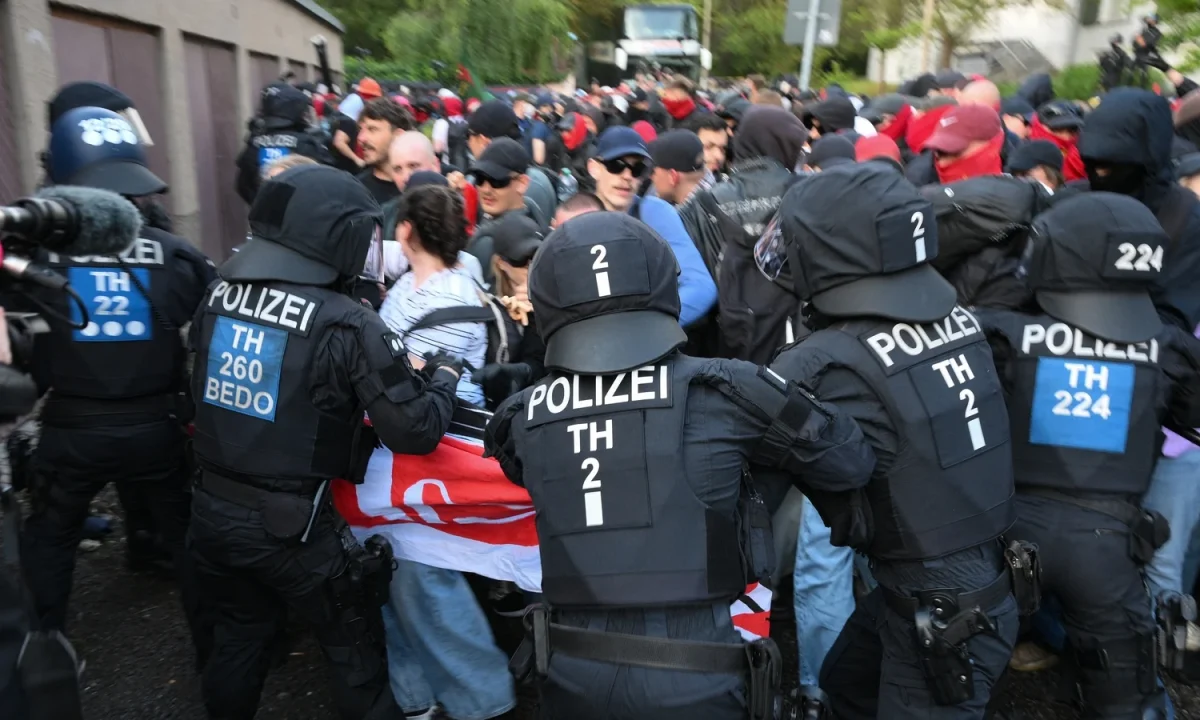
Protesters from unions, civil society organisations and left-wing parties converged on the eastern city as police prepared for the AfD’s two-day conference, deploying large numbers of officers and reinforcements brought in from across Germany.
AfD stands for Alternative for Germany.
Under the watch of police in riot gear, groups of protesters sat shoulder to shoulder in rows, blocking highways and access roads leading to the convention centre hosting the meeting. Police estimated that about 15,000 people took part in demonstrations in and around Erfurt.
Protesters from unions, civil society groups and left-wing parties gathered
Inside the hall, the conference opened with speeches that jeered at the crowds outside, branding them anti-democratic. Speakers celebrated the AfD’s ascent — and the prospect that it could win power in regional elections this year for the first time — while casting mainstream competitors as exhausted, detached and responsible for what they described as Germany’s decline.
“For this remains our last chance to save our country,” Ms Weidel said. “More and more people in this country want to support us in the fight against Germany’s decline, in the fight for our fatherland and for our identity.”
Hints of the party’s uncompromising immigration message surfaced even before proceedings began: minutes ahead of the opening, a song titled “Send them back” played on the AfD’s social media stream. In the convention centre, supporters could buy vintage-style cards bearing slogans including “YOU will be deported”.
Björn Höcke — widely viewed as among the AfD’s most radical and controversial figures — blended longing for an idealised past with sharp attacks on the present, at one point citing the condition of Germany’s motorway toilets as evidence of wider national malaise.
“A great Germany is a Germany where one need not fear taking a walk through the city park in the evening. A great Germany is a country where apartment keys can be left hanging on the outside of the door,” he said.
Police vehicles stationed close to where the conference is taking place
Leading in the polls
The party’s gathering comes as Germany looks toward September elections in the eastern states of Saxony-Anhalt and Mecklenburg-Vorpommern, contests the AfD hopes will help build momentum for eventual success on the national stage.
“We will govern. First at a regional level, then at national level,” Mr Chrupalla told delegates, using his address to emphasise unity within the party.
Mr Chrupalla — a trained painter and varnisher from the eastern state of Saxony — and Ms Weidel, a former Goldman Sachs analyst from western Germany, won re-election without opposition. But Mr Chrupalla secured 70%, a noticeable drop from the 81% he achieved in the last vote two years ago.
Mr Chrupalla, who has argued for stopping military aid to Ukraine, has also called for a reset of relations between Berlin and Moscow, which have become openly hostile amid the war in Ukraine.
The AfD launched the event by re-electing party chiefs Alice Weidel (R) and Tino Chrupalla (L)
Created more than a decade ago, the AfD has advanced through a blend of nationalist messaging, demands for stricter immigration policies, and appeals to voters who say they are fed up with successive governments and years of economic stagnation.
“Criminals and illegal migrants have no place in Germany anymore,” Ms Weidel said. “We will deport them rigorously, because our country deserves better.”
Critics argue the AfD pushes racist policies and attitudes at odds with Germany’s democratic values and warn it could endanger the country’s constitutional order.
Germany’s mainstream parties have rejected any cooperation with the AfD under a so-called “firewall” strategy intended to isolate the party and prevent it from entering coalition governments.
AfD leaders insist they do not oppose Germany’s democratic foundations, and earlier this year the party won a court injunction ordering the domestic intelligence service to suspend an earlier classification of the party as “extremist”.
In recent polls, AfD support has reached as high as 29%, compared with about 22% for the CDU/CSU conservatives led by Mr Merz.
The party draws its strongest backing from the former communist east, where surveys point to the highest levels of disillusionment with the traditional party system.