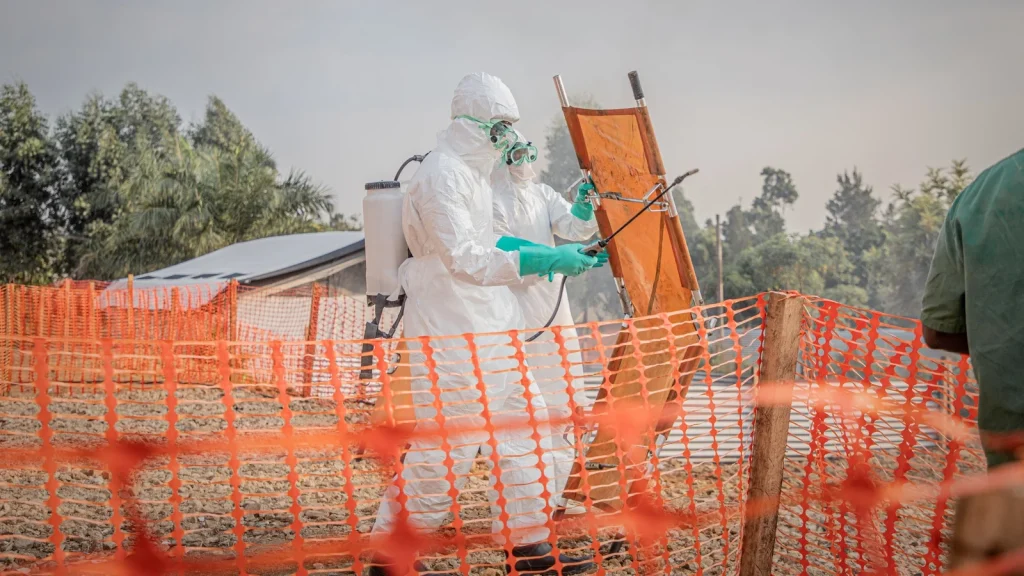
The Ebola outbreak in the Democratic Republic of Congo is accelerating at a devastating pace, with more than 2,500 people dead and half of those deaths recorded in just the past 20 days, the UN’s senior coordinator for the response said.
Already the largest Ebola outbreak in the country’s history, the epidemic is spreading faster than any previous recorded outbreak of the deadly virus.
- Advertisement -
Julien Harneis, speaking to reporters in Geneva by video link from Bunia, the outbreak’s epicentre, said the latest figures showed the virus was “growing exponentially”.
“More than 2,500 people” have died over the past three months, he said, adding that “half of those” deaths occurred within the last 20 days.
The DRC’s 17th Ebola outbreak is believed to have circulated for several weeks before authorities officially declared it on 15 May.
The virus has reached northern and eastern areas where government authority is limited, medical infrastructure is weak and numerous armed groups have operated for decades.
Doctors Without Borders, known by its French initials MSF, warned on Thursday that the outbreak was spreading “at an alarming rate”.
“This epidemic continues to spread, moving faster than the response can keep up,” MSF president Javid Abdelmoneim said in a statement.
Harneis urged authorities and international partners to expand the response, which has faced criticism over delays and poor coordination. Efforts have also been hindered by widespread mistrust among local communities.
Cases reported in six DR Congo provinces
Cases have been identified in six provinces of the DRC, including areas near the South Sudanese border, and have also crossed into neighbouring Uganda.
Uganda, where two people died among 20 confirmed Ebola cases, declared itself free of the virus last month.
No approved vaccine or specific treatment exists for the Bundibugyo virus strain responsible for the current surge, although several clinical trials are in progress.
The World Health Organization said yesterday that the DRC would receive 70,000 doses of Ervebo, a vaccine that has demonstrated effectiveness against the more common Zaire strain.
Earlier this month, WHO vaccine experts recommended a large-scale human trial of Ervebo, the only approved Ebola vaccine, to determine whether it provides protection against the Bundibugyo strain.
Early evidence, particularly from animal studies, suggests the vaccine could offer some protection. However, WHO spokesperson Christian Lindmeier stressed that “it is not yet known whether Ervebo is protective against the Bundibugyo virus in humans”.
Containing Ebola, which spreads through contact with bodily fluids and causes haemorrhagic fever, has been made more difficult by a long list of additional obstacles.
Harneis pointed to persistent insecurity and the fragile health system in eastern DRC as major barriers to the response.
“The law and order is undermined, and the basic services, particularly health, have been fragmented,” he said, describing conditions for responders as “brutal”.
About 160 healthcare workers have contracted Ebola since the outbreak began, including 43 who have died, Harneis said. Ambulances and other frontline personnel have also come under repeated attack.
He said the country’s barely functioning banking system had complicated efforts to pay outbreak workers. At the same time, cuts to international funding have reduced the capacity of humanitarian organisations by a third.
Harneis appealed for increased international assistance.
“If we provide more staffing, if we get more resources into remote areas across… the east of the Democratic Republic of Congo, within months we can slow the transmission and move to stopping it,” he said.
“If we do not… then this epidemic will become more deadly. It will spread wider and it risks to spread into neighbouring countries.”