Saturday August 1, 2026
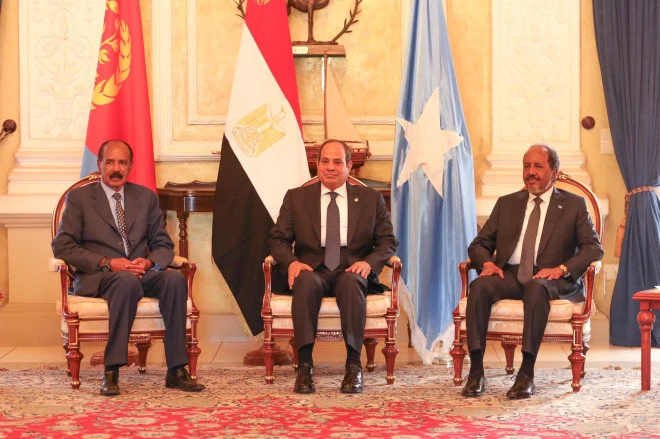
Cairo, Egypt – Behind closed doors in Cairo, Egypt, Somalia, Eritrea and a senior US envoy held a series of diplomatic consultations as pressure mounts to align responses to security challenges spanning the Horn of Africa and the Red Sea.
The talks come amid Ethiopia’s push for maritime access, continuing threats to Red Sea shipping and a broader regional review of longstanding alliances and security arrangements.
Few details of the meetings have been released publicly. Official statements said security in the Horn of Africa and the Red Sea region was the central focus.
That description reflects the growing overlap between issues once treated as separate: Ethiopia’s expanding regional influence, maritime security and the competition for strategic partnerships.
The importance of the Cairo consultations rests less on any publicly announced agreement than on the attempt to align diplomacy involving Egypt, the United States and influential Horn of Africa actors during a period of mounting uncertainty.
The meetings appear to have consisted of separate consultations rather than one joint session. Even so, they pointed to a common interest in coordinating positions on regional security, Red Sea stability and wider geopolitical competition.
For Egypt, much of that calculation continues to centre on Ethiopia.
Egypt’s focus is moving beyond the Nile
For years, the Grand Ethiopian Renaissance Dam dispute has defined Cairo’s relationship with Addis Ababa. Egypt’s concerns, however, now reach well beyond the question of water security.
Ethiopia’s campaign for maritime access, its efforts to expand regional partnerships and its growing influence in the Horn of Africa have all entered Cairo’s strategic assessment.
Egypt has long treated developments involving Ethiopia as matters of national security. The Horn of Africa adds a further dimension, especially as competition for ports, coastlines and political influence grows more intense.
From Cairo’s perspective, the Red Sea is no longer merely a route for commercial shipping. It is increasingly part of Egypt’s wider security environment, where trade, maritime access and regional politics meet.
Events in the area carry significance not only because of its location, but also because it borders major global shipping routes and the strategically vital Suez Canal.
Why Somalia is central to the conversation
Somalia’s role in this equation extends beyond its internal political and security challenges.
The country occupies a strategic position near the Bab el-Mandeb Strait and along important maritime corridors. Its place in the current debate is also shaped by its dispute with Ethiopia over sovereignty and access to the sea.
Ethiopia’s drive to secure maritime access has become one of the region’s most sensitive issues. Addis Ababa considers improved access to the sea an economic and strategic necessity, while Mogadishu has rejected steps it believes could compromise Somalia’s territorial integrity.
The dispute has altered diplomatic engagement throughout the region. Somalia’s objections have brought it closer to Egypt and to other governments monitoring Ethiopia’s expanding regional role.
For Cairo, its relationship with Mogadishu offers a way to reinforce its influence in a region where governments are reconsidering their security partnerships.
Eritrea’s strategic position
Eritrea brings another set of complications to the regional picture.
Its Red Sea coastline and lengthy, often difficult relationship with Ethiopia make it an important participant in any discussion of regional security.
Asmara’s interests do not always coincide fully with those of Egypt or Somalia, but its geography ensures that it carries considerable strategic weight.
For Cairo, maintaining relations with Eritrea and Somalia is part of a wider effort to retain influence in an area where access, security arrangements and political loyalties are increasingly contested.
Why Washington’s role matters
The involvement of a US envoy in the Cairo consultations gave the talks an international dimension and highlighted Washington’s continuing interest in the Horn of Africa and the Red Sea.
After separate meetings in Cairo with Somali and Eritrean officials, US President’s Senior Adviser for Africa Massad Boulos said on X that discussions with Somalia’s foreign minister covered “important issues of security and stability in the Horn of Africa”, including efforts to promote regional stability and Somalia’s domestic political dialogue.
After meeting Eritrean Foreign Minister Osman Saleh, Boulos said they had discussed opportunities to expand cooperation in trade, regional economic development and security. He also stressed the need to “work together constructively to address regional conflicts and advance lasting peace, stability, and prosperity in the Red Sea and the Horn of Africa.”
Washington’s established priorities in the region include stability, counterterrorism and protecting one of the world’s busiest maritime routes. Disruptions to Red Sea shipping and broader geopolitical tensions have made the waterway an even more prominent international concern.
Speaking to Al Jazeera, Mubarak Aliyu, a political and security risk analyst specialising in West Africa and the Sahel, said Egypt’s coordination with Washington reflected an understanding that regional crises could no longer be handled in isolation.
“Egypt’s coordination with the United States is an acknowledgment that crises in the Horn of Africa have become interconnected, demanding diplomacy that balances deterrence, regional partnerships and long-term stability.”
Aliyu said the timing of the Cairo meetings indicated that Egypt was trying to influence the emerging security order in the Horn of Africa rather than merely respond to events unfolding around it.
One question left open by the consultations is whether Washington is pursuing a wider diplomatic framework or seeking primarily to prevent another regional crisis.
The dam dispute remains unresolved, but no longer stands aloneDespite its importance to Egypt’s foreign policy, there is no indication that the Grand Ethiopian Renaissance Dam dispute produced any new development during the Cairo consultations.
Its continued importance is not diminished. Rather, the meetings illustrate that Cairo’s concerns about Ethiopia now extend beyond the Nile. The dam issue sits alongside questions about Ethiopia’s broader regional ambitions, its pursuit of maritime access and its ties with neighbouring states.
Sudan and the wider regional balance
Sudan did not publicly take part in the Cairo consultations, yet events there remain central to Egypt’s wider security calculations.
The war in Sudan continues to influence the strategic environment along the Red Sea and Egypt’s southern border. Sudan’s geography also makes it a significant factor in the balance of power across the Horn of Africa and Northeast Africa.
There is no indication that Sudan was directly discussed in Cairo. Its relevance is rooted in the wider regional setting rather than in the immediate diplomatic format of the meetings.
Cairo’s broader calculation
The Cairo consultations do not appear to represent the creation of a new regional bloc. Instead of a formal alliance, they are better seen as a framework for dialogue among states whose interests increasingly overlap across the Horn of Africa and the Red Sea.
The meetings underscore the extent to which the regional landscape is changing. The Horn of Africa and the Red Sea are increasingly treated as one strategic arena, in which maritime access, political influence and security competition are difficult to disentangle.
Speaking to Al Jazeera, Tegha King, secretary-general of the Universal Peace Federation (UPF) Ghana, recognised “Cairo’s diplomatic efforts to bring the United States and other international partners into dialogue on the Horn of Africa.”
He said lasting peace would nevertheless require “inclusive, AU-led cooperative frameworks that uphold the sovereign rights, security, and developmental aspirations of all Nile and Red Sea states.”
Aliyu said the Cairo meetings demonstrated Egypt’s determination to do more than respond to regional developments; Cairo also wants to help define the emerging security order around the Horn of Africa and the Red Sea.
He added that the strategy’s effectiveness would depend on whether regional and international engagement promotes cooperation or generates fresh rivalries.
“The challenge is ensuring that external coordination reinforces African-led stability instead of deepening regional rivalries.”