
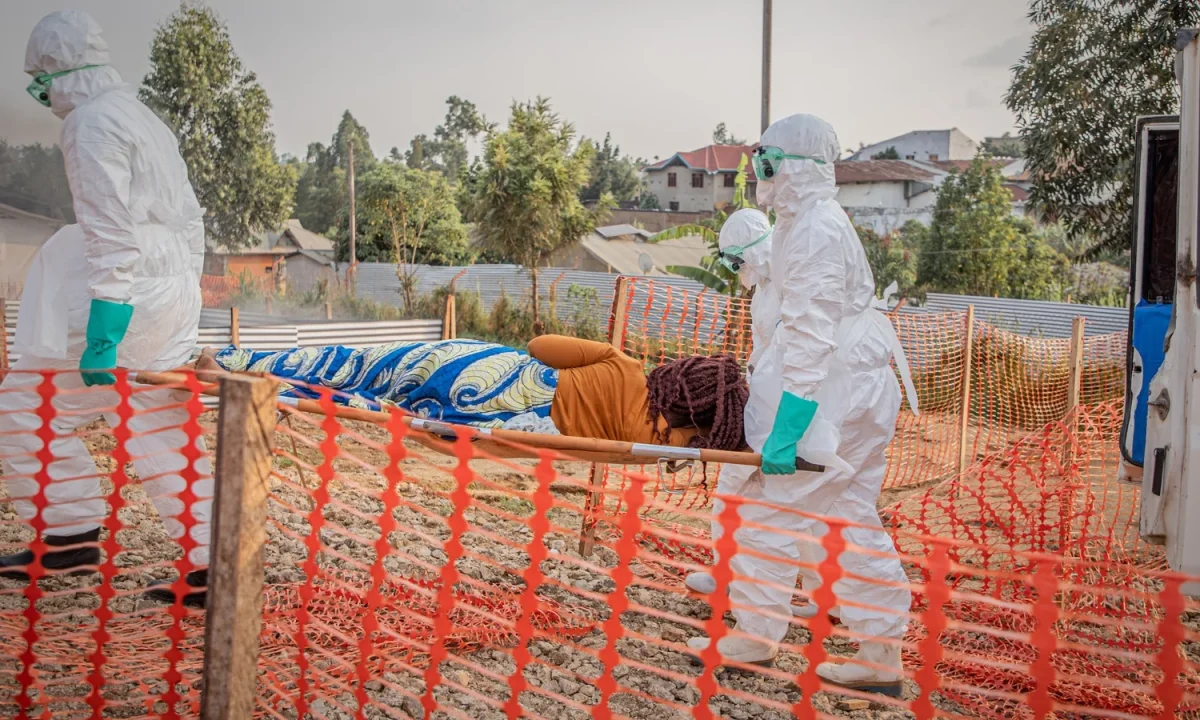
Congo’s Ebola crisis has crossed into two additional northeastern provinces, with infections now reported in Haut-Uele and Tshopo, according to the Democratic Republic of Congo’s public health institute.
Official figures released late last night put the nationwide total at 1,926 confirmed cases, including 702 deaths.
By Saturday, Tshopo had recorded four cases, two of them fatal, while Haut-Uele had confirmed one death.
Declared on 15 May, the latest outbreak is Congo’s 17th. It has been centred largely in Ituri province, although cases have also emerged in North Kivu and South Kivu.
Health authorities began tracing people who may have been exposed to the virus in Tshopo and Haut-Uele in June. Until now, however, neither province had appeared in the government’s daily outbreak reports.
“Although current investigations suggest that all cases detected in these two provinces are primarily imported from Niania in Ituri, it is necessary and appropriate … to consider these two provinces as an epidemic zone,” the National Institute of Public Health said in its report dated 11 July.
The expansion raises concern because Tshopo is home to Kisangani, its provincial capital and one of Congo’s largest cities. Haut-Uele, meanwhile, borders both South Sudan and the Central African Republic.
A senior World Health Organization official warned last week that the outbreak’s real scale may be two to four times greater than official figures suggest. Four in every five new cases have no known connection to existing patients, complicating efforts to map transmission.
Meanwhile, an American Ebola patient arrived in Germany for treatment, Berlin’s health ministry said today, just weeks after another infected US citizen received care in the German capital.
The patient landed in Frankfurt overnight before being taken to the city’s university hospital, according to the ministry.
The head of the World Health Organization identified the man as a “humanitarian worker” who had been in Bunia.