By STAN CHOEWednesday July 15, 2026
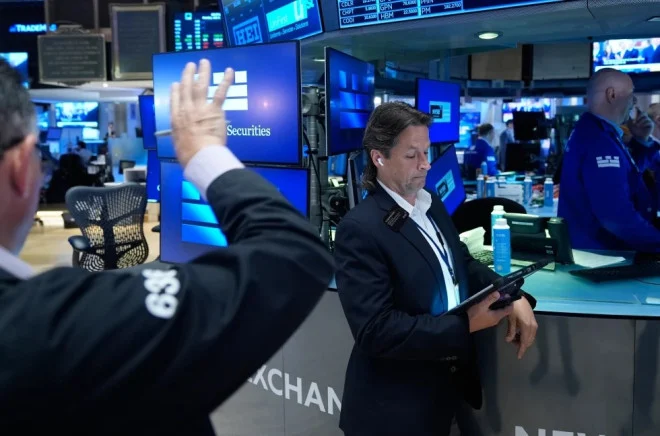
Patrick McKeon works on the floor at the New York Stock Exchange in New York, Monday, July 6, 2026. (AP Photo/Seth Wenig)
Wall Street regained ground Tuesday as a milder-than-expected U.S. inflation report calmed investors, offsetting another rise in oil prices amid fears that the United States and Iran could slide back into full-scale war.
The S&P 500 rose 0.4%, clawing back part of its 0.8% decline from Monday. The Dow Jones Industrial Average edged up 9 points, or less than 0.1%, while the Nasdaq composite gained 0.9%.
Lower bond yields gave stocks a lift after data showed consumer prices, including gasoline, food and other household expenses, were 3.5% higher in June than a year earlier. The reading improved from May’s 4.2% inflation rate and came in below economists’ forecast of 3.9% for June.
The softer inflation figure reduces some of the pressure on the Federal Reserve as it weighs whether to raise interest rates. Rate increases can restrain inflation, but they can also slow economic growth and weigh on a broad range of investments.
After the report, traders put the odds of the Fed increasing its key rate at its meeting in a couple weeks at less than 17%, according to CME Group data. That compares with nearly 42% a day earlier.
A rebound in major technology companies also helped support the market. The sector has been especially volatile in recent weeks as investors question whether shares have climbed too far amid enthusiasm for artificial-intelligence technology and whether enormous spending on AI chips and data centers will ultimately generate the expected profits and productivity gains.
Micron Technology gained 4.9%, while Nvidia advanced 4.1%. Both had been among the biggest drags on the S&P 500 a day earlier, when Micron dropped 4.4% and Nvidia fell 3.5%.
Still, inflation faces significant threats. Conflict in the Middle East has raised concerns that fighting could shut the Strait of Hormuz, the narrow passage used by tankers carrying oil out of the Persian Gulf to customers around the world.
Brent crude, the international benchmark, briefly moved above $87 per barrel in morning trading. After surging nearly 10% on Monday, oil had returned to levels seen before the United States and Iran signed their interim agreement to stop fighting in the middle of last month.
Brent later surrendered part of its advance, settling at $84.73 per barrel, up 1.7% from Monday’s close. Prices eased after Donald Trump stepped back from a threat he made Monday to impose a 20% charge on all cargo moving through the strait to repay the U.S. military for providing protection.
Investors are also watching the opening of earnings season, when companies report profits for the April-through-June quarter. With indexes near record levels despite recent AI-driven turbulence, companies face mounting pressure to show strong growth that can support elevated stock prices.
Bank of America, Citigroup, JPMorgan Chase, Goldman Sachs and Wells Fargo each reported quarterly profits Tuesday that exceeded analysts’ expectations. Their results pointed to strong trading operations and indicated that spending by U.S. consumers has remained durable.
Most of their shares rose after the reports. Goldman Sachs surged 9%, though Citigroup declined 5.3%.
IBM was the S&P 500’s biggest drag and the main reason the Dow trailed other major indexes, plunging 25.2%. FactSet said it was IBM’s worst daily performance since at least 1972.
Chief Executive Arvind Krishna said IBM’s software and infrastructure operations underperformed expectations during the latest quarter as customers redirected spending toward servers, storage and memory ahead of anticipated price increases tied to the AI boom.
“These conditions require our teams to execute perfectly, and this quarter we faltered,” Krishna wrote in a letter to investors. “We did not adapt and move quickly enough, and numerous large deals failed to close on the timelines we expected, driving the majority of our shortfall.”
Overall, the S&P 500 gained 28.25 points to finish at 7,543.59. The Dow Jones Industrial Average added 9.63, closing at 52,508.27, while the Nasdaq composite rose 233.83 to 26,107.01.
In the bond market, the yield on the 10-year Treasury fell to 4.58% from 4.62% late Monday. The decline stopped a climb that had carried yields from 3.97% before the war with Iran began.
Federal Reserve Chairman Kevin Warsh appeared before lawmakers on Capitol Hill for the first time since becoming head of the central bank. He vowed to make high inflation “a thing of the past,” though he gave no indication of what the Fed may do next.
Overseas markets were generally higher, with European indexes edging up after Asian markets ended the day with stronger gains.
Japan’s Nikkei 225 rose 0.7%, helped by a 3.3% gain for SoftBank Group Corp. The company is a major AI investor, and Chairman Masayoshi Son told an audience in Tokyo that he dismissed suggestions of a bubble in spending on AI capacity.
Shanghai stocks climbed 1.4% after the government said China’s exports surged 27% in June from a year earlier, driven by strong AI-related demand for computer chips and other technology products.
___
AP Business Writer Elaine Kurtenbach contributed to this report.