By Erica L. Green and Dylan FreedmanReporting from WashingtonSunday July 12, 2026
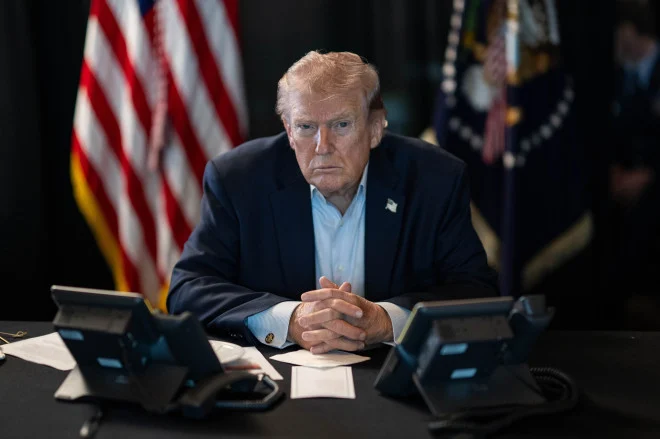
President Trump’s reposting of a short video showing Somali American kindergarten students in caps and gowns — accompanied by a comment highlighting that the girls wore hijabs — drew outrage from Muslim and Somali communities in Minnesota, who said the president had needlessly targeted young children.
The clips threaded through Mr. Trump’s often chaotic social feed this week, mixed among boastful posts about the economy and holiday images of Washington decked out for the Fourth of July.
But one 14-second clip stood out: a St. Paul, Minn., kindergarten promotion in which Somali American children sing an upbeat Somali educational song while wearing blue caps and gowns. The same footage was reposted with a remark from a right-wing account called “End Wokeness”: “Every girl is in a hijab… in kindergarten.”
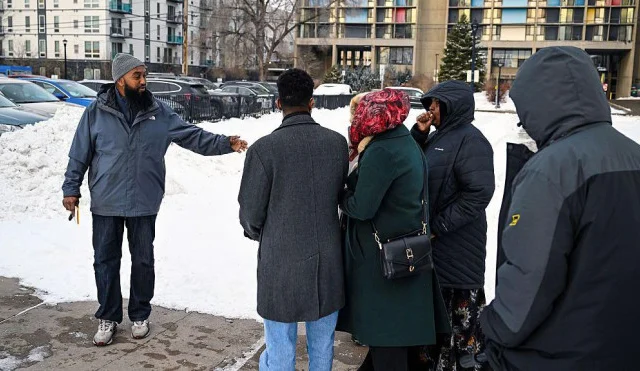
While the posts did not spark widespread national uproar, they reverberated sharply in Minnesota’s sizable Muslim and Somali communities, many of whose members said the president’s actions revived a pattern of vilification and felt especially cruel because they targeted children.
“This was a red line,” said Khalid Omar, a community organizer with the interfaith group Isaiah and Faith in St. Paul. “Children who are just celebrating, and wanting to look like their mothers — forget about the hijab — who are just children enjoying themselves, seeing their families, singing. For him to go after those children, it’s awful, it’s dangerous, it’s inhumane, it’s wrong.”
For more than a year, Mr. Trump has repeatedly assailed Minnesota’s Somali population in a series of xenophobic attacks. He has called Somali immigrants “garbage” who should “go back to where they came from,” described their children as overwhelming public schools and mocked Representative Ilhan Omar of Minnesota, who was born in Somalia, including deriding her hijab as a “little turban.”
Using a welfare fraud scandal concentrated among Minnesota’s Somali community as a pretext, his administration initiated an immigration crackdown, threatened cuts to federal child care funding and opened investigations that a judge concluded were meant to “harass and retaliate against” state Democratic officials.
Even in that context, the posts Mr. Trump shared with nearly 13 million followers on Monday struck a raw nerve.
“He is a bigoted bully,” said James J. Zogby, president of the Arab American Institute. “He picks on vulnerable people — women, immigrants — but picking on 5-year-olds, it’s so low, even for him.”
Abigail Jackson, a White House spokeswoman, declined repeated requests for comment about the recent posts. She defended the president’s earlier assertions that Somali schoolchildren strain Minnesota’s public schools.
“President Trump is right,” Ms. Jackson said. “Aliens who come to our country, complain about how much they hate America, fail to contribute to our economy, rip off Americans and refuse to assimilate into our society should not be here. And nothing about that is racist.”
National civil rights groups and state leaders joined local activists in condemning the posts as the week wore on.
“I am no longer surprised when Donald Trump uses his platform to provoke attacks on Black, brown, or immigrant communities — but I am always disgusted,” said Keith Ellison, Minnesota’s attorney general.
At the same time, support for Mr. Trump’s reposts swelled online, often expressed in virulently racist and Islamophobic language.
Replying to the clips, some of Mr. Trump’s followers called the students “future terrorists,” labeled the hijab-wearing children a “disgrace,” urged the deportation of Muslims and demanded a ban on Islam. One account with more than a million followers declared the president had revealed a “terrifying reality” and warned that America was being “conquered.”
This episode follows earlier occasions when Mr. Trump singled out Somali children. In April of last year, he said: “You have states like Minnesota, where the school systems are collapsing under the weight of the refugee children, especially from Somalia.”
In November, he lamented “a vibrant beautiful community in Minneapolis, gone.”
“It’s not recognizable,” he said then. “You have children that are going to school that don’t speak a word of English, they don’t speak a word of anything, and the teachers, they cry themselves to sleep.”
Mr. Trump has frequently used his social accounts to circulate racist imagery and disparage immigrant communities. Earlier this year, he posted a racist image depicting former President Barack Obama and Michelle Obama as apes, drawing swift bipartisan condemnation and prompting him to remove the post; he later blamed an aide and refused to apologize.
This week he also shared a doctored photo of the Obamas in Air Force One with added graffiti that included the acronym “BLM” and Arabic script. When referring to the former president, he has often used the middle name “Hussein.”
Some observers noted a stark contrast between the administration’s professed emphasis on fighting anti-religious bias — particularly toward Christians and Jews — and the tolerance, critics say, shown for anti-Muslim rhetoric.
State Senator Zaynab Mohamed, a Democrat who is the youngest woman ever elected to the Minnesota Senate and its first female Muslim member, said she did not think Mr. Trump would have posted the video if it showed children of another faith.
“Imagine if these kids were children who were wearing yarmulkes,” she said. “Imagine the reaction people would have. We would all be angry because we should be, because they are just as American as anyone else. And these kids who are wearing a hijab are just as American as the child who goes to a Catholic school that wears a particular uniform.”
Groups that track Islamophobia say Mr. Trump’s posts fit a pattern of normalizing anti-Muslim sentiment and demeaning rhetoric that has been linked to violence and could spur more.
A poll last year by the Institute for Social Policy and Understanding found that 63 percent of Muslims reported religious discrimination. The survey also found that 47 percent of Muslim parents with children in grades K-12 said their children had been bullied for their religious identity in the past year — roughly twice the rate of the general population — and nearly half of those families said the bullying came from an adult.
“This is the context within which Muslims have been living in the United States for a long time,” said Dr. Saher Selod, the institute’s director of research. “The bar has just been lowered so much in terms of what people can and cannot say about Muslims. We’re waiting for everyone to recognize how dehumanizing this is.”
Imam Yussuf Abdulle, director of the Islamic Association of North America, which oversees more than three dozen Islamic centers and groups, said his own children came home asking: “Baba, are we OK? What did we do to him? Does he hate us?” after the “garbage” remark.
“I now know the answer,” he said. “Our president is not sparing the most vulnerable of our community. There’s no mercy for us in his heart.”
“What could make you happy, if not a kindergarten graduation?” he added. “If that makes you angry, there is no happiness left.”
Still, he said, the students embodied a resilient hope for the future.
The song they sang, “I Am a Student,” celebrates cultural pride, educational aspiration and responsibility to family and country.
I am a student, I am a student
I am the flower (hope) of this nation
I strive, I strive, I go to schools
So that I may repay the debt I owe my father and mother
With all the effort I bring, O Allah, help me, amen, amen
O Allah, support me, amen, amen
I am a student, I am a student, I am the light of the dawn
I run, I run, I go to take exams
So that I may gain knowledge, and benefit my country
With all the effort I bring, O Allah, help me, amen, amen
O Allah, support me, amen, amen.
______________________________________________
Ernesto Londoño contributed reporting from Minneapolis.
Erica L. Green is a White House correspondent for The Times, covering President Trump and his administration.
Dylan Freedman is the A.I. projects editor for The Times, investigating a range of topics. He has experience as both a reporter and a machine-learning engineer.