By Sarah ShamimMonday July 13, 2026
Iran’s Islamic Revolutionary Guard Corps launched a coordinated series of strikes overnight, saying it hit US military sites in Bahrain, destroyed radar installations in Oman and struck targets in Jordan and Kuwait as part of a broad retaliatory operation against the United States.
Tehran framed Monday’s strikes as a direct response to escalating American attacks, dimming hopes for a quick de-escalation between the two countries.
Here is a recap of the latest attacks:
Where were the latest Iran attacks?
Oman: The IRGC said its latest phase of reprisals included strikes on Oman, where it claimed to have destroyed “the FPS long-range aerial radar and the vessel detection radar in Oman”.
Bahrain: The IRGC said it launched missile and drone strikes against “installations and infrastructure of the aggressive US army” in Juffair, Bahrain.
Bahrain’s Ministry of Interior reported that sirens were sounded across the country on Monday, urging residents to remain calm and move to the nearest safe location.
The IRGC earlier said it targeted several facilities at the Sheikh Isa Air Base in Bahrain.
Jordan: Jordan’s military announced it intercepted and shot down “four missiles that entered Jordanian airspace” which it said originated from Iranian territory.
Earlier, the IRGC stated it struck Jordan’s Prince Hassan Air Base with missiles and drones, setting fire to several fuel depots and ammunition storage facilities.
Kuwait: The IRGC also said it targeted a US surface-to-surface missile base in Kuwait, claiming to have “set fire to two HIMARS missile launchers and missile-packed warehouses, completely destroying them”.
HIMARS stands for high mobility artillery rocket systems, mobile rocket launchers manufactured by the US.
The General Staff of Kuwait’s Army earlier said its air defence systems were engaging “hostile aerial targets” within Kuwaiti airspace.
It added that any explosions heard were from intercepts and urged the public to follow safety and security instructions.
Where was Iran hit?
The US military’s Central Command (CENTCOM) said it struck “dozens of targets at multiple locations with precision munitions to degrade Iran’s ability to continue attacking international shipping flowing through the Strait of Hormuz”.
CENTCOM listed targets as Iranian military air-defence systems, coastal radar sites, missile and drone capabilities, and small boats.
The command said it deployed US fighter aircraft, naval vessels, one-way attack aerial drones, and one-way attack sea drones for the first time.
Valiollah Hayati, deputy governor for security and law enforcement in Iran’s Khuzestan province, told the semi-official ISNA news agency that US forces struck at least eight locations across Khuzestan overnight.
Hayati, cited by the IRNA news agency, said one person was killed and four were wounded when a projectile struck an agricultural water-pumping station in Mahshahr.
Iran’s Tasnim News Agency reported that a US-manufactured LUCAS (low-cost uncrewed combat attack system) suicide drone was “accurately hit and shot down” in Bandar Abbas on the Strait of Hormuz.
What has each side said?
The Iranian Ministry of Foreign Affairs issued a statement on Monday condemning US strikes inside Iran.
US President Donald Trump, speaking on NBC’s Meet the Press on Sunday, insisted the Strait of Hormuz remained open.
“They’re very, very evil and sick people. We had meetings with them. They agreed to a deal yesterday, a perfect deal for us. No nuclear, no this, no that, no nothing. They gave up everything. And then after that, they left the room. And then within an hour, they launched a drone at a ship,” Trump said.
When did the conflict reignite?
The flare-up began on July 6, when the IRGC struck three commercial vessels, including a Qatari liquefied natural gas tanker, off Oman. Iran said the ships attempted to transit the Strait of Hormuz without its permission, citing its interpretation of a clause in the June memorandum of understanding (MoU) with the US that it says gives Tehran authority to manage traffic through the waterway.
On July 7, the US reported carrying out strikes on Iranian military targets. Tehran answered with missile and drone strikes on bases across the Gulf housing US forces.
By the following Wednesday, Trump declared the MoU ended, and on Saturday the IRGC said the Strait of Hormuz was closed once more.
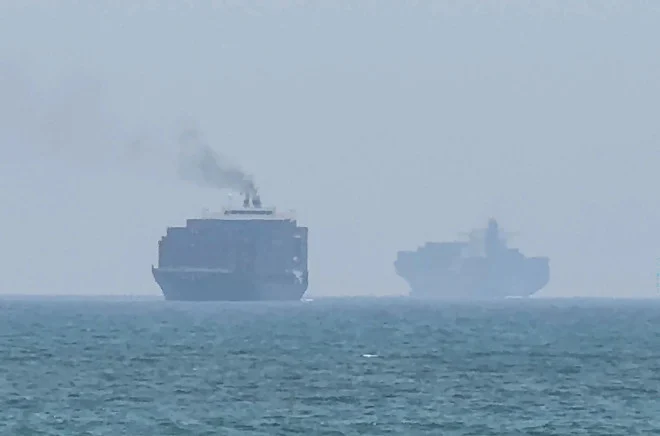
How has this impacted the Strait of Hormuz and shipping?The number of vessels transiting the Strait of Hormuz has dropped to its lowest level in five weeks, according to shipping data.
Trade intelligence firm Kpler reported six ships passed through the strait on Sunday, including the Humanity and the Capetan Andreas, carrying 2 million barrels of Iranian oil and 500,000 barrels of Kuwaiti petroleum products, respectively.
The data also showed three empty tankers entered the Gulf to load cargo.