
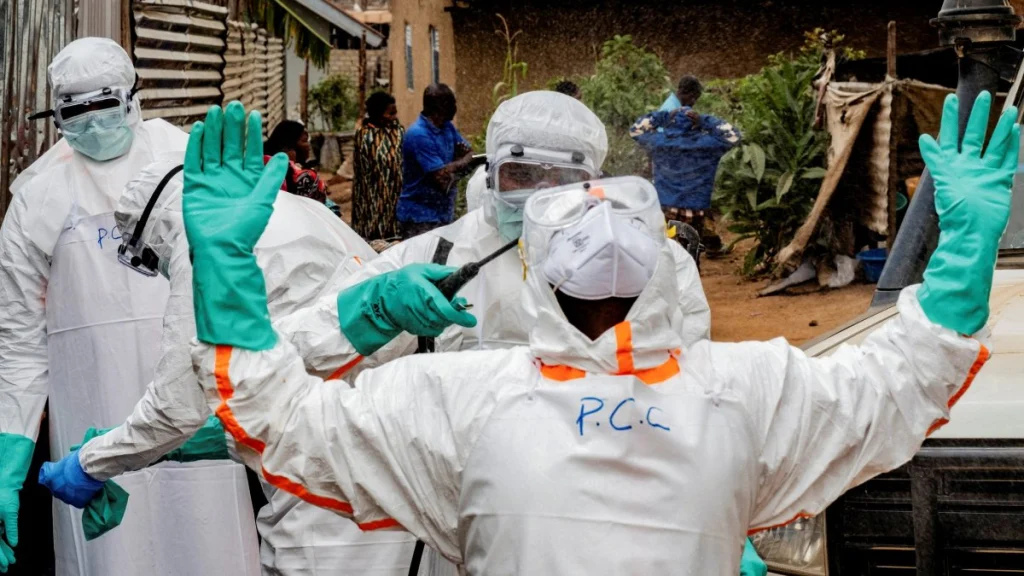
A man’s death in Bas-Uele has extended Congo’s Ebola outbreak to a sixth province, underscoring fears that the rapidly expanding epidemic is reaching increasingly difficult-to-access areas, the Africa Centres for Disease Control and Prevention said Thursday.
The man died in Buta, Bas-Uele’s provincial capital, after traveling there from Isiro in neighboring Haut-Uele province, said Jean Kaseya, director general of Africa CDC.
- Advertisement -
Jean-Jacques Muyembe, who heads Congo’s National Institute for Biomedical Research, identified the man as a motorcycle-taxi driver who visited several hospitals seeking care before he died. After his death, some colleagues tried to take his body by force, prompting police intervention and raising concerns that additional people could have been exposed to the virus, Muyembe said.
The outbreak in eastern Congo is spreading faster than any Ebola outbreak on record and is on course to overtake the deadliest epidemic in history, which killed more than 11,000 people in West Africa between 2014 and 2016, the World Health Organization said Wednesday.
The current epidemic is being caused by the rare Bundibugyo virus, for which no approved vaccines or treatments currently exist.
Government figures show that more than 2,100 people have died among more than 4,500 reported cases. The death toll has climbed nearly three times faster than it did during the 2014-16 West Africa outbreak, which remains the deadliest Ebola epidemic on record.
The crisis is unfolding amid some of the most difficult conditions imaginable. Health workers have gone on strike over unpaid wages, rebel groups have issued threats, communities scarred by years of trauma have expressed anger, and misinformation has circulated claiming Ebola does not exist.
Bas-Uele is a vast province in northeastern Congo bordering the Central African Republic, where recurring armed violence has driven thousands of people into the province seeking refuge. Poorly connected roads and limited communications networks make access difficult. The area also sees frequent population movements linked to gold mining and conflict-related displacement.
As of Thursday, Ebola had reached six of Congo’s 26 provinces. About 90% of cases and 80% of deaths are concentrated in Ituri province, the WHO said Wednesday.
Mercy Corps, an aid organization, said Thursday that cases had been recorded along a major travel route roughly 35 kilometers (22 miles) from Congo’s border with South Sudan. The group expressed concern about the outbreak’s “widening footprint,” although no cases have yet been confirmed in South Sudan.
In Ituri, one of the provinces hardest hit, health workers at the Nizi Treatment Center walked off the job Thursday, forcing the facility to close temporarily. Workers said they had gone three months without pay.
Kaseya called on Congo’s government Thursday to settle the outstanding salaries.
“We need to pay health workers,” he told reporters. “This is the responsibility of the government, not partners. And they told us that money is available.”
The full scale of the outbreak remains unclear. Congo declared the epidemic May 15, but the WHO said Wednesday that genetic sequencing indicated it had begun months earlier, in February.
Health authorities say between 60% and 70% of new infections are being detected outside the monitored group of known contacts. They have described the spread as “alarming.” Contact tracing is intended to interrupt transmission by identifying exposed people early and responding quickly if they develop symptoms.
“We are chasing the virus; the virus is ahead of us,” the WHO regional director for Africa, Dr. Mohamed Yakub Janabi, said this week.
Kaseya said Thursday that contact tracing in Congo had effectively broken down.
“The concept of contact tracing in DRC has become useless,” he said.
Ebola is uncommon but highly contagious. It can spread through bodily fluids including vomit, blood and semen, as well as through contaminated surfaces and materials such as bedding and clothing. The resulting disease is severe and frequently fatal.
Clinical trials of two potential treatments for this form of Ebola began last month in Ituri, the hardest-hit of the five provinces in Congo where cases had been reported.
Two vaccines developed specifically for the Bundibugyo virus are also being tested in people for the first time, the WHO said Wednesday.
The WHO plans to study whether an existing Ebola vaccine can protect against the virus after animal studies produced promising results.
Kaseya said Africa CDC supports using Ervebo, a vaccine authorized for the Zaire Ebola strain, in provinces affected by Bundibugyo virus. He said some studies indicate that available vaccines could offer a degree of cross-protection.
“We are in a gray area,” he said. “And when you are in a gray area, you have to make strong decisions to stop seeing people dying.”