
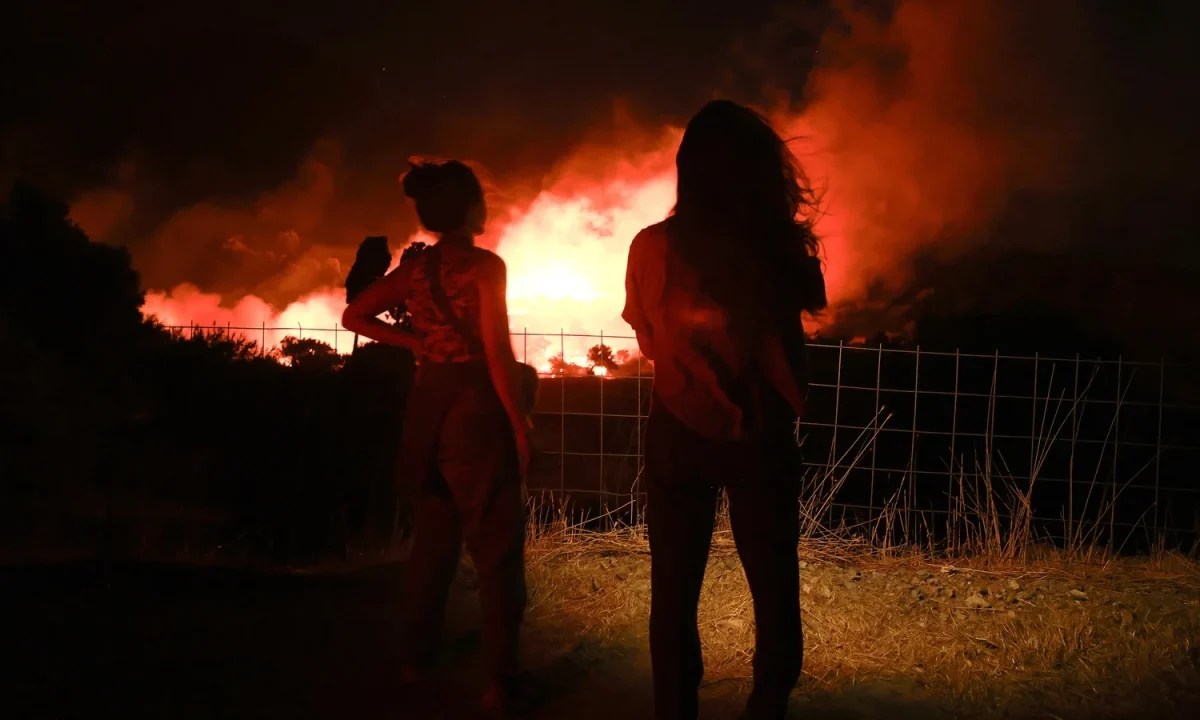
Wildfires are testing crews across southern Europe and beyond, with Greek firefighters still working to subdue a blaze tearing through parts of Crete even as officials reported a slight easing in conditions.
“The situation around Rethymno is better,” a fire department spokesperson said.
But the fire remained dangerous and unsettled. It “has not yet been contained, there are still many hotspots,” he added.
Blazes were also burning on the Aegean islands of Paros, Kalymnos and Andros, though “the situation is better”, the fire service said.
Officials said strong, stubborn winds and difficult terrain were continuing to hamper crews on the ground and in the air.
Firefighters and civil protection teams have been put on general alert across Greece, fire brigade spokesman Vassilis Vathrakogiannis told a briefing yesterday.
More firefighting resources sent to Crete
Large parts of Greece, including the Athens region, Crete, several Aegean islands and areas of the Peloponnese, were under a “very high” wildfire risk today, the second-highest category on the country’s five-point scale, Greek civil protection said.
Mr Vathrakogiannis said Greece’s geography, with hundreds of islands scattered across the seas, makes it harder to move emergency crews quickly to where they are needed.
Extra firefighting resources have now been sent to Crete.
“Strong winds and dense smoke are creating conditions of near-zero visibility and severe turbulence, making aerial water drops extremely difficult, if not impossible,” he said, referring in particular to the conditions in Crete.
On Wednesday, Greek authorities ordered the evacuation of around 8,000 residents and tourists from the coastal resort of Agia Galini.
Most of those forced to leave have since gone back to their homes and hotels, as Crete remains in the middle of its peak tourist season.
Prime Minister Kyriakos Mitsotakis said Greece, after largely avoiding the extreme heatwaves and destructive wildfires seen earlier this summer in countries including France and Spain, was now facing a more difficult stretch.
“August … is traditionally a difficult month,” he said.
“Conditions are expected to worsen further in the coming days,” the fire department spokesperson also warned.
Three firefighters have died this week while battling wildfires in Crete and the Peloponnese, Greek authorities said.
Suffolk fire described as ‘an apocalypse film’
In Britain, crews fighting a major wildfire near one of the country’s largest nuclear power stations said the blaze had stabilised overnight, while warning that the threat of fresh outbreaks remained high.
The fire, close to the Sizewell B nuclear power station on the Suffolk coast, has scorched 150 hectares of land and forced residents and holidaymakers to leave the area.
More than 100 firefighters, supported by a helicopter, have been battling the flames since Wednesday.
Henry Griffin, Deputy Chief Fire Officer for Suffolk Fire and Rescue Service, said an investigation had begun into the cause of the fire.
Mr Griffin said, “we have a couple of fire fronts we are actively monitoring, checking on their wind speed, checking on that wind direction, to make sure any reignition is controlled and monitored throughout the coming hours.
“Due to the scale and unpredictable nature of the wind direction I wouldn’t say it is under control, it’s certainly stabilised and we have plans in place to mitigate,” he added.
Authorities have stressed that there is no concern about the fire spreading towards the Sizewell B nuclear power station
Around 50 people have been evacuated from homes and a nearby holiday park. Cliff House Holiday Park, which has about 200 caravans, was also fully cleared as a precaution.
Connor Dowsett, a holidaymaker evacuated from his grandparents’ lodge, said the Suffolk wildfire looked like something “out of an apocalypse film”.
Mr Dowsett said, “we noticed the moon … it was very orange. As we were getting closer, we could see the glow of the fire.
“We could see the brown smoke filling the air. The smell was powerful.
“It was a scary, scary sight.”
According to the UK Met Office, Suffolk has received only 2% of its average monthly rainfall for July so far
Martin Harris, 80, and his wife Sheila Harris, 76, who have been visiting a holiday park in the area for more than 40 years, said they had time only to grab their medication before leaving their static caravan.
Mrs Harris said they first saw a “glow”, adding, “it went from just being in the distance, and suddenly we were just covered in this black, and it was really scary so we just wanted to get out.”
“Yesterday, I had a really bad moment because I suddenly thought, ‘I’ve been on site since 1980.’
“‘If the caravan goes, then no chance of affording another one,” she added.
Turkey fights 169 wildfires this week
In southwestern Turkey, hundreds of firefighters pushed against strong winds on Thursday as they worked to bring a wildfire under control, while other wind-driven fires along the Mediterranean coast were contained.
Forestry Minister Ibrahim Yumakli said crews had responded to 169 fires this week, with only one still burning in the Cine area, about 100 kilometres inland from the resort city of Bodrum.
Firefighters worked through the night, evacuating animals from four areas. By morning, nine helicopters, three firefighting planes, 42 fire engines and nine water tankers were deployed against the flames.
Authorities remain on alert in case any fires reignite.
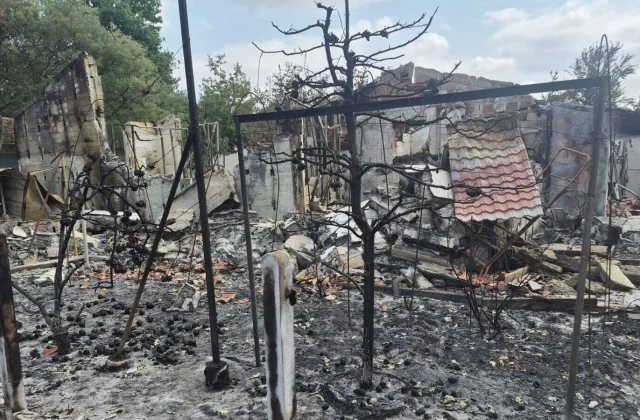
Residents who had been evacuated described scenes of heartbreak and loss.
“We’ve been reduced to ashes, nothing is left. My dog is gone, he was more precious to me than my own life,” said Arzu Celep.
“Everything we owned has gone up in flames. We took our animals uphill, if we’d stayed here, we’d have gone up in flames too,” said another woman called Raziye Askin.
Until now, Turkey had been largely spared from wildfires this year, helped by heavy winter rain and snowfall that replenished groundwater and protected vegetation.
Figures from the European Forest Fire Information System show 64 fires in Turkey this year, burning more than 22,000 hectares of land.
Millions exposed to wildfire pollution
Wildfires in France and Spain have pushed health-damaging air pollution over millions of people in recent days, scientists said.
Wildfire smoke carries a blend of pollutants that can degrade air quality even hundreds of kilometres from the flames.
Researchers said they were especially worried about fine particulate matter, known as PM2.5, which is linked to cardiovascular disease, lung cancer and respiratory problems.
“We know that this has a really major health effect, particularly when there’s exposure over multiple days,” said Theodore Keeping, a climate scientist at Imperial College London.
“We’re seeing increasingly severe and frequent high-intensity fires where people are exposed to these very, very high levels of PM2.5.”
Smoke from fires contains a mix of pollutants that reduce air quality even hundreds of kilometres away
In Bordeaux, France, PM2.5 pollution climbed to peaks above 300 micrograms per cubic metre on 26 July, according to data from the EU’s Copernicus Atmosphere Monitoring Service.
Mr Keeping said PM2.5 levels in Bordeaux averaged 115 micrograms on 26 July, almost five times the EU’s average daily limit.
In Limoges, more than 200km northeast of Bordeaux, PM2.5 levels peaked above 400 micrograms per cubic metre over the weekend.
Wildfires in Europe have emitted 18 million metric tons of CO2 this year
Scientists say wildfires can make PM2.5 more hazardous, raising the toxicity of particles as they mix with other components in smoke.
Across Europe, wildfires have released 18 million metric tons of CO2 this year, while France has recorded its highest fire-related CO2 emissions for this point in the year, according to European Forest Fire Information System data.
Half of the EU’s fire emissions this year came in the past week alone.
Researchers said this year’s fire emissions had not yet grown large enough to derail climate targets, but warned the picture could shift as climate change pushes fire risk farther north into countries with forests that store large amounts of CO2.
“Once we start seeing fire weather conditions that cause large fires in those regions, where that’s a large part of their net zero target, then that would be more of an issue,” Mr Keeping said.